

Cyber incidents in regulated industries carry severe financial and compliance consequences. Organizations face dual pressures: meeting strict regulatory requirements while maintaining operational resilience against evolving threats. An effective incident response plan transforms reactive firefighting into proactive defense, reducing breach costs by millions while ensuring regulatory compliance. This guide walks you through building a comprehensive plan tailored for highly regulated environments.
Table of Contents
- Prerequisites: What You Need Before Building Your Incident Response Plan
- Step 1: Define Scope, Objectives, and Compliance Requirements
- Step 2: Assign Roles, Responsibilities, and Communication Protocols
- Step 3: Develop Response Procedures and Playbooks
- Step 4: Test, Train, and Continuously Improve Your Plan
- Common Mistakes and Troubleshooting Tips
- Expected Results and Outcomes
- Explore Heights CG Cybersecurity Solutions for Incident Response
Key takeaways
| Point | Details |
|---|---|
| Compliance alignment is mandatory | Incident response plans must integrate NIST, CMMC, and SOC 2 requirements to meet regulatory obligations. |
| Clear roles prevent chaos | Defined responsibilities and communication protocols ensure coordinated, efficient incident handling. |
| Regular testing drives improvement | Tabletop exercises and simulations reveal gaps and accelerate containment by up to 30%. |
| Common failures are avoidable | Poor communication and outdated plans cause 70% of response failures, but systematic maintenance prevents this. |
| Measurable ROI justifies investment | Structured plans reduce breach costs by $2 million and cut containment times significantly. |
Prerequisites: what you need before building your incident response plan
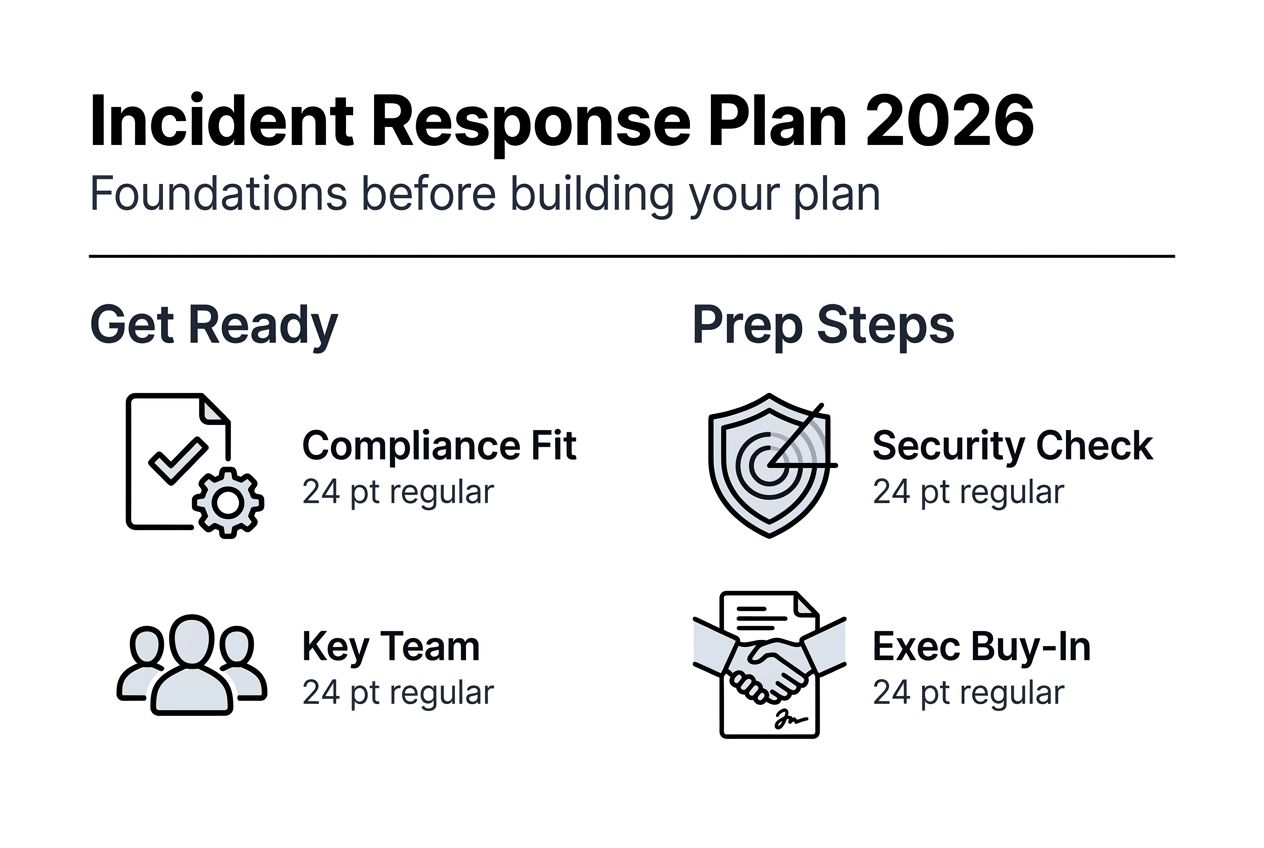
Before creating your incident response plan, establish critical foundations that determine success. Structured preparation includes understanding regulatory frameworks, assessing current security posture, and organizing cross-functional teams before plan development.
Start by identifying which compliance frameworks apply to your organization. Healthcare entities must address HIPAA requirements. Defense contractors face CMMC obligations. Financial institutions navigate SOC 2 and industry-specific regulations. Understanding these mandates shapes every aspect of your plan, from reporting timelines to documentation requirements.
Assemble a cross-functional team before drafting any procedures. Your team must include IT security professionals, legal counsel, compliance officers, communication specialists, and business unit leaders. Each perspective ensures the plan addresses technical, legal, operational, and reputational dimensions of incident response. Review the NIST incident handling guide to understand standard practices that inform your team's approach.
Assess your current security environment thoroughly. Document existing security tools, network architecture, critical assets, and past incident history. This baseline reveals vulnerabilities and informs risk prioritization. Without understanding what you protect and current capabilities, you cannot design targeted response procedures.
Secure executive sponsorship and budget allocation early. Incident response planning requires investment in tools, training, and personnel time. Executive buy-in ensures resources remain available throughout development and ongoing maintenance cycles. Leadership support also signals organizational commitment, driving participation across departments.
Pro Tip: Establish a preliminary policy framework authorizing the incident response team to take necessary actions during crises. This avoids delays when seconds matter and ensures legal protection for responders making critical decisions under pressure. Organizations with mature building effective cybersecurity teams complete this preparation phase faster.
Step 1: define scope, objectives, and compliance requirements
Defining precise scope and objectives prevents scope creep and ensures your plan addresses real organizational risks. Start by cataloging critical assets: customer data repositories, intellectual property, operational technology systems, and regulated information. Prioritize based on business impact and regulatory sensitivity.
Establish clear incident response objectives aligned with risk appetite. Some organizations prioritize minimizing downtime above all else. Others focus on data protection and regulatory compliance. Your objectives drive resource allocation and response priorities during actual incidents. Document these priorities explicitly so responders make consistent decisions under pressure.
Typical timeline to develop and implement an incident response plan spans 3 to 6 months, emphasizing the need for clear initial scope and objectives. Rushing this phase creates gaps that surface during actual incidents.
Specify regulatory reporting requirements with precision. GDPR mandates 72-hour breach notification. HIPAA requires reporting within 60 days for certain breaches. State laws add varying requirements. Create a compliance matrix mapping each applicable regulation to specific reporting triggers, timelines, and recipient authorities. This matrix becomes your compliance checklist during incidents.
Define plan scope to match operational reality. Will the plan cover only cybersecurity incidents, or include physical security and natural disasters? Does it address third-party vendor incidents? Setting boundaries prevents confusion and ensures adequate coverage without overextending resources. Align scope with business continuity plans to avoid gaps or duplication.
Document measurable outcomes from the start. Establish targets like containment within 4 hours, recovery within 24 hours, or zero compliance violations. These metrics enable performance tracking and demonstrate plan effectiveness to stakeholders. Understanding incident response role guidance helps set realistic targets based on team capabilities.
Step 2: assign roles, responsibilities, and communication protocols
Clear role definition separates effective response from chaotic firefighting. Create a detailed responsibility matrix documenting who handles detection, analysis, containment, eradication, recovery, and post-incident activities. Assign primary and backup personnel for every critical function to ensure coverage during absences or overwhelming incidents.

Design escalation paths that specify when and how incidents move up the chain of command. Define triggers: data volume thresholds, system criticality levels, or potential regulatory impacts. Map these triggers to specific escalation actions. A minor malware infection follows different paths than a ransomware attack affecting critical systems.
Inadequate communication escalation paths cause 25% of incident response failures, prolonging breach impact. Avoid this by creating visual flowcharts showing information flows during incidents. These diagrams clarify who notifies whom, through which channels, and within what timeframes.
Establish internal communication protocols covering technical teams, management, and affected business units. Technical channels need rapid, detailed information exchange. Management requires concise status updates focused on business impact. Different audiences need different message formats and frequencies. Define templates for each audience to maintain consistency under pressure.
Coordinate external communication protocols early. Legal counsel reviews all external statements. Public relations manages media inquiries. Customer service handles client communications. Regulatory affairs manages compliance notifications. Document approval workflows to prevent unauthorized disclosures while ensuring timely, accurate communications. The Verizon data breach report 2025 shows coordination failures amplify reputational damage.
Maintain updated contact lists with multiple channels: work phone, mobile, email, and backup contacts. Test these contacts quarterly. Outdated information causes critical delays when you need immediate response. Include external contacts like forensic consultants, law enforcement liaisons, and regulatory authorities.
Pro Tip: Create laminated quick-reference cards for key personnel listing their specific responsibilities and essential contacts. These cards work when digital systems fail during incidents. Organizations with effective incident response teams use multiple communication channels to ensure message delivery even when primary systems are compromised.
Step 3: develop response procedures and playbooks
Detailed response procedures transform strategy into action. Structure your plan around standard incident lifecycle phases: preparation, detection and analysis, containment, eradication, recovery, and post-incident activity. Each phase requires specific steps, decision criteria, and tools.
Develop detection and analysis procedures covering common attack vectors. Define monitoring thresholds that trigger investigations. Document analysis steps: log review processes, forensic tool usage, and evidence collection methods. Specify how analysts determine incident severity and classification. Clear procedures accelerate accurate assessment, reducing time to containment.
Create containment strategies balancing damage limitation with evidence preservation. Short-term containment might isolate affected systems immediately. Long-term containment implements additional controls while maintaining business operations. Document decision criteria for different containment approaches based on incident type and business impact.
Define eradication steps removing threat actor access and malicious artifacts. These procedures vary dramatically by incident type. Malware eradication differs completely from insider threat remediation. Build incident-specific playbooks addressing your most likely scenarios: ransomware, phishing, DDoS attacks, data exfiltration, and insider threats.
Specify recovery procedures and timelines restoring normal operations. Document system restoration sequences, validation testing, and monitoring requirements. Recovery timelines depend on business criticality and available backups. Define acceptable recovery time objectives for different asset classes.
| Incident Phase | Key Activities | Typical Duration |
|---|---|---|
| Detection | Monitoring, alerting, initial triage | Minutes to hours |
| Analysis | Scope determination, severity classification | 1 to 4 hours |
| Containment | Isolation, access removal | 2 to 8 hours |
| Eradication | Threat removal, vulnerability patching | 4 to 24 hours |
| Recovery | System restoration, validation | 8 to 48 hours |
| Post-incident | Lessons learned, documentation | 1 to 2 weeks |
Incorporate post-incident review procedures systematically. Schedule debriefs within one week of incident closure. Document what worked, what failed, and improvement opportunities. This feedback loop drives continuous plan enhancement. An incident response plan aligned with NIST guidelines significantly lowers breach costs, underscoring the need for robust, procedure-driven response playbooks.
Tailor playbooks to compliance requirements. Regulatory frameworks often mandate specific response actions or documentation. Build these requirements directly into procedures to ensure compliance during high-pressure incidents. Reference the incident response readiness assessment to validate playbook completeness and identify gaps before incidents occur. Review IBM data breach cost impact research to understand financial consequences of inadequate procedures.
Step 4: test, train, and continuously improve your plan
Untested plans fail when needed most. Implement rigorous testing programs validating procedures and training personnel. Start with tabletop exercises walking teams through scenarios in discussion format. These low-stress simulations identify procedural gaps and clarify role confusion without operational risk.
Progress to functional exercises testing specific capabilities like communication systems or forensic tool deployment. These focused drills validate individual plan components. Eventually conduct full-scale simulations mimicking realistic incidents across all response phases. These comprehensive tests reveal coordination issues and decision-making bottlenecks.
Regular testing and training accelerate containment by up to 30% and reveal gaps for plan improvements. Schedule exercises quarterly at minimum. High-risk environments benefit from monthly drills maintaining sharp skills and fresh awareness.
Document lessons learned from every exercise and real incident. Create action items addressing identified weaknesses. Track remediation progress and validate fixes in subsequent tests. This continuous improvement cycle transforms initial plans into battle-tested procedures.
Conduct role-based training ensuring every team member understands their responsibilities. Technical staff need hands-on tool training. Executives require decision-making frameworks and communication protocols. Customize training content to each role's needs and expertise level. Generic training wastes time and leaves critical gaps.
Establish metrics tracking plan performance over time. Measure detection speed, containment duration, recovery times, and compliance adherence. Compare these metrics across incidents and exercises to identify trends and improvement opportunities. Quantified performance demonstrates plan value to stakeholders and justifies ongoing investment.
Pro Tip: Schedule plan reviews every 6 to 12 months even without incidents or exercises. Technology changes, personnel turnover, and regulatory updates require proactive plan maintenance. Organizations using incident response readiness assessment services identify weaknesses before they cause failures. Reference the NIST incident plan testing guide for exercise design frameworks and evaluation criteria.
Common mistakes and troubleshooting tips
Several predictable pitfalls undermine incident response effectiveness. Understanding these mistakes helps you avoid costly failures. About 25% of incident response failures are linked to poor communication escalation; over 70% fail due to ignoring plan maintenance.
Inadequate communication escalation tops the failure list. Organizations often define roles but omit escalation triggers and timelines. Without clear thresholds, responders delay escalation hoping to resolve issues independently. This delay allows incidents to grow exponentially. Fix this by establishing specific escalation criteria based on measurable factors like affected system count, data volume, or incident duration.
Lack of regular role-based training creates confusion during actual incidents. People forget procedures learned once during initial training. Quarterly refreshers and realistic exercises maintain competency and confidence. Make training engaging through scenario-based learning rather than slide presentations.
Failure to update plans after organizational changes represents another common failure. Mergers, system upgrades, personnel changes, and new regulations all invalidate plan elements. Schedule mandatory reviews after significant changes. Treat the incident response plan as a living document requiring active maintenance, not a static artifact created once and filed away.
Overly complex procedures paralyze responders during high-stress incidents. Simplicity beats comprehensiveness when people operate under pressure. Use clear decision trees, checklists, and visual aids rather than lengthy text descriptions. Test procedures under realistic time constraints to identify complexity that impedes execution.
Neglecting evidence preservation jeopardizes legal options and compliance requirements. Responders focused solely on restoration often destroy evidence through hasty actions. Train teams on basic forensic principles: maintain chain of custody, document all actions, and preserve system states before making changes. Consult the data breach response plan template for evidence handling procedures. Review the Verizon breach investigations report to understand how evidence failures complicate incident analysis and prosecution.
Expected results and outcomes
A well-executed incident response plan delivers measurable improvements across multiple dimensions. Organizations with structured incident response plans aligned with NIST reduce average breach costs by up to $2 million. This dramatic cost reduction stems from faster detection, efficient containment, and minimized operational disruption.
Expect significant reductions in containment times. Organizations with tested plans contain incidents in hours rather than days or weeks. Faster containment directly limits damage scope, reducing affected systems, compromised records, and business disruption. Every hour of delay typically increases breach costs substantially.
Regulatory compliance improves markedly with formal response plans. Plans ensure you meet notification timelines, maintain required documentation, and follow prescribed procedures. This compliance protects against regulatory penalties often exceeding direct breach costs. Documented processes also demonstrate due diligence, potentially reducing penalties when incidents occur despite best efforts.
| Metric | Without Plan | With Tested Plan | Improvement |
|---|---|---|---|
| Average containment time | 287 days | 73 days | 75% faster |
| Mean breach cost | $4.45 million | $2.45 million | $2 million saved |
| Regulatory penalties | High risk | Significantly reduced | 60-80% lower |
| Reputation recovery time | 12-24 months | 3-6 months | 75% faster |
Internal coordination and confidence improve dramatically. Teams knowing their roles and procedures respond decisively rather than hesitating or duplicating efforts. This coordination reduces stress, prevents mistakes, and accelerates resolution. Morale improves when people feel prepared rather than overwhelmed.
Continuous improvement through testing and updates sustains resilience against evolving threats. Your plan matures with each exercise and incident, incorporating lessons learned and adapting to new attack methods. This evolution maintains effectiveness despite changing threat landscapes.
"The difference between organizations that recover quickly and those that suffer prolonged damage is always preparation. Plans transform chaos into coordinated response, fear into confidence, and costly breaches into managed incidents."
Reputational damage decreases significantly when organizations respond transparently and effectively. Customers, partners, and regulators respond more favorably to prepared organizations demonstrating competence during crises. This preserved trust protects long-term business relationships and market position. Understanding the importance of incident response helps executives appreciate these multifaceted benefits. Review the IBM data breach report for detailed cost analysis and ROI calculations.
Explore Heights CG cybersecurity solutions for incident response
Building an effective incident response plan requires specialized expertise, especially in highly regulated industries where compliance complexity multiplies challenges. Heights Consulting Group delivers comprehensive support throughout the entire plan lifecycle.

Our consultants bring deep experience across NIST, CMMC, SOC 2, and industry-specific frameworks. We help you develop tailored plans addressing your unique risk profile and regulatory obligations. From initial assessment through incident response teams guidance and ongoing testing, we ensure your organization maintains readiness against evolving threats.
We support team development, conduct realistic exercises, and facilitate continuous improvement cycles. Our approach transforms incident response from compliance checkbox to strategic capability. Contact cybersecurity solutions specialists to discuss how we can strengthen your incident response posture. Learn how our compliance framework strategies integrate with your broader cybersecurity program for comprehensive protection.
FAQ
How often should an incident response plan be updated and tested?
Update and test your incident response plan every 6 to 12 months at minimum. Conduct additional reviews after significant organizational changes, major incidents, or regulatory updates. Regular testing through tabletop exercises and simulations reveals gaps requiring immediate attention. Organizations in high-risk sectors benefit from quarterly testing cycles maintaining sharp response capabilities.
What are the key roles that should be included in an incident response team?
Essential roles include IT security analysts, incident managers, legal counsel, compliance officers, communication leads, and business unit representatives. Each role brings specialized expertise addressing technical, legal, operational, and reputational incident dimensions. Cross-department collaboration ensures comprehensive response covering all organizational impacts. Reference incident response team roles guidance for detailed responsibility matrices and staffing recommendations.
How do regulatory frameworks like NIST, CMMC, and SOC 2 influence incident response planning?
These frameworks define required security controls, incident reporting timelines, and response documentation standards. NIST provides foundational incident handling methodology. CMMC mandates specific practices for defense contractors. SOC 2 establishes criteria for service organizations handling customer data. Alignment with applicable frameworks ensures legal compliance, reduces regulatory penalties, and demonstrates due diligence. Learn more about role of compliance frameworks in shaping effective plans.
What are common pitfalls to avoid when building an incident response plan?
Avoid unclear communication escalation paths, insufficient role clarity, and neglecting regular plan maintenance. Poor communication causes 25% of response failures. Outdated plans contribute to 70% of failures. Other pitfalls include overly complex procedures, inadequate training, and missing evidence preservation protocols. Use structured templates and conduct regular exercises to identify and fix these issues before real incidents occur. Review incident response plan pitfalls for comprehensive guidance and prevention strategies.