

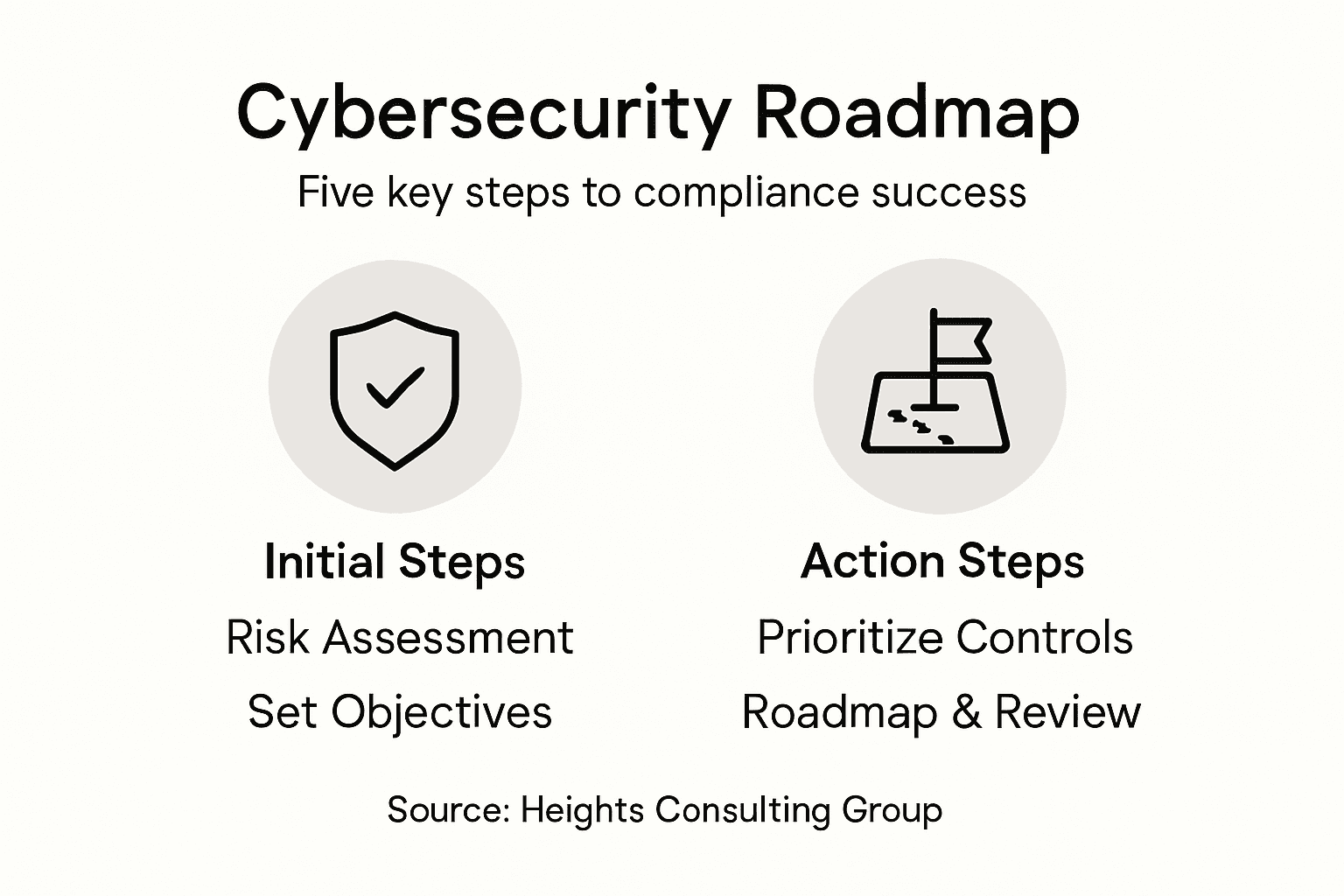
Building a resilient cybersecurity strategy can feel complex for any American healthcare organization facing growing risks and compliance demands. The stakes are high with patient data protection, regulatory pressures, and evolving threats all competing for attention. A comprehensive roadmap—grounded in the structured guidance of the NIST Cybersecurity Framework—helps create clarity, ensuring every step from risk assessment to milestone tracking delivers tangible value for leadership and operations.
Table of Contents
- Step 1: Assess Organizational Risks And Compliance Needs
- Step 2: Define Cybersecurity Objectives And Align With Business Goals
- Step 3: Prioritize Controls And Map To Regulatory Frameworks
- Step 4: Develop Actionable Roadmap With Milestones
- Step 5: Validate, Monitor, And Refine Implementation
Quick Summary
| Key Insight | Explanation |
|---|---|
| 1. Conduct a thorough risk assessment | Understanding your organization’s unique risks lays the foundation for effective cybersecurity strategies and compliance efforts. |
| 2. Align cybersecurity goals with business objectives | Connecting security strategies with business priorities enhances operational efficiency and protects patient data, supporting overall mission. |
| 3. Prioritize cybersecurity controls | Focus on controls that mitigate critical risks while ensuring compliance, using a matrix to correlate them with regulatory requirements. |
| 4. Develop a clear, actionable roadmap | Create a roadmap with specific milestones that align cybersecurity objectives with risks and business goals for effective implementation. |
| 5. Continuously monitor and refine your efforts | Implement ongoing performance tracking and regular reviews to adjust strategies, ensuring they remain effective against evolving threats. |
Step 1: Assess organizational risks and compliance needs
To develop an effective cybersecurity roadmap, you must start by comprehensively understanding your organization's unique risk landscape and regulatory requirements. This initial assessment forms the critical foundation for all subsequent security strategies and compliance efforts.
Begin by conducting a thorough systematic risk assessment that evaluates your current cybersecurity posture. This process involves mapping out all digital assets, identifying potential vulnerabilities, and analyzing potential threat scenarios specific to your healthcare organization. Leverage frameworks like the NIST Cybersecurity Framework to create a structured approach that covers identification, protection, detection, response, and recovery domains. Focus on critical areas such as patient data protection, electronic health record systems, network infrastructure, and third-party vendor connections.
Key components of a robust risk assessment include analyzing historical incident data, performing vulnerability scans, reviewing existing security controls, and understanding industry-specific compliance mandates like HIPAA. Consider engaging external cybersecurity experts who can provide an objective perspective and help you uncover blind spots in your current security architecture.
Professional advice: Document every aspect of your risk assessment meticulously, as this baseline analysis will serve as a critical reference point for future security investments and strategic planning.
Step 2: Define cybersecurity objectives and align with business goals
Defining clear cybersecurity objectives is crucial for transforming security from a technical requirement into a strategic business enabler. Your goal is to create a roadmap that not only protects your organization but actively supports its broader strategic mission.
Start by developing strategic cybersecurity goals that directly connect with your healthcare organization's core business objectives. This means moving beyond traditional compliance checklists to create security strategies that enhance operational efficiency, protect patient data, and enable innovative healthcare delivery. Engage with executive leadership to understand their primary business drivers such as patient care quality, operational cost reduction, and technological innovation. Translate these business priorities into specific cybersecurity outcomes like reducing data breach risks, ensuring continuous system availability, and maintaining patient trust.
Consider creating a matrix that maps each cybersecurity objective to a corresponding business benefit. For example, implementing advanced endpoint protection might translate to reduced patient care interruptions, while robust identity management could support seamless telehealth services. Prioritize objectives that offer clear value propositions and demonstrate how security investments directly contribute to organizational resilience and strategic growth.
Professional advice: Treat your cybersecurity objectives as living documents that can be dynamically adjusted as your healthcare organization's strategic landscape evolves.
The following table summarizes how aligning cybersecurity objectives with business goals benefits healthcare organizations:
| Cybersecurity Objective | Strategic Business Impact | Example Benefit |
|---|---|---|
| Reduce data breach risks | Enhance patient trust | Fewer privacy incidents |
| Ensure continuous system uptime | Improve care quality | Minimize service disruption |
| Enable secure telehealth | Support innovation and growth | Expand virtual services |
| Optimize security investments | Reduce operational costs | Avoid unnecessary expenses |
Step 3: Prioritize controls and map to regulatory frameworks
Prioritizing cybersecurity controls and effectively mapping them to relevant regulatory frameworks is a critical step in building a robust compliance strategy. This process ensures your security measures are not only comprehensive but strategically aligned with industry standards and legal requirements.

Begin by mapping cybersecurity controls systematically to established frameworks like NIST SP 800-53, HIPAA, and other healthcare specific regulations. Focus on identifying the most impactful controls that address your highest risk areas while ensuring complete regulatory coverage. Create a detailed matrix that correlates each control to specific regulatory requirements, allowing you to demonstrate comprehensive compliance and identify potential gaps in your current security infrastructure.
Prioritize controls based on their potential to mitigate critical risks and their alignment with your organization's strategic objectives. Consider factors such as potential financial impact, patient data protection, system availability, and operational continuity. Develop a weighted scoring system that helps you rank controls based on their effectiveness, compliance significance, and resource requirements. This approach allows you to allocate your cybersecurity resources more efficiently and create a targeted implementation strategy that balances regulatory compliance with operational effectiveness.
Professional advice: Regularly review and update your control prioritization matrix to ensure ongoing alignment with evolving regulatory landscapes and emerging cybersecurity threats.
Step 4: Develop actionable roadmap with milestones
Creating an actionable cybersecurity roadmap transforms your strategic vision into a practical implementation plan. This crucial step bridges the gap between theoretical security objectives and real world execution, providing a clear path forward for your healthcare organization.
Begin by developing strategic cybersecurity roadmaps that break down your comprehensive security strategy into specific, measurable milestones. Each milestone should have clear objectives, responsible stakeholders, required resources, and precise timelines. Organize these milestones into short term (3 months), medium term (6 to 12 months), and long term (12 to 24 months) phases. Ensure each milestone directly addresses specific risks identified in your earlier risk assessment and aligns with your compliance and business objectives.
Structure your roadmap to include detailed performance metrics that allow for continuous tracking and adaptation. This means defining specific key performance indicators (KPIs) for each milestone that measure not just technical implementation but also business impact. Consider metrics like risk reduction percentage, compliance coverage, incident response time, and cost efficiency. Build flexibility into your roadmap to accommodate emerging threats, technological changes, and shifts in regulatory requirements. Remember that a great roadmap is a living document that evolves with your organization's changing security landscape.
Professional advice: Schedule quarterly review sessions to reassess your roadmap and ensure it remains aligned with your organization's strategic priorities and emerging cybersecurity challenges.
Step 5: Validate, monitor, and refine implementation
Validating and continuously monitoring your cybersecurity implementation ensures your roadmap remains responsive and effective. This critical phase transforms your strategic plan from a static document into a dynamic security management system that adapts to emerging threats and organizational changes.
Implement a comprehensive continuous monitoring framework that systematically tracks the performance of your cybersecurity controls. Develop a robust set of metrics that go beyond traditional compliance checkboxes and measure actual security effectiveness. This means establishing key performance indicators that evaluate incident response times, vulnerability detection rates, risk mitigation success, and overall security posture. Use automated monitoring tools that provide real time insights into your system's security status and generate actionable intelligence for immediate intervention.
Create a structured feedback loop that allows for regular assessment and refinement of your cybersecurity strategy. Schedule quarterly comprehensive reviews where your security team can analyze performance data, identify potential improvements, and adjust your implementation roadmap accordingly. This iterative approach ensures your cybersecurity strategy remains agile and aligned with both technological advancements and your organization's evolving business objectives. Be prepared to make data driven adjustments that enhance your security resilience and maintain compliance with changing regulatory requirements.
Professional advice: Implement a cross functional review process that includes perspectives from IT security, compliance, operations, and executive leadership to ensure holistic and balanced security strategy refinement.
Below is a quick reference table on key metrics for monitoring cybersecurity roadmap effectiveness:
| KPI | Measurement Focus | Business Value |
|---|---|---|
| Incident response time | Speed to contain threats | Limit potential damages |
| Risk reduction percentage | Decrease in vulnerabilities | Strengthen data protection |
| Compliance coverage | Framework adherence rate | Maintain legal compliance |
| Cost efficiency | Resource allocation | Maximize ROI on security |
Transform Your Cybersecurity Roadmap Into a Strategic Advantage
Building an effective cybersecurity roadmap for compliance success requires more than just a checklist approach. The challenge lies in aligning every security control and risk mitigation effort with your organization’s unique business goals and evolving regulatory demands. If you are struggling with prioritizing controls, defining measurable milestones, or maintaining continuous monitoring as highlighted in the article, you are not alone. Many healthcare and regulated organizations face critical pain points such as protecting patient data, ensuring system uptime, and achieving regulatory compliance without overwhelming resources.
At Heights Consulting Group, we specialize in guiding organizations through these complexities. Our strategic cybersecurity consulting services seamlessly integrate risk management frameworks like NIST and HIPAA into actionable roadmaps that support your business objectives. We help you prioritize controls that reduce your most significant risks and maintain compliance with confidence. With offerings spanning managed cybersecurity, incident response, and compliance frameworks tailored for highly regulated industries, we empower your organization to transform cybersecurity from a technical burden into a competitive business advantage. Discover how our expertise in cybersecurity strategy, compliance solutions, and incident response services can help you optimize your roadmap and accelerate your journey to compliance success.
Do not wait to take control of your cybersecurity future. Visit Heights Consulting Group today to connect with experts who will help you build, validate, and refine a dynamic cybersecurity roadmap that drives measurable results and protects your organizational mission.
Frequently Asked Questions
What is the first step to building a cybersecurity roadmap for compliance success?
Start by assessing your organization's risks and compliance needs. Conduct a systematic risk assessment that evaluates your current cybersecurity posture and identifies vulnerabilities within your healthcare organization.
How do I define cybersecurity objectives that align with business goals?
Clearly define your cybersecurity objectives by aligning them with your healthcare organization's core business goals. Identify key business drivers and transform these priorities into specific cybersecurity outcomes that add value, such as reducing data breach risks or improving operational efficiency.
What should be included in the cybersecurity controls prioritization process?
Prioritize cybersecurity controls by mapping them to relevant regulatory frameworks, such as HIPAA and NIST. Create a matrix that correlates each control with specific regulatory requirements, focusing on those that mitigate the highest risks and align with your strategic objectives.
How can I develop an actionable roadmap with clear milestones?
Create an actionable cybersecurity roadmap that breaks down your strategy into specific milestones with defined objectives, responsible stakeholders, required resources, and timelines. Organize these milestones into short-term, medium-term, and long-term phases to ensure clarity and focus on your goals.
What metrics should I monitor for effective implementation of the cybersecurity roadmap?
Establish key performance indicators (KPIs) to monitor the effectiveness of your cybersecurity implementation. Focus on metrics such as incident response time and risk reduction percentage to evaluate your security posture, ensuring you make data-driven adjustments over time.
How often should I review and refine my cybersecurity roadmap?
Schedule quarterly review sessions to reassess and refine your cybersecurity roadmap. Regularly analyze performance data to ensure your strategy remains aligned with evolving threats and regulatory requirements, adapting as necessary to maintain effectiveness.
Recommended
- Cybersecurity Insights &Leadership
- Crafting Your Cybersecurity Roadmap for Success - Heights Consulting Group
- Unlocking the Hidden Value of Compliance in Business Growth - Heights Consulting Group
- Mastering Regulatory Compliance: Confidence and Clarity for Executive Leaders - Heights Consulting Group