

Defining cybersecurity objectives can feel like aligning moving targets when federal regulations, business needs, and executive expectations all compete for attention. For CISOs and security leaders in highly regulated American industries, clarity at this stage lays the groundwork for measurable risk assessment success. By focusing on cybersecurity objectives and compliance requirements tailored to the organization's mission, you support confident decisions about resource allocation, policy development, and alignment with every critical regulatory framework.
Table of Contents
- Step 1: Define Cybersecurity Objectives And Compliance Needs
- Step 2: Identify And Categorize Critical Assets And Threats
- Step 3: Assess Vulnerabilities And Quantify Potential Impacts
- Step 4: Prioritize Risks And Allocate Mitigation Resources
- Step 5: Validate Controls And Continuously Monitor Effectiveness
Quick Summary
| Key Point | Explanation |
|---|---|
| 1. Define cybersecurity goals clearly | Establish clear objectives aligned with the organization's mission to guide resource allocation, policy, and compliance effectively. |
| 2. Thoroughly inventory critical assets | Create a comprehensive list of systems and data, categorizing them by priority to ensure targeted protection during risk assessment. |
| 3. Assess and quantify vulnerabilities | Evaluate system weaknesses and calculate potential impact to prioritize risks and guide informed decisions on security investments. |
| 4. Prioritize risks for resource allocation | Use calculated risk scores to identify where security budget should be spent, addressing the highest risks first for maximum impact. |
| 5. Continuously validate and monitor security controls | Establish processes to ensure security measures work effectively, adapting them over time to address evolving threats efficiently. |
Step 1: Define cybersecurity objectives and compliance needs
Before you can build an effective risk assessment program, you need to establish clear cybersecurity objectives that directly support your organization's mission and operational requirements. Your objectives serve as the foundation for everything that follows: resource allocation, policy development, security tool selection, and compliance efforts. This step requires you to look inward at your business priorities while also looking outward at regulatory demands specific to your industry and location.
Start by identifying what you're trying to protect and why it matters to your organization. For financial institutions, this means safeguarding customer data and transaction integrity. For healthcare organizations, it means protecting patient information and ensuring system availability for critical operations. Document your core security goals, which typically fall into three categories: confidentiality (preventing unauthorized access), integrity (preventing unauthorized modification), and availability (ensuring systems function when needed). Then map your compliance obligations. Different industries face different requirements. Banks must meet Federal Financial Institutions Examination Council standards. Healthcare organizations answer to HIPAA. Defense contractors work under CMMC frameworks. Federal agencies follow CISA guidance and executive orders. Understanding these obligations isn't just about checking boxes; it shapes your entire risk assessment approach. Strategic cybersecurity roadmaps help you align these compliance demands with your business goals rather than treating them as separate burdens.
Working with your executive team, create a written statement that articulates both your cybersecurity objectives and your compliance scope. This statement should identify which systems, data, and processes fall under regulatory requirements and which represent business-critical assets. Be specific about your regulatory environment. Don't just say "we must comply with industry standards." Instead, identify which specific frameworks apply to your organization, which business units they affect, and what deadlines you're working toward. This clarity prevents teams from working at cross-purposes and ensures your risk assessment focuses on what actually matters most.
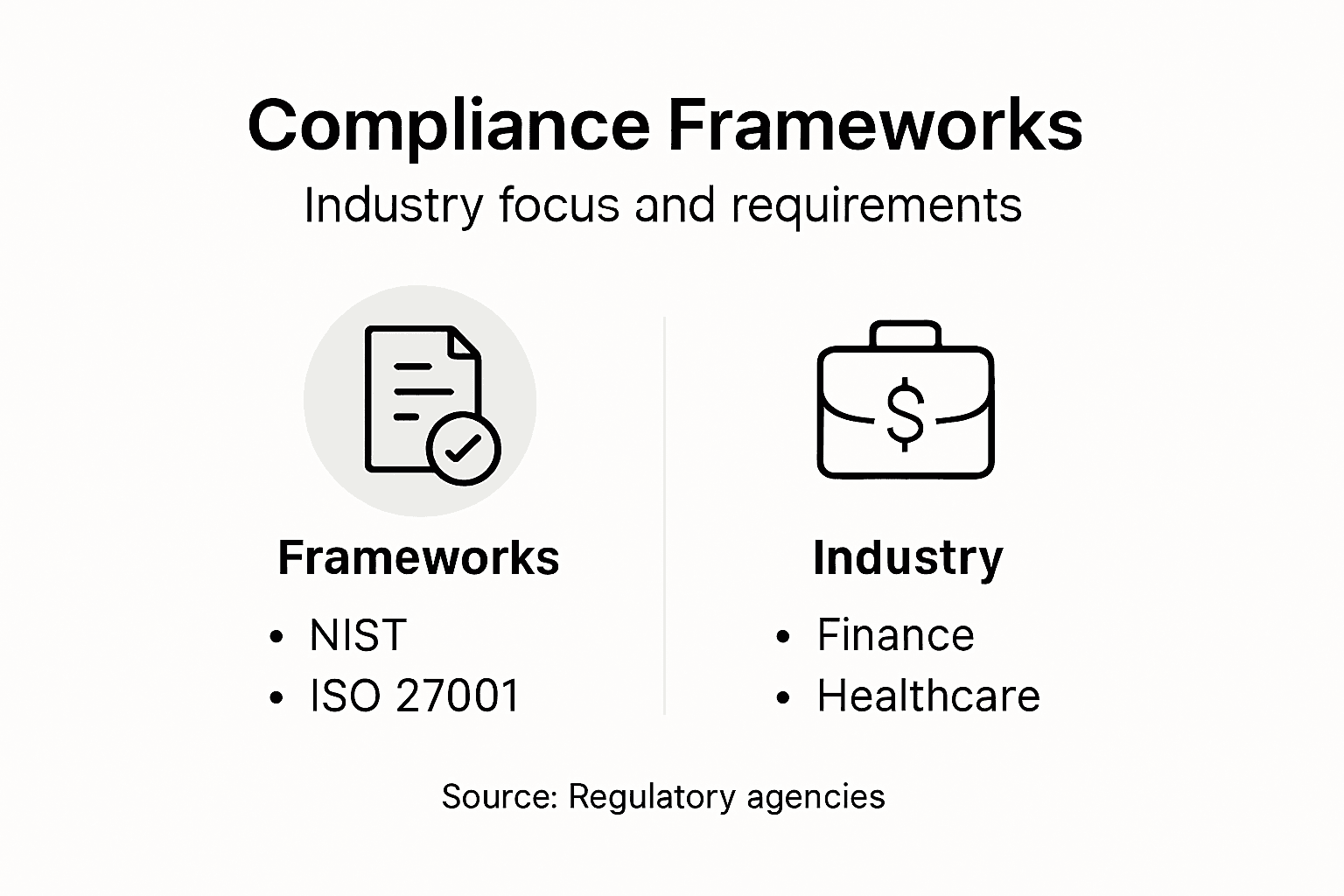
Here is a comparison of major cybersecurity compliance frameworks and their unique focus areas:
| Framework | Primary Industry | Main Focus | Key Requirement |
|---|---|---|---|
| HIPAA | Healthcare | Patient data protection | Security and privacy of medical info |
| FFIEC | Financial Services | Transaction integrity | Data security, audit trails |
| CMMC | Defense Contracting | Supply chain security | Maturity model certification |
| CISA Guidance | Federal Agencies | Critical infrastructure defense | Resilience, risk reporting procedures |
Pro tip: Hold a workshop with your CISO, compliance officer, CFO, and business unit leaders to jointly define these objectives and compliance needs. When leaders from different functions agree on priorities together, implementation becomes significantly easier and funding requests gain faster approval.
Step 2: Identify and categorize critical assets and threats
Now that you have defined your cybersecurity objectives and compliance requirements, you need to inventory what you actually have and what could harm it. This step transforms abstract security goals into concrete lists of systems, data, and processes that demand protection. You will identify your critical assets, understand the threats targeting them, and categorize everything by priority so your risk assessment efforts focus on what matters most.
Start by creating a comprehensive asset inventory. Walk through your organization and document every system, application, database, server, network device, and piece of hardware that stores, processes, or transmits data. For financial services firms, this includes payment processing systems, customer databases, and transaction servers. For healthcare organizations, it includes electronic health records systems, medical devices, and patient data repositories. The methodical approach to asset inventory includes developing a taxonomy that categorizes assets by function, criticality to operations, and regulatory sensitivity. Your inventory should answer specific questions: What data does this system hold? Who depends on it? What happens if it fails? How long can operations continue without it? Which compliance frameworks govern it? Create a living spreadsheet or asset management system that captures this information. This inventory becomes your roadmap.

Next, identify the threats that could affect each asset. Threats represent potential harmful actors or conditions such as ransomware operators targeting payment systems, insiders accessing customer records, or malware spreading through email attachments. Categorize threats by source: external threat actors, malicious insiders, system failures, or natural disasters. Then identify vulnerabilities in your assets, which are weaknesses that threats could exploit. A vulnerability might be unpatched software, weak password policies, or inadequate access controls. The combination of a threat, a vulnerability, and the potential impact creates your risk picture. Rank your assets by criticality. A compromised payment system demands immediate remediation. A non-critical development server requires less urgent attention. This prioritization ensures your risk assessment focuses resources on protecting what truly matters to your mission and compliance obligations.
Here's a summary of asset categories and example threats to guide risk assessment:
| Asset Category | Common Example | Potential Threats | Regulatory Sensitivity |
|---|---|---|---|
| Payment Systems | Transaction servers | Ransomware, fraud attempts | High in finance sector |
| Medical Devices | Electronic health records | Malware, device tampering | Critical for HIPAA compliance |
| Customer Databases | CRM platforms | Insider data theft | Regulated by consumer protection laws |
| Internal Servers | Development/test servers | System failures, weak security | Typically low unless handling regulated info |
Pro tip: Interview business process owners and system administrators directly rather than relying solely on IT documentation. They know which systems actually run the business, which are used by customers, and which have workarounds that never made it into formal records, giving you a complete picture.
Step 3: Assess vulnerabilities and quantify potential impacts
With your assets and threats identified, you now need to understand what weaknesses exist in your systems and what the consequences would be if those weaknesses were exploited. This step moves beyond inventory into analysis. You will systematically find vulnerabilities, evaluate their severity, and calculate the business impact of potential breaches so you can make informed decisions about where to invest your security resources.
Start by assessing your vulnerabilities using a structured methodology. The OCTAVE framework provides a systematic approach to identify information assets, evaluate associated threats and vulnerabilities, and understand risk exposure levels. Your vulnerability assessment involves multiple techniques. Run automated scanning tools against your networks and applications to find unpatched software, weak configurations, and known security flaws. Conduct manual testing and code reviews to catch logic errors and design weaknesses that automated tools miss. Interview your system administrators and developers about workarounds, legacy systems, and known issues they have documented informally. For each vulnerability you discover, assign it a severity rating based on how easily it can be exploited and what access it grants an attacker. A remote code execution vulnerability in a publicly facing web application is more severe than a local privilege escalation on an internal system with limited access. The goal is not to find every vulnerability but to understand which vulnerabilities matter most because they affect your critical assets or enable attacks aligned with known threats.
Next, quantify the potential impact of successful attacks. Work with business leaders to assign financial values to different loss scenarios. If a payment processing system goes down for one hour, what revenue is lost? If customer data is stolen, what is the cost of notification, credit monitoring, regulatory fines, and reputation damage? If intellectual property is compromised, what competitive advantage is lost? The Department of Defense approach to risk assessment includes quantifying impact and likelihood by assigning metrics for severity and calculating overall risk levels. For each critical asset, estimate both the likelihood that a threat will exploit a vulnerability and the magnitude of potential impact. Multiply likelihood by impact to calculate risk scores. A high-likelihood threat with catastrophic impact demands immediate mitigation. A low-likelihood threat with minor impact can be accepted or monitored. This quantification transforms abstract security conversations into concrete business decisions that executives understand and can fund appropriately.
Pro tip: Use your insurance broker and claims history as reference data for impact quantification. They have analyzed real breach costs across your industry and can provide realistic figures for notification expenses, business interruption, and liability that beat guesswork.
Step 4: Prioritize risks and allocate mitigation resources
You have identified your assets, understood your threats, assessed vulnerabilities, and quantified potential impacts. Now comes the critical decision point: where do you actually spend your security budget? You cannot fix everything at once, and attempting to do so wastes resources on low-priority problems while critical risks go unaddressed. This step requires you to rank your risks systematically and allocate your mitigation resources where they will create the most value for your organization.
Rank your risks using the calculations you performed in the previous step. Multiply your threat likelihood by vulnerability severity by asset impact to create a composite risk score for each vulnerability affecting each critical asset. The highest-scoring risks demand immediate attention. A critical financial system with a remote code execution vulnerability and high likelihood of exploitation gets resources first. An administrative workstation with a minor information disclosure issue gets addressed later. Risk prioritization should be guided by metrics such as cost-effectiveness of mitigation, allowing you to address higher-priority vulnerabilities within your constrained budget. Create a risk register that lists every identified risk with its priority score, current status, owner, and planned mitigation strategy. This register becomes your working document throughout the year, showing progress and justifying budget requests to leadership. Some organizations use a risk heat map displaying risks on a two-by-two or three-by-three matrix with likelihood on one axis and impact on the other. This visual representation helps executives quickly grasp where the real dangers lie and what deserves funding.
Next, allocate your mitigation resources strategically. You have multiple options for addressing each risk. You can reduce the likelihood of exploitation by patching vulnerabilities, implementing access controls, or deploying detection systems. You can reduce the impact of successful attacks through segmentation, backups, and incident response preparation. You can transfer risk through insurance. You can accept certain risks if the cost of mitigation exceeds the potential loss. In complex environments with competing operational demands, effective risk management requires balancing cybersecurity investments against operational priorities while maintaining continuity. Assign each high-priority risk to a responsible owner with accountability for implementing the mitigation plan. Set realistic timelines based on resource availability and technical complexity. Quick wins matter psychologically and demonstrate progress, but do not ignore longer-term strategic improvements. Your risk register should show not just what needs fixing, but who is fixing it, when it will be fixed, and how you will verify the fix actually reduced the risk.
Pro tip: When presenting risk prioritization to executives, translate risk scores into business impact language they understand instead of using technical metrics. "This vulnerability could enable theft of customer payment cards" resonates far better than "CVSS 8.1 remote code execution vulnerability."
Step 5: Validate controls and continuously monitor effectiveness
Implementing security controls is not a one-time project that ends with deployment. Controls degrade over time as threats evolve, systems change, and teams become complacent. This step focuses on building the processes and discipline to validate that your controls actually work as intended and to continuously monitor their effectiveness so you catch failures before attackers do. Your goal is to move from a static control environment to a dynamic, responsive one that adapts to threats in real time.
Start by establishing a validation process for each control you have deployed. For access controls, validate that users only have the permissions they actually need for their jobs and that inactive accounts are disabled promptly. For patch management, validate that critical systems receive security updates within your defined timeframe and that patches are actually installed and verified. For endpoint detection systems, validate that they are properly configured, forwarding logs to your security operations center, and generating alerts for suspicious activity. Run tabletop exercises and simulations to test your incident response procedures without waiting for a real attack. Continuous monitoring involves evaluating security controls and responding to identified deficiencies through corrective actions, ensuring your defenses remain effective against emerging threats. Create a control validation checklist specific to your environment and assign responsibility for each validation task. Schedule these validations throughout the year rather than cramming them into annual audits. Monthly validation of high-priority controls gives you early warning of failures. Quarterly validation of medium-priority controls balances effort with coverage. Annual validation of lower-priority controls ensures nothing is forgotten.
Next, implement continuous monitoring that tracks control effectiveness over time. Deploy dashboards that show patch compliance percentages, vulnerability detection trends, security alert volumes, and incident response times. Monitor whether your controls are reducing the number of successful attacks or the time attackers spend undetected in your environment. Regular review and validation of controls as part of ongoing risk management includes monitoring risk mitigations and assessing effectiveness through metrics so you can adapt countermeasures over time. If your access control implementation reduces unauthorized access attempts by eighty percent but attacks are succeeding through other paths, you know where to focus next. If your intrusion detection system generates so many false alarms that your team ignores them, you need tuning. Feed monitoring results back into your risk assessment process. A control that is working perfectly reduces the likelihood of exploitation and should lower the priority of that particular risk. A control that is failing requires remediation or acceptance of increased risk. This creates a feedback loop where your risk assessment, mitigation strategies, and control monitoring strengthen each other continuously.
Pro tip: Assign a dedicated control owner for each major security control rather than leaving validation responsibility vague. That person owns the dashboard, schedules testing, tracks the repair of broken controls, and reports status to leadership quarterly, creating accountability that ensures monitoring actually happens.
Elevate Your Risk Assessment With Strategic Cybersecurity Partnership
Are you struggling to prioritize risks, quantify potential impacts, or maintain continuous control validation as outlined in the "Guide to Risk Assessment for Advanced Cybersecurity Outcomes"? Organizations today face complex challenges from evolving threats and stringent compliance demands that require more than a one-size-fits-all approach. Your critical assets deserve focused protection grounded in clear objectives and measurable risk management strategies.
At Heights Consulting Group, we transform your risk assessment findings into actionable cybersecurity programs tailored to your business goals and regulatory requirements. Our expert team helps you seamlessly implement frameworks like CMMC and NIST, allocate mitigation resources effectively, and establish ongoing control monitoring. Don’t let vulnerabilities linger or precious resources be misallocated. Visit Heights Consulting Group to discover how our strategic guidance and technical services can convert cybersecurity from a compliance obligation into a lasting competitive advantage. Get started now to safeguard your most valuable assets and enable confident decision-making across your organization. Learn more about how we align cybersecurity with business objectives by exploring our services and our proven approach to strategic cybersecurity roadmaps.
Frequently Asked Questions
What are the key cybersecurity objectives for a risk assessment?
Your key cybersecurity objectives should include confidentiality, integrity, and availability. Start by identifying what data, systems, and processes are critical to your organization’s mission, outlining how they align with compliance needs within 30 days.
How do I categorize my organization's critical assets?
Categorize critical assets by creating a comprehensive inventory that includes all systems, applications, and data repositories. Walk through your organization and document each asset to prioritize them based on their function and importance to operations.
What steps should I take to assess vulnerabilities in my systems?
To assess vulnerabilities, employ a structured methodology like the OCTAVE framework to identify weaknesses and evaluate their severity. Implement scanning tools and conduct manual checks; aim to complete this assessment within 60 days for a thorough understanding of your security posture.
How can I quantify the potential impact of cybersecurity risks?
Quantify potential impacts by collaborating with business leaders to assign financial values to different loss scenarios, such as the cost of a system outage or data breach. Develop estimates that reflect potential losses to guide resource allocation effectively.
What is the best way to prioritize cybersecurity risks?
Prioritize cybersecurity risks by calculating a composite risk score based on threat likelihood and potential impact for each vulnerability. Create a risk register to track the status and mitigation plans of the highest-scoring risks, ensuring that critical vulnerabilities are addressed first.
How can I ensure that my cybersecurity controls remain effective over time?
Ensure the effectiveness of your cybersecurity controls by establishing a continuous monitoring process that evaluates their performance regularly. Schedule monthly validations of high-priority controls and maintain a dashboard to track compliance and any needed adjustments.
Recommended
- Boardroom Cybersecurity: Heights CG's Strategic Governance
- A Guide to Cybersecurity Risk Assessment Services Overview - Heights Consulting Group
- Your Guide to a Cyber Risk Assessment Framework - Heights Consulting Group
- What Is Security Risk Management Explained - Heights Consulting Group
- Cosa Sono I Rischi Cyber: Guida Essenziale 2024 - Security Hub
- Complete Guide to Cybersecurity Basics for Small Business | Ibrandmedia