

More than 80 percent of American organizations report that unclear cybersecurity governance increases their regulatory risk exposures. For CISOs and compliance officers in regulated sectors, fragmented oversight and shifting digital threats put business resilience on the line every day. This article offers clear insights to help American security leaders define governance, align accountability, and build robust frameworks that withstand both industry regulations and real-world cyber attacks.
Table of Contents
- Defining Governance In Cybersecurity Programs
- Key Frameworks And Types Of Cybersecurity Governance
- Aligning Governance With Business Objectives
- Leadership Accountability And Board Responsibilities
- Meeting Regulatory Compliance And Risk Management
- Common Pitfalls And How To Avoid Them
Key Takeaways
| Point | Details |
|---|---|
| Cybersecurity Governance Frameworks Are Essential | Organizations should employ structured frameworks like NIST CSF and ISO/IEC 27001 to effectively manage cyber risks and align strategies with business objectives. |
| Strategic Integration Is Crucial | Cybersecurity initiatives must be integrated with business goals, translating technical risks into strategic insights to enhance organizational value. |
| Active Board Engagement Is Necessary | Board members must take an active role in understanding and managing cyber risks to ensure strategic oversight and resource allocation. |
| Proactive Compliance Management Is Key | A holistic approach to compliance and risk management helps organizations go beyond minimum standards, fostering a culture of proactive cybersecurity. |
Defining governance in cybersecurity programs
Cybersecurity governance represents a structured approach to managing and directing an organization's cybersecurity strategy, aligning technological protection with broader business objectives. At its core, governance establishes clear accountability mechanisms, defining who makes critical security decisions and how those decisions connect to organizational risk tolerance.
A comprehensive cybersecurity governance framework involves multiple layers of oversight, starting with board-level accountability and extending through executive leadership to operational security teams. Corporate governance in cybersecurity requires boards to actively challenge management about cyber risk mitigation strategies, even if they are not technical experts. This means creating transparent reporting mechanisms where Chief Information Security Officers (CISOs) can communicate complex security metrics in business-relevant terms.
Effective governance goes beyond technical controls, integrating information security oversight with strategic planning. Key components include:
- Establishing clear security roles and responsibilities
- Defining risk appetite and tolerance levels
- Creating accountability frameworks
- Ensuring alignment between security initiatives and business goals
- Developing comprehensive incident response protocols
Pro tip: Implement a quarterly governance review process that involves both technical security leaders and business executives to maintain strategic cybersecurity alignment.
Key frameworks and types of cybersecurity governance
Cybersecurity governance frameworks serve as critical blueprints for organizations to systematically manage digital risks and align security strategies with business objectives. These structured approaches provide comprehensive methodologies for identifying, assessing, and mitigating potential cybersecurity vulnerabilities across various organizational domains.
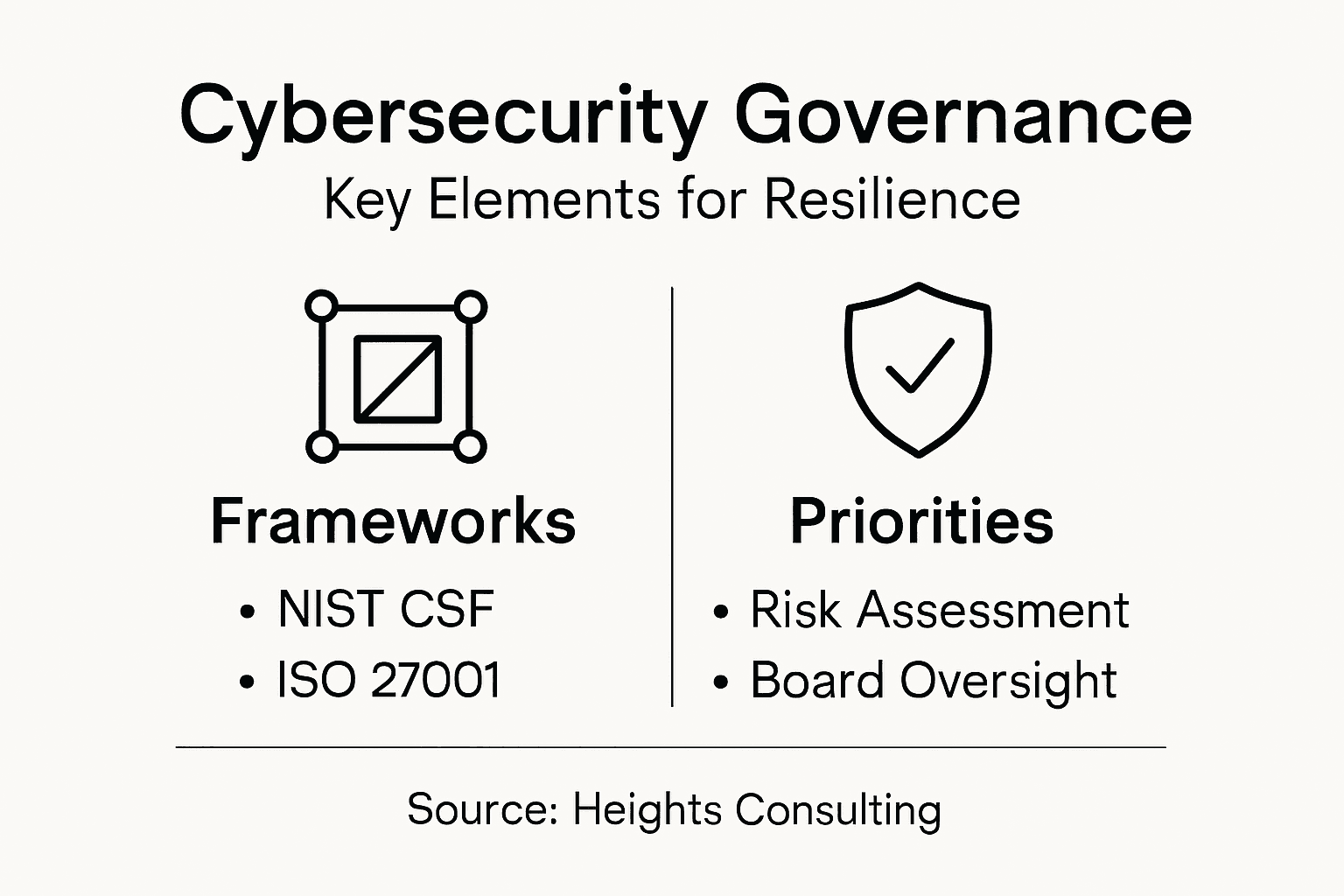
Cybersecurity governance frameworks integrate governance, risk management, and compliance principles, enabling organizations to develop holistic security strategies. They typically encompass multiple dimensions, including IT infrastructure protection, regulatory adherence, and strategic risk assessment. The NIST Cybersecurity Framework stands out as a premier example, offering a comprehensive taxonomy of cybersecurity outcomes applicable across industries and organizational sizes.
Key cybersecurity governance frameworks include:
- NIST Cybersecurity Framework (CSF)
- ISO/IEC 27001
- COBIT (Control Objectives for Information and Related Technologies)
- ITIL (Information Technology Infrastructure Library)
- CIS Critical Security Controls
These frameworks differ in their specific approaches but share common objectives of establishing structured processes for managing cybersecurity risks, defining accountability, and creating systematic methods for continuous improvement and threat mitigation.
Here's a comparison of major cybersecurity governance frameworks and their core strengths:
| Framework | Main Focus | Best For |
|---|---|---|
| NIST CSF | Comprehensive risk management | All organization sizes, adaptable to industries |
| ISO/IEC 27001 | Information security management system | Compliance-focused, global operations |
| COBIT | Alignment of IT and business goals | Enterprises seeking IT governance |
| ITIL | IT service management maturity | Organizations optimizing IT processes |
| CIS Controls | Prescriptive security controls | Quick wins, technical security improvements |
Pro tip: Select a cybersecurity governance framework that matches your organization's specific industry requirements and complexity level, ensuring flexibility for future adaptation.
Aligning governance with business objectives
Effective cybersecurity governance requires more than technical controls. It demands strategic integration of security initiatives with core organizational objectives, transforming cybersecurity from a cost center to a value-generating business function. Cybersecurity governance at the board level prioritizes understanding how digital risks directly impact business performance and strategic goals.
The alignment process involves creating a comprehensive framework that translates technical security requirements into business language. Effective security governance ensures security strategies support organizational missions while providing clear accountability mechanisms. This means developing governance structures that:
- Translate cyber risks into financial and operational impact terms
- Create metrics that demonstrate security's contribution to business objectives
- Establish communication channels between technical teams and executive leadership
- Develop risk management strategies aligned with organizational risk tolerance
- Integrate security considerations into strategic planning processes
Successful alignment requires breaking down traditional silos between IT security and business units. Cybersecurity governance must become a collaborative effort where security leaders speak the language of business strategy, demonstrating how robust security practices protect and enable organizational growth, reputation, and competitive advantage.

Pro tip: Conduct quarterly joint workshops between cybersecurity leaders and business unit executives to translate technical risks into strategic business insights.
Leadership accountability and board responsibilities
Cybersecurity leadership demands a comprehensive approach that goes far beyond traditional technical oversight. Board governance of cyber risk requires active engagement, strategic thinking, and a deep understanding of how digital vulnerabilities can impact organizational sustainability and reputation.
Cybersecurity governance challenges necessitate that board members transform from passive observers to active cyber risk managers. This requires developing critical competencies that enable effective oversight, including:
- Understanding fundamental cybersecurity principles
- Evaluating organizational cyber risk exposure
- Challenging management's security strategies
- Ensuring appropriate resource allocation
- Establishing clear accountability mechanisms
- Monitoring and reviewing cybersecurity performance metrics
Board responsibilities extend beyond periodic reviews. They must foster a proactive culture of cybersecurity awareness, integrating digital risk management into strategic planning processes. This means creating robust governance structures that empower executive leadership to make informed decisions, allocate resources strategically, and develop comprehensive incident response capabilities that protect the organization's long-term interests.
The following table summarizes how effective cybersecurity governance links leadership roles to business outcomes:
| Leadership Role | Governance Responsibility | Business Impact |
|---|---|---|
| Board of Directors | Strategic oversight, resource allocation | Enhanced resilience, regulatory alignment |
| Executive Leadership | Risk management, performance review | Informed decision-making, continuous improvement |
| Security Teams | Implementation, incident response | Reduced vulnerabilities, faster recovery |
Pro tip: Develop a board-level cybersecurity committee with members possessing diverse technical and strategic expertise to enhance organizational cyber resilience.
Meeting regulatory compliance and risk management
Navigating the complex landscape of regulatory compliance requires a strategic, proactive approach to cybersecurity governance. Cybersecurity governance frameworks are designed to ensure organizations systematically address legal requirements while maintaining robust risk management practices.
Comprehensive cyber risk regulation demands a multifaceted strategy that extends beyond traditional compliance checkboxes. Organizations must develop dynamic frameworks that address critical components such as:
- Continuous risk assessment and monitoring
- Comprehensive governance arrangements
- Detailed risk management protocols
- Rigorous third-party service provider oversight
- Adaptive supervisory practices
- Regular compliance performance evaluations
Successful regulatory compliance is not about meeting minimum standards but creating a culture of proactive risk management. This requires integrating compliance considerations into every level of organizational strategy, ensuring that cybersecurity becomes an inherent part of business operations rather than a disconnected administrative function.
Pro tip: Implement a cross-functional compliance review team that includes legal, IT, and business strategy representatives to ensure comprehensive regulatory alignment.
Common pitfalls and how to avoid them
Cybersecurity governance is fraught with complex challenges that can undermine an organization's digital resilience. Fundamental cybersecurity governance challenges reveal critical vulnerabilities that organizations must proactively address to maintain effective security strategies.
Cybersecurity governance challenges often emerge from rapidly evolving technological landscapes and leadership gaps. Key pitfalls organizations must navigate include:
- Lack of clear accountability structures
- Insufficient board-level cybersecurity expertise
- Fragmented risk management practices
- Inadequate communication of cyber risks
- Failure to integrate cybersecurity into business strategy
- Resistance to continuous learning and adaptation
Successful mitigation requires a holistic approach that transforms these potential weaknesses into strategic strengths. Organizations must develop adaptive governance frameworks that foster transparency, encourage ongoing education, and create robust communication channels between technical teams and executive leadership. This means investing in leadership development, creating cross-functional teams, and establishing clear, measurable cybersecurity performance indicators.
Pro tip: Conduct annual cybersecurity governance maturity assessments to systematically identify and address potential governance gaps before they become critical vulnerabilities.
Strengthen Your Cybersecurity Governance to Build Lasting Business Resilience
Navigating the complex challenges of cybersecurity governance requires more than technical fixes. The article highlights critical pain points like unclear accountability, the need for leadership engagement, and aligning security with business goals. At Heights Consulting Group, we specialize in transforming these challenges into strategic strengths by providing tailored solutions focused on governance frameworks, risk management, and regulatory compliance. Our expertise ensures your cybersecurity initiatives not only protect but also empower your organization's growth and reputation.

Take control of your cybersecurity governance today with expert guidance from Heights Consulting Group. Explore how our advisory, managed cybersecurity, and compliance services help you establish clear accountability, enhance board-level oversight, and align security strategies with your business objectives. Don't wait until vulnerabilities become critical risks. Visit Heights Consulting Group and discover how we can help turn cybersecurity governance into your competitive advantage.
Frequently Asked Questions
What is the role of governance in cybersecurity?
Governance in cybersecurity involves managing and directing an organization's cybersecurity strategy, ensuring that it aligns with broader business objectives and risk tolerance. It establishes accountability and defines decision-making processes for security management.
How can cybersecurity governance frameworks benefit my organization?
Cybersecurity governance frameworks provide structured methodologies for identifying, assessing, and mitigating digital risks. They ensure alignment between cybersecurity initiatives and business goals, promote compliance, and enable continuous improvement in security practices.
What are some key components of a cybersecurity governance framework?
Key components of a cybersecurity governance framework include establishing clear roles and responsibilities, defining risk appetite, creating accountability frameworks, ensuring alignment with business objectives, and developing robust incident response protocols.
How can organizations avoid common pitfalls in cybersecurity governance?
Organizations can avoid pitfalls by developing clear accountability structures, ensuring board-level cybersecurity expertise, improving communication around cyber risks, integrating cybersecurity with business strategy, and fostering a culture of continuous learning and adaptation.