

Supply chain cyber attacks hit 45% of organizations in 2025, yet many executives still rely on outdated vendor questionnaires and software bill of materials (SBOM) reviews to manage risk. This approach misses the evolving mechanics of modern supply chain threats, including stolen credentials, OAuth token theft, and multi-tenant SaaS breaches. As regulations like DORA, NIS2, and NERC CIP-013 impose stricter requirements, leaders in regulated industries need a clear, evidence-based understanding of supply chain cyber risk to protect operational resilience and maintain compliance. This guide defines supply chain cyber risk, explains how attacks unfold, clarifies regulatory obligations, and provides actionable mitigation strategies tailored for C-level executives and cybersecurity leaders.
Table of Contents
- Key takeaways
- What is supply chain cyber risk? A comprehensive definition
- Mechanics and common threat vectors in supply chain cyber risk
- Regulatory landscape shaping supply chain cyber risk management
- Emerging nuances, challenges, and strategic mitigation approaches
- How Heights Consulting Group supports supply chain cyber risk management
- Frequently asked questions
Key Takeaways
| Point | Details |
|---|---|
| Extended supply chain mapping | Map and continuously update your extended supply chain across hardware, software, services, cloud, and OT providers to reveal risks across multiple tiers. |
| Runtime controls and zero trust | Traditional vendor questionnaires are insufficient; implement runtime monitoring and zero trust to detect and contain attacks as they unfold. |
| Regulatory obligations | DORA, NIS2, and NERC CIP 013 impose strict supply chain risk and incident reporting requirements that regulators expect you to meet. |
| Incident response planning | Mitigation should include formal incident response planning and ongoing monitoring to detect breaches quickly and minimize impact. |
What is supply chain cyber risk? A comprehensive definition
The NIST Cybersecurity Supply Chain Risk Management (C-SCRM) framework defines supply chain cyber risk as potential damage from supplier-related vulnerabilities across Information and Communications Technology (ICT) and Operational Technology (OT) environments. This definition extends beyond software dependencies to include hardware components, cloud services, managed service providers, and system integrators. Understanding this broad scope is critical because risks can enter your organization through any layer of your technology stack, from firmware in IoT devices to APIs in third-party SaaS platforms.
Supply chain cyber risk affects multiple vendor tiers. Your organization may contract directly with a primary vendor, but that vendor relies on second-tier suppliers for components or services, who in turn depend on third and fourth-tier providers. Each layer introduces potential vulnerabilities. A breach at a fourth-tier supplier can cascade through the chain, impacting your operations even when you have no direct relationship with the compromised entity. This interconnectedness makes mapping your extended supply chain a foundational step in risk management.
The scope includes several categories:
- Hardware risks: backdoors in chips, counterfeit components, or tampered devices during manufacturing or shipping
- Software risks: malicious code injected during development, vulnerabilities in open-source libraries, or compromised update mechanisms
- Service risks: unauthorized access by managed service providers, insecure cloud configurations, or breaches at hosting providers
- Operational technology risks: compromised industrial control systems, vulnerabilities in SCADA networks, or attacks on critical infrastructure suppliers
Regulated industries face heightened exposure because attackers target supply chain security threats as a path to high-value data and critical systems. Financial services, healthcare, energy, and defense sectors must recognize that supply chain cyber risk is not a vendor management checkbox but a dynamic threat requiring continuous attention and specialized controls.
Mechanics and common threat vectors in supply chain cyber risk
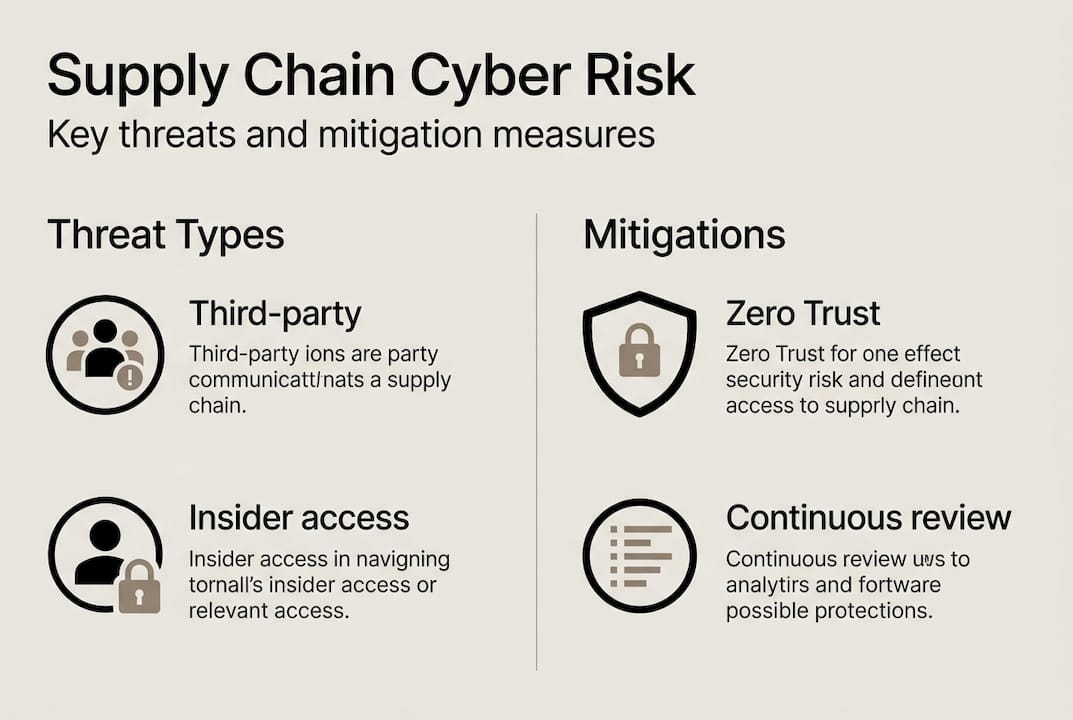
Supply chain attacks exploit trust relationships between organizations and their vendors. Attackers compromise a supplier's environment, then use that foothold to access downstream customers. The mechanics vary, but several vectors dominate the threat landscape. Stolen credentials account for 16.10% of incidents, while software flaws represent 18.08%. OAuth token theft and multi-tenant SaaS breaches enable lateral movement across customer environments, turning a single vendor compromise into a mass data loss event.

Edge environments amplify risk. VPNs, Managed File Transfer (MFT) systems, and remote access tools create entry points that attackers exploit to pivot into internal networks. Once inside, adversaries move laterally, escalate privileges, and exfiltrate data. Traditional perimeter defenses fail because the attacker enters through a trusted channel. This is why questionnaire-based assessments lack runtime detection capabilities. A vendor may pass a security review in January but suffer a breach in March, leaving your organization exposed until the next annual assessment.
Common attack patterns include:
- Compromised software updates: attackers inject malware into legitimate vendor updates, distributing it to all customers
- API abuse: stolen API keys or weak authentication allow unauthorized access to customer data stored in SaaS platforms
- Cloud misconfigurations: vendors with poorly secured cloud environments expose customer data through open storage buckets or overly permissive access controls
- Insider threats: malicious or negligent vendor employees with access to customer systems cause data breaches or sabotage
Pro Tip: Implement zero-trust architectures that verify every access request regardless of source. This approach reduces dwell time from months to hours by limiting lateral movement and requiring continuous authentication. Pair zero-trust with runtime behavioral monitoring to detect anomalies that static assessments miss.
The shift toward resilience-focused strategies reflects a recognition that perfect prevention is impossible. Instead, organizations must assume breaches will occur and build capabilities to detect, contain, and recover quickly. Cyber risk management best practices emphasize layered defenses, rapid incident response, and continuous improvement based on threat intelligence. Executives should prioritize investments in technologies and processes that minimize impact over those promising absolute protection. Understanding how to prevent and respond to supply chain attacks requires integrating technical controls with organizational readiness.
Regulatory landscape shaping supply chain cyber risk management
Regulatory frameworks increasingly mandate specific supply chain cybersecurity practices. The Digital Operational Resilience Act (DORA) requires 22,000 financial entities to implement third-party ICT risk management, including contractual safeguards, continuous monitoring, and incident reporting. The Network and Information Security Directive 2 (NIS2) governs over 160,000 entities across critical infrastructure sectors, with fines potentially exceeding €10 million for noncompliance. These regulations shift supply chain cyber risk from a best practice to a legal obligation, with board-level accountability and public disclosure requirements.
| Regulation | Scope | Key requirements | Penalties for noncompliance |
|---|---|---|---|
| DORA | 22,000 EU financial entities | Third-party risk management, contractual safeguards, incident reporting within 24 hours | Fines up to 2% of global turnover, operational restrictions |
| NIS2 | 160,000+ EU entities in critical sectors | Supply chain security measures, board oversight, vulnerability disclosure | Fines over €10M or 2% of global turnover, potential criminal liability for executives |
| NERC CIP-013 | North American bulk electric system operators | Vendor cyber risk management plans, software integrity verification, incident response coordination | Penalties up to $1M per day per violation, mandatory compliance audits |
| SEC Disclosure Rules | US public companies | Material cybersecurity incident disclosure within 4 business days, annual risk management reporting | SEC enforcement actions, shareholder lawsuits, reputational damage |
The NERC CIP-013 standard specifically addresses supply chain cyber risk for the energy sector, requiring operators to develop plans for assessing vendor risks, verifying software integrity, and coordinating incident response with suppliers. This standard recognizes that attacks on energy infrastructure often target less-secure vendors as entry points. SEC disclosure rules similarly acknowledge that supply chain breaches constitute material risks requiring prompt investor notification.
Compliance demands go beyond documentation. Regulators expect organizations to implement technical controls, conduct regular audits, and demonstrate continuous improvement. Regulated industry compliance strategies must integrate supply chain risk management into broader cybersecurity programs, with clear governance structures and measurable outcomes. Executives should treat regulatory compliance as a floor, not a ceiling, because meeting minimum requirements may not sufficiently protect against sophisticated threats.
The convergence of these regulations creates both challenges and opportunities. Organizations operating across multiple jurisdictions must navigate overlapping requirements, but the common themes (risk assessment, contractual protections, incident response, transparency) provide a foundation for unified programs. Compliance by design strategies embed regulatory requirements into technology selection, vendor onboarding, and operational processes, reducing the burden of reactive compliance efforts. Boards increasingly demand visibility into supply chain cyber risks, making this a strategic priority requiring executive attention and resource allocation.
Emerging nuances, challenges, and strategic mitigation approaches
Supply chain cyber risk continues evolving beyond traditional vendor compromises. Shadow AI introduces risks when employees use unauthorized AI tools that process sensitive data through third-party models. Hardware backdoors embedded during manufacturing can remain dormant for years before activation. Double brokering fraud in logistics creates opportunities for data interception and cargo theft. Insider threats at vendor organizations pose risks that technical controls alone cannot fully mitigate. Geopolitical tensions raise risks in shipping and maritime domains, where attacks on port systems or vessel navigation can disrupt global supply chains.
These emerging threats require nuanced approaches. Prevention-focused methods are giving way to resilience strategies that prioritize rapid detection and recovery. Organizations cannot eliminate all supply chain risks, but they can minimize impact through architectural choices and operational readiness. The following framework provides a structured approach to mitigation:
- Map your extended supply chain including fourth-party suppliers to understand dependencies and concentration risks
- Combine SBOM analysis and static code reviews with runtime behavioral monitoring to detect both known vulnerabilities and anomalous activity
- Implement zero-trust network architectures that require continuous verification and limit lateral movement
- Use blockchain or distributed ledger technologies to create tamper-evident records of software provenance and supply chain transactions
- Conduct continuous audits of vendor security controls, moving beyond annual assessments to quarterly or event-triggered reviews
- Develop incident response plans that explicitly address supply chain scenarios, including vendor notification protocols and data recovery procedures
| Approach | Strengths | Limitations | Best use case |
|---|---|---|---|
| SBOM + static analysis | Identifies known vulnerabilities, supports compliance documentation | Misses runtime threats, requires frequent updates | Regulated environments needing audit trails |
| Behavioral monitoring | Detects anomalies and zero-day exploits, reduces dwell time | Generates false positives, requires tuning | High-risk environments with skilled security teams |
| Zero-trust architecture | Limits blast radius, enforces least privilege | Complex implementation, may impact user experience | Organizations with distributed workforces and cloud services |
| Blockchain for provenance | Creates tamper-evident records, improves transparency | Scalability challenges, integration complexity | Supply chains requiring strong chain-of-custody verification |
Pro Tip: Prioritize visibility over perfection. You cannot protect what you cannot see. Start by mapping your critical suppliers and the data they access, then layer controls based on risk. This pragmatic approach delivers faster results than attempting comprehensive coverage from day one.
Effective mitigation includes mapping full supply chain layers and combining multiple control types. No single technology or process eliminates supply chain cyber risk, but a defense-in-depth strategy significantly reduces exposure. Executives should focus on building organizational capabilities, including threat intelligence sharing with vendors, joint tabletop exercises, and clear escalation paths for security incidents. Incident response planning must account for scenarios where your organization is not the primary victim but is affected through a vendor breach.
Board oversight plays a crucial role in effective supply chain cyber risk management. Cybersecurity board oversight should include regular reporting on vendor risk assessments, incident trends, and mitigation progress. Boards should ask probing questions about fourth-party dependencies, recovery time objectives for critical vendor services, and the organization's ability to switch suppliers if a vendor suffers a catastrophic breach. This governance layer ensures that supply chain cyber risk receives appropriate executive attention and resource allocation.
How Heights Consulting Group supports supply chain cyber risk management
Navigating the complex landscape of supply chain cyber risk requires specialized expertise and strategic guidance. Heights Consulting Group partners with executives in regulated industries to build comprehensive supply chain risk management programs that meet regulatory requirements while enhancing operational resilience. Our consultants bring deep experience in frameworks like NIST C-SCRM, DORA, and NIS2, translating regulatory mandates into practical implementation roadmaps tailored to your organization's risk profile and technology environment.
We help you map extended supply chains, identify concentration risks, and implement continuous monitoring solutions that detect threats in real time. Our regulatory compliance consulting services ensure your supply chain controls meet evolving standards while supporting your broader cybersecurity strategy. When incidents occur, our incident response services include vendor coordination, forensic analysis, and recovery support. We also provide technical cybersecurity consulting to design and deploy zero-trust architectures, behavioral monitoring systems, and other advanced controls. Let Heights Consulting Group transform supply chain cyber risk from a compliance burden into a competitive advantage.
Frequently asked questions
What is supply chain cyber risk?
Supply chain cyber risk is the potential harm arising from vulnerabilities in suppliers' products, services, and processes that affect your organization's digital ecosystem. It includes risks across hardware, software, cloud services, and operational technology supply chains. The risk extends through multiple vendor tiers, meaning a compromise at a fourth-party supplier can impact your operations even without a direct relationship.
How do regulations like DORA and NIS2 impact supply chain cyber risk management?
DORA, NIS2, and similar regulations mandate comprehensive ICT third-party risk management, including contractual safeguards, continuous monitoring, board oversight, and rapid incident reporting. Organizations must implement technical controls, conduct regular audits, and demonstrate measurable risk reduction. Noncompliance risks include fines exceeding €10 million, operational restrictions, and potential criminal liability for executives in some jurisdictions.
Why are traditional vendor questionnaires insufficient for supply chain cyber risk?
Questionnaires capture point-in-time security postures but fail to detect real-time threats like OAuth token theft, API abuse, or multi-tenant SaaS breaches. A vendor may pass an annual assessment yet suffer a compromise weeks later, leaving your organization exposed until the next review cycle. Effective defense requires runtime controls, behavioral monitoring, and zero-trust models that verify trust continuously rather than relying on periodic static assessments.
What practical steps can executives take to mitigate supply chain cyber risks?
Start by mapping your entire supply chain including fourth-party suppliers to understand dependencies and concentration risks. Adopt zero-trust security architectures that limit lateral movement and require continuous verification. Implement behavioral monitoring to detect anomalies that static assessments miss. Develop incident response plans that explicitly address vendor breach scenarios, including notification protocols and data recovery procedures. Leverage frameworks like NIST C-SCRM and maintain compliance with relevant regulations through continuous audits and board-level oversight.