

The most effective data breach prevention workflow runs two tracks in parallel: a continuous Identify and Protect track that hardens data and access before anything happens, and a Detect, Respond, and Recover track built to act within minutes, not hours, once something does. Both tracks need named owners, measurable targets, and audit-ready evidence, or the workflow exists only on paper.
If you lead security or IT operations and need to act today, three moves matter more than anything else on this page:
- Verify MFA coverage on every high-risk identity — admin accounts, service accounts, and anyone with access to regulated data — within the next 24 hours.
- Confirm your SIEM or XDR platform is actually ingesting telemetry from endpoints, identity providers, and cloud audit logs, not just a subset configured two audits ago.
- Run a 15-minute evidence-collection check: can your team produce a time-stamped log, a configuration snapshot, and a current data inventory entry for your three most sensitive systems right now? If not, that gap is your next project.
Everything below expands on why this two-track structure works, what belongs in each phase, and how AI-accelerated attacks are compressing the timelines security leaders have to work with.
Key Takeaways
A data breach prevention workflow succeeds when pre-breach controls and a detect-respond-recover track both run continuously, produce audit-ready evidence, and hit single-digit-minute detection targets.
| Point | Details |
|---|---|
| Run two parallel tracks | Separate Identify/Protect from Detect/Respond/Recover, each with distinct owners and resource plans. |
| Prioritize identity controls first | MFA and least-privilege access close the highest-volume attack vectors, phishing and credential theft. |
| Target single-digit-minute MTTD | AI-accelerated attacks compress the window for detection and containment to minutes, not hours. |
| Test quarterly, not annually | Layer tabletop, purple-team, and penetration testing to validate controls beyond a once-a-year checkbox. |
| Keep the POA&M alive | Update it with every exercise finding, owner, and evidence link so it holds up under audit. |
| Get tactical implementation help | Heightscg operationalizes this workflow through technical consulting and managed security services for regulated organizations. |
Table of Contents
- What Counts as a Data Breach, and Why a Formal Workflow Matters
- Which Attack Vectors Cause the Most Data Breaches?
- How Do You Build the Pre-Breach Prevention Workflow?
- What Telemetry and Detection Capabilities Do You Actually Need?
- What Should Happen in the First 24 Hours After Detection?
- How Often Should You Test Your Breach Response Plan?
- What KPIs and Evidence Prove Your Program Works?
- How Is AI Changing the Speed Requirements for Breach Response?
- Where Do Most Security Programs Actually Fall Short?
- How a Cybersecurity Partner Accelerates This Workflow
- Sources
What Counts as a Data Breach, and Why a Formal Workflow Matters
A data breach is the unauthorized acquisition, access, or disclosure of sensitive or confidential data, whether that data is exfiltrated by an outside attacker, exposed through misconfiguration, or leaked by an insider. That definition matters because it includes far more than the classic external hack. A misconfigured storage bucket that exposes customer records to the internet is a breach even if no one downloads a single file, because the data was accessible without authorization.
A formal workflow matters because speed and evidence determine outcomes. Organizations that detect and contain an incident quickly limit the blast radius; organizations that stumble through an ad-hoc response tend to compound the damage with delayed notifications, inconsistent evidence, and regulatory scrutiny they could have avoided. The GLBA Safeguards Rule requires notification to the FTC within 30 days of discovery for breaches affecting a defined number of consumers above a regulatory threshold. That clock starts the moment you know, not the moment you finish investigating, which is exactly why a reproducible workflow beats reinventing the response every time.
The consequences of skipping this discipline show up across four categories that your leadership team will recognize immediately:
- Financial: incident response costs, regulatory fines, and customer remediation expenses that scale with delay.
- Reputational: customer and partner trust erodes faster when disclosure feels reactive rather than controlled.
- Legal and regulatory: missed notification windows or incomplete evidence trigger separate enforcement exposure on top of the breach itself.
- Operational: downtime during containment and recovery interrupts revenue-generating systems, sometimes for days.
Which Attack Vectors Cause the Most Data Breaches?
Phishing and stolen credentials remain the leading cause of data breaches, but the vectors below deserve attention in roughly this order of priority, based on both frequency and how quickly they escalate once AI tools enter an attacker's toolkit.
- Phishing and credential theft. Still the most common entry point. Attackers use AI to generate more convincing lures at scale, personalizing messages using scraped LinkedIn data and internal jargon pulled from breached documents. Watch for anomalous login geography, impossible travel alerts, and sudden password reset requests.
- Compromised service accounts and API keys. These credentials rarely rotate and often carry excessive privileges. Monitor for API calls from unfamiliar IP ranges or unusual data volume pulled through a single key.
- Misconfiguration and exposed storage. Cloud storage buckets, unsecured databases, and overly permissive sharing settings account for a steady share of breaches, often discovered by external researchers before internal teams notice. Automated configuration scanning is the primary indicator source here.
- Insider misuse. Whether malicious or careless, insider activity is hardest to catch with perimeter tools. User and entity behavior analytics that flag deviations from a baseline, like a finance employee suddenly querying HR records, are the main defense.
- Supply-chain compromise. A vulnerability or malicious update in a third-party library or vendor platform can hand attackers a foothold across every customer of that vendor simultaneously. Software bills of materials and vendor risk assessments are your early-warning system.
- Lateral movement after initial foothold. Once inside, attackers move toward high-value data using legitimate administrative tools, which is why this stage often evades signature-based detection. Watch for unusual authentication patterns between systems that rarely communicate.
AI changes the math on all six. Industry reporting from IBM via Cybersecurity Dive found that breach costs keep climbing while many organizations deploy AI agents without governance keeping pace, and identity controls in particular often fail to catch up. Reconnaissance that once took an attacker days, mapping an organization's technology stack and employee roles, now takes minutes with automated scraping tools. Phishing content adapts in real time based on target responses. Exploit chaining, stringing together multiple small vulnerabilities into a full compromise, can now be partially automated. The vectors haven't changed; the clock attackers operate on has collapsed.
How Do You Build the Pre-Breach Prevention Workflow?
The Identify and Protect track is where most of your breach prevention actually happens, long before any alert fires. It starts with knowing what data you have and ends with hardened, monitored systems that make an attacker's job measurably harder.
Step 1: Map and inventory sensitive data. You cannot protect what you cannot find. Capture every data store, application, integration, and third-party connection that touches sensitive or regulated information. This inventory becomes the backbone of your entire security program, referenced in access reviews, incident scoping, and regulatory filings alike.
Step 2: Define controls and assign owners. Least-privilege identity and access management, multi-factor authentication on every privileged and remote-access account, and encryption at rest and in transit form the baseline. Layer in data loss prevention (DLP) to catch sensitive data leaving approved channels, privileged access management (PAM) to control and log administrative sessions, and a cloud access security broker (CASB) where cloud application sprawl demands it. Each control needs a named owner, not a shared inbox.
Step 3: Establish a vulnerability and patch management cadence. The Safeguards Rule sets a useful baseline: annual penetration testing and vulnerability assessments at least every six months. Mature programs move beyond that minimum toward continuous validation, but the annual-plus-biannual rhythm gives you a defensible floor and a clear audit trail.
Step 4: Build secure development guardrails. Static and dynamic application security testing (SAST/DAST) in the CI/CD pipeline, mandatory code review for anything touching sensitive data, and software bills of materials (SBOMs) for third-party components close the supply-chain gap before code ships.
The NIST-aligned data confidentiality reference architecture treats data discovery, encryption, access control, and logging as modular building blocks rather than a single monolithic tool purchase, which gives you flexibility to phase implementation without leaving gaps.
Each step should produce an artifact, and each artifact needs an owner:
- Data inventory and classification map → data owner or privacy lead.
- System Security Plan (SSP) documenting controls in place → security architect.
- Plan of Action and Milestones (POA&M) tracking open gaps → CISO or program manager.
- Configuration snapshots and baseline images → infrastructure team.
- Penetration test and vulnerability assessment reports → security operations lead.
Prioritize in three horizons. Quick wins, MFA rollout and DLP policy tuning, close within 30 to 60 days. Medium-term engineering projects, full data classification and PAM deployment, run three to six months. Long-term architecture changes, like zero-trust network redesign, belong on a 12-to-18-month roadmap tied to budget cycles.
Pro Tip: Treat your data inventory as a living document reviewed quarterly, not a one-time project. New SaaS integrations and shadow AI tools change your data flows faster than most teams update their documentation, and an outdated inventory gives auditors and incident responders false confidence.
What Telemetry and Detection Capabilities Do You Actually Need?
Detection only works when the right telemetry reaches a system capable of correlating it. Centralize these sources before investing in more advanced analytics:
- Endpoint detection and response (EDR) telemetry from every managed device.
- Identity and authentication logs from your identity provider, including failed login attempts and privilege escalation events.
- Network flow data showing traffic patterns between internal segments and to external destinations.
- Application logs from customer-facing and internal business systems.
- Cloud audit logs covering configuration changes and API activity.
- Output from data-protection tools like DLP and CASB platforms.
Each tool category plays a distinct role. A security information and event management (SIEM) platform aggregates and correlates logs across sources. Extended detection and response (XDR) unifies endpoint, network, and cloud signals into a single investigative view. EDR focuses specifically on endpoint behavior, catching process injection or unusual file activity. User and entity behavior analytics (UEBA) baselines normal activity so it can flag deviations, like a dormant account suddenly authenticating from a new country. None of these tools work in isolation; the integration between them, feeding EDR alerts into your SIEM and correlating them with identity logs, is what turns raw data into an actionable signal.
Set your detection target deliberately. ENISA's guidance on frontier AI threats recommends teams aim for mean time to detect (MTTD) measured in minutes to reflect the speed at which AI-assisted attacks can proceed. Measure MTTD from the moment malicious activity begins, not from when a ticket gets opened, and track it as a rolling monthly average rather than a point-in-time snapshot.
Alert fatigue kills detection programs faster than any single technical gap. Tune use cases around your actual environment rather than importing every vendor-recommended rule. Retire rules that generate more false positives than true findings within a 90-day review cycle, and route only high-confidence alerts to your on-call analyst; lower-confidence signals belong in a queue for periodic review, not a pager that goes off at 2 a.m. Our security monitoring guide for executives walks through building that audit-ready telemetry pipeline in more detail.
What Should Happen in the First 24 Hours After Detection?
Containment speed determines how much damage a breach ultimately causes. Break your response into three time windows with pre-approved actions for each.

First minutes: Isolate the affected host or account from the network without powering it down, which preserves memory-resident evidence. Revoke or suspend credentials tied to the suspicious activity. Block known exfiltration channels, whether that's a specific outbound IP, a cloud storage endpoint, or a compromised API key.
First hour: Convene the incident response team and assign an incident commander. Begin evidence collection in parallel with containment, not after it. Notify legal and compliance stakeholders internally so the regulatory notification clock is tracked from the start, even before public disclosure decisions are made.
First 24 hours: Complete a scoping assessment to determine what data and systems were actually affected. Draft the initial incident timeline. Begin the eradication process for confirmed malicious footholds while continuing to monitor for lateral movement you haven't found yet.
Evidence preservation makes or breaks both your legal position and your ability to prevent a repeat. Collect these items before you touch or rebuild anything:
- Time-stamped logs from affected systems and the security tools that generated the alert.
- Memory and disk snapshots of compromised hosts, taken before remediation.
- A documented chain of custody showing who accessed evidence and when.
- Network capture data covering the suspected timeframe of compromise.
The NIST reference materials for data confidentiality emphasize centralized log collection and correlation specifically because scattered, unindexed logs slow down scope determination when speed matters most. Build your logging architecture so evidence is already centralized before an incident occurs, not scrambled together during one.
Regulatory notification runs on a strict clock. Under the GLBA Safeguards Rule, financial institutions must notify the FTC within 30 days of discovering a breach affecting 500 or more consumers. To meet that deadline without scrambling, capture the discovery date immediately, document the number of affected individuals as soon as scoping allows, and assign notification ownership to legal or compliance from hour one, not after the technical investigation wraps.
Recovery follows eradication. Rebuild affected systems from known-good images rather than patching in place. Harden configurations based on what the incident revealed, closing the specific gap that allowed initial access. Validate that monitoring is fully restored and generating expected telemetry before declaring systems production-ready, and require sign-off from both security and the business system owner before traffic returns to normal. Our guide on building business resilience through incident response covers the governance structure behind this phase in more depth.
How Often Should You Test Your Breach Response Plan?
A workflow that has never been tested is a hypothesis, not a plan. Build a testing cadence that layers different exercise types at different frequencies:
- Quarterly tabletop exercises walk your incident response team through a scenario verbally, testing decision-making and communication without touching production systems.
- Semiannual purple-team engagements pair your defenders with attackers in a coordinated exercise, closing the loop between what red teams find and what your SOC actually catches in real time.
- Annual red-team or penetration testing simulates a full adversarial engagement against your production environment, meeting the Safeguards Rule's annual testing requirement while surfacing gaps tabletop exercises can't reach.
- Continuous breach and attack simulation (BAS) runs automated, smaller-scale tests against specific controls between the larger annual exercises, catching configuration drift before it becomes a real gap.
Success looks different for each exercise. A tabletop succeeds when the team completes the decision tree without confusion about who owns which call. A purple-team engagement succeeds when detection rules catch the simulated technique in real time, not after a post-exercise log review. A penetration test succeeds when findings are specific enough to translate directly into remediation tickets rather than generic recommendations.
Every finding from every exercise should convert into a POA&M entry with an owner, a milestone date, and a link to supporting evidence. Regulators and auditors routinely request the current POA&M during reviews, and NIST's guidance on operationalizing it treats it as a living tool, not a static compliance document filed once a year. If your POA&M hasn't changed since your last exercise, that's a signal the exercise didn't find anything real, or your team isn't closing the loop.
What KPIs and Evidence Prove Your Program Works?
Executives and auditors both want the same thing from your metrics: proof that the workflow functions, not just that it exists. Track these core indicators on a monthly cadence:
| Metric | Target / Evidence |
|---|---|
| Mean time to detect (MTTD) | Single-digit minutes for high-confidence alerts, tracked as a rolling average |
| Mean time to respond/contain | Measured from detection to containment; benchmark against your prior quarter |
| Sensitive data inventoried | Percentage of known data stores classified and mapped, reviewed quarterly |
| High-risk systems with MFA/encryption | Percentage coverage across privileged accounts and regulated data stores |
| Time to remediate critical vulnerabilities | Days from discovery to patch, tracked against your internal SLA |
Audit-ready artifacts turn these metrics into something regulators and leadership can trust. A System Security Plan documents which controls are in place and why. POA&M entries show open gaps with owners and dates attached. Penetration test reports and vulnerability assessments, run at the annual and semiannual cadence the Safeguards Rule requires, give third-party validation of your controls. Time-stamped logs and configuration snapshots provide the forensic backbone if you ever need to reconstruct an incident timeline months later.
Map each artifact to the requirement it satisfies before an auditor asks. A current data inventory and SSP typically satisfy NIST Cybersecurity Framework Identify and Protect functions. Centralized logs and correlation rules, aligned with the NCCoE data confidentiality reference design, support both the Detect function and breach-scoping requirements under most state and federal notification statutes. Penetration test reports satisfy the Safeguards Rule's testing mandate directly. Building this mapping once, and keeping it current, saves your team weeks of scrambling during every audit cycle. This is general information rather than legal advice, and organizations should confirm current notification and testing obligations with counsel or the relevant regulator for their sector.
How Is AI Changing the Speed Requirements for Breach Response?
ENISA describes a dynamic worth internalizing: a Velocity Asymmetry between attackers and defenders, where AI lets an attacker automate reconnaissance, phishing personalization, and exploit chaining faster than most organizational approval chains can move. That speed gap creates what amounts to an Authority Gap, the space between the moment a system detects a high-confidence threat and the moment a human with the authority to act actually approves containment. When that gap stretches to hours because an analyst is waiting on manager sign-off, AI-accelerated attackers have already finished exfiltrating data.
Closing that gap requires automation with guardrails, not automation without them. ENISA's guidance points toward mean-times to detect and respond measured in minutes as practical targets, achievable only when certain containment decisions are pre-authorized rather than escalated in real time. That means building autonomous playbooks for high-confidence, low-ambiguity scenarios: a device exhibiting known ransomware behavior gets isolated automatically, a credential flagged with high confidence for compromise gets suspended without waiting for a ticket to route. Lower-confidence or higher-impact decisions, like taking a production database offline, stay human-gated, but with a defined response-time SLA rather than an open-ended approval queue.
This tradeoff cuts both ways. Autonomous containment reduces dwell time, but automated patching or rollback carries its own risk if a bad update takes down a production system faster than a human would have caught the error. Mitigate that with staged rollouts, testing automated actions against a canary group before full deployment, and a documented rapid-rollback plan for every automated action you authorize. Governance matters as much as the technology here: someone needs explicit ownership of which decisions are automated, which stay human-gated, and how often those thresholds get reviewed as your threat model evolves. Our board-level guide to AI risk management covers how to structure that oversight without slowing the SOC down.
Protecting the data feeding your own AI-assisted detection tools matters too. Guidance on securing AI training and operational data recommends cryptographic integrity checks, provenance verification, and regular sanitization to prevent data poisoning, an attack vector that specifically targets the machine learning models increasingly embedded in detection platforms. A practical guide to hardening AI systems covers additional controls worth reviewing if your detection stack relies on locally hosted models.
Pro Tip: Before authorizing any autonomous containment action, run it through a tabletop exercise first. Teams routinely discover that an automated rule they assumed was narrow enough to trust safely would have quarantined a business-critical system during a false positive.
- Set explicit confidence thresholds for what triggers autonomous action versus human review.
- Document rollback procedures for every automated response before it goes live, not after an incident reveals the gap.
- Review authority-gap thresholds quarterly as your threat model and tooling change.
Where Do Most Security Programs Actually Fall Short?
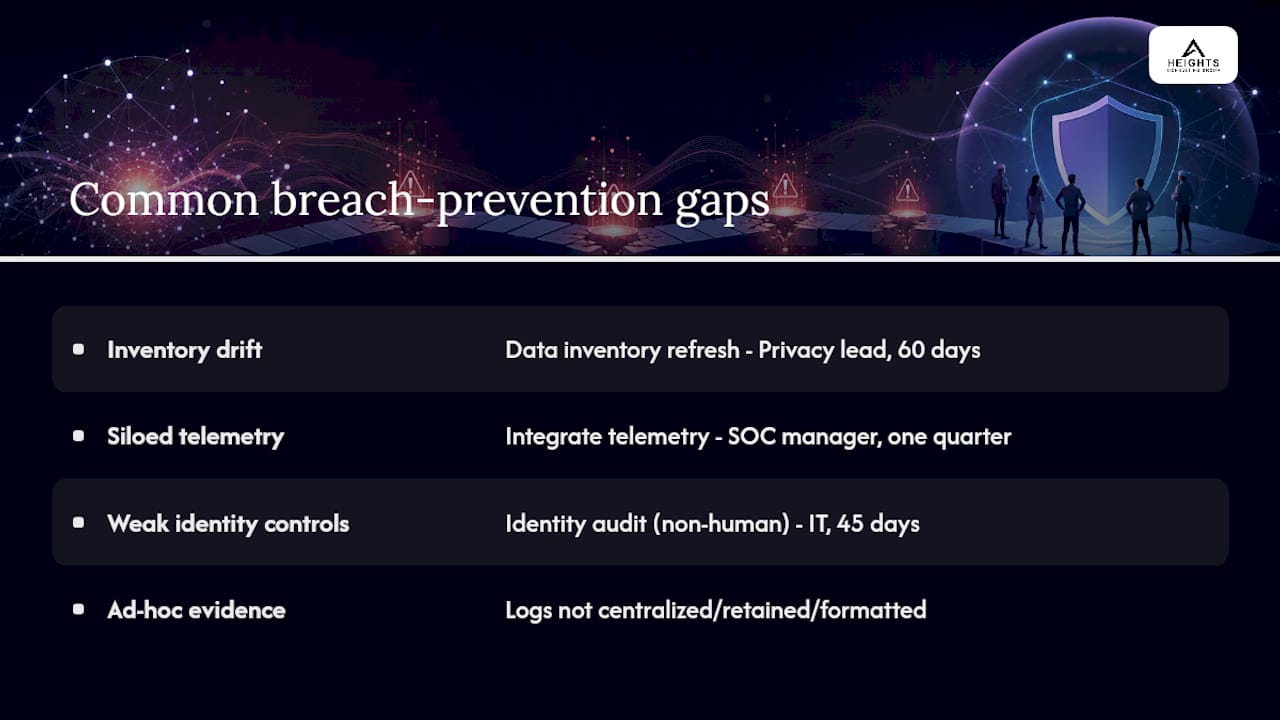
Most breach prevention workflows fail quietly, long before an incident exposes them. In our experience advising security teams across regulated industries, the same handful of gaps show up repeatedly, and they rarely show up in the tools an organization already owns.
Inventory drift tops the list. A data inventory built during a compliance push two years ago rarely reflects the SaaS tools, shadow AI integrations, and new data flows a business has added since. Every incident response effort that starts with "wait, where does this data actually live" traces back to this gap.
Siloed telemetry comes next. Organizations often own strong individual tools, a capable EDR platform, a functioning identity provider, without the integration work that lets those tools talk to each other. The result is a security team that can see pieces of an attack but not the full picture until damage is already done.
Weak identity controls persist even in programs that consider themselves mature, particularly around service accounts and third-party integrations that never made it into the MFA rollout everyone assumes is complete. Ad-hoc evidence collection rounds out the pattern: logs exist, but they aren't centralized, retained long enough, or formatted in a way that supports a fast forensic timeline when it matters.
Closing these gaps doesn't require a rebuilt security program. It requires assigning an owner and a deadline to each one: a data inventory refresh owned by the privacy lead within 60 days, a telemetry integration project owned by the SOC manager within one quarter, an identity audit covering every non-human account owned by IT within 45 days. The single most useful thing a security leader can do this quarter is put the pre-breach and detect-respond-recover tracks on your governance calendar as standing agenda items, reviewed with the same rigor as a budget line, not as an annual audit checkbox.
How a Cybersecurity Partner Accelerates This Workflow
Building the two-track workflow described here takes real engineering time, and most internal security teams are already stretched across daily operations, vendor management, and the next audit cycle. A partner who specializes in continuous validation, SOC uplift, and incident response runbook development can compress a 12-to-18-month internal roadmap into a matter of months, particularly when it comes to integrating detection tools that were bought separately and never fully connected.
When evaluating a cybersecurity consulting partner, look for evidence-first testing practices rather than checkbox assessments, cross-functional integration experience that spans your identity, endpoint, and cloud environments, and a track record with the compliance frameworks that actually apply to your sector, whether that's NIST, CMMC, SOC 2, or GLBA.
Heightscg builds and operationalizes exactly this kind of workflow for organizations in regulated industries, turning a POA&M from a static document into a living operational tool tied to real evidence. If your team needs tactical help translating this workflow into your specific environment, from SOC uplift to incident response runbook implementation, our technical cybersecurity consulting services are built to close exactly the gaps outlined above. Reach out to Heightscg to walk through where your current workflow stands and what a phased implementation plan would look like for your organization.