

TL;DR:
- Cybersecurity maturity models provide structured frameworks for organizations to assess and improve their security capabilities on a continuous spectrum. They enable risk-based resource allocation, strengthen security culture, and help manage AI-related governance and threat challenges. Implementing these models starts with honest current-state assessments, prioritized roadmaps, and ongoing cycle reassessments, especially as AI introduces new complexity.
A cybersecurity maturity model is a structured framework that defines progressive levels of security capability, enabling organizations to benchmark their current defenses and build toward measurable, risk-aligned improvement. Unlike a one-time audit or compliance checklist, maturity models treat security as a continuous growth process. Three frameworks dominate this space in 2026: CMMC 2.0 (Cybersecurity Maturity Model Certification), NIST CSF 2.0, and the DOE's C2M2. Each serves a distinct purpose, but all share the same core logic: security effectiveness is not binary. It exists on a spectrum, and organizations that understand where they stand can allocate resources, manage risk, and communicate with boards far more effectively than those chasing point-in-time certifications. As AI-driven threats introduce new governance gaps, maturity models have become the most practical tool available for translating security complexity into executive-level strategy.
What is a cybersecurity maturity model and how does it work?
A cybersecurity maturity model defines stages of security capability from ad hoc and reactive to fully optimized and continuously improving. The concept originates from the Capability Maturity Model Integration (CMMI) developed at Carnegie Mellon University, which was later adapted for cybersecurity contexts. The core mechanism is straightforward: an organization assesses its current security practices against a defined set of controls or functions, identifies gaps, and builds a prioritized roadmap toward a target maturity level.

Maturity models measure how thoroughly security is embedded in organizational operations, not just whether a policy document exists. This distinction matters enormously for CISOs and security leaders. A firewall policy written in 2019 and never reviewed does not represent mature security. A firewall policy that is reviewed quarterly, tested against threat intelligence, and updated based on incident data does.
The levels of cybersecurity maturity typically range from Level 1 (basic, foundational practices) through Level 3 or higher (advanced, adaptive, and continuously optimized). CMMC 2.0 uses three levels. NIST CSF 2.0 uses four implementation tiers. C2M2 uses four Maturity Indicator Levels (MILs). The labels differ, but the progression logic is consistent across all major frameworks.
What are the leading cybersecurity maturity models and how do they compare?
Three frameworks define the current standard for maturity assessment in cybersecurity. Understanding their differences allows organizations to select the right model for their regulatory context, sector, and risk profile.
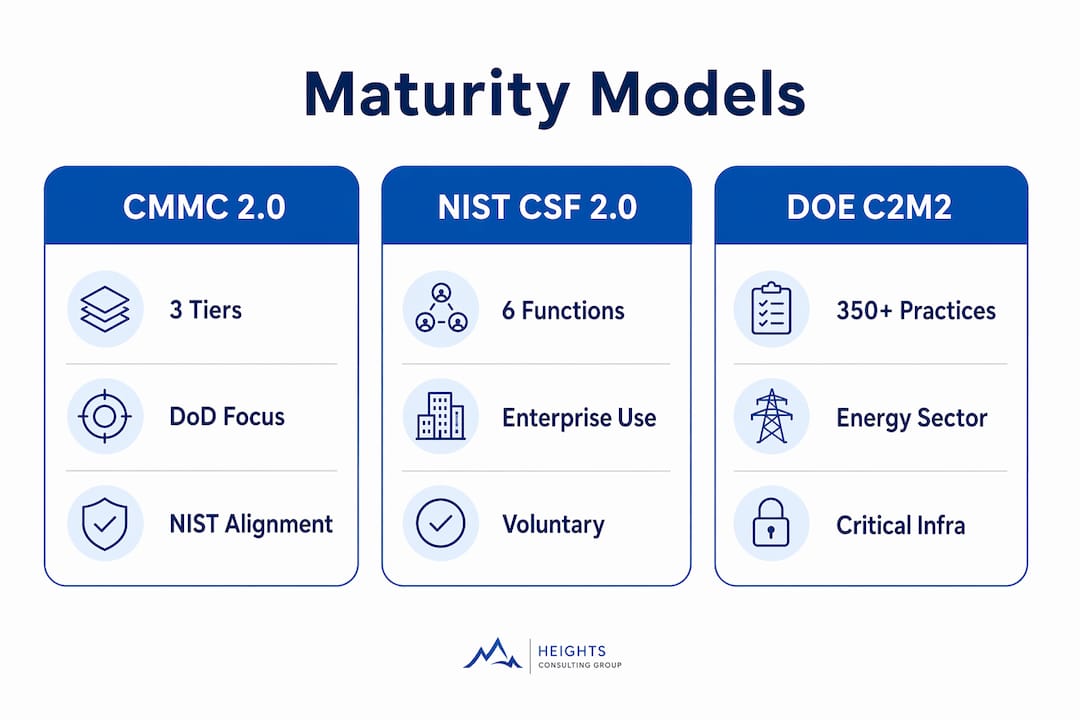
CMMC 2.0
CMMC 2.0 aligns its three certification levels directly with NIST standards, simplifying the original five-level structure that many DoD contractors found difficult to implement. Level 1 covers 17 basic safeguarding practices. Level 2 maps to NIST SP 800-171's 110 practices. Level 3 adds controls from NIST SP 800-172 for organizations handling the most sensitive Controlled Unclassified Information (CUI). CMMC 2.0 is mandatory for organizations in the Defense Industrial Base (DIB), making it a compliance requirement rather than a voluntary framework. For a detailed breakdown of CMMC requirements, the CMMC compliance guide at Heightscg provides practical context on certification pathways.
NIST CSF 2.0
NIST CSF 2.0 organizes cybersecurity activities into six core functions: Govern, Identify, Protect, Detect, Respond, and Recover. The addition of the Govern function in version 2.0 signals a deliberate shift toward treating cybersecurity as an organizational governance priority, not just a technical discipline. CSF 2.0 broadens scope beyond critical infrastructure to any organization regardless of size, and it explicitly addresses supply chain risk management. This makes it the most universally applicable framework available today.
DOE C2M2
The Department of Energy's C2M2 is built for critical infrastructure sectors, particularly energy. C2M2 uses over 350 practices across 10 domains, providing sector-specific maturity guidance that general frameworks cannot match. Its depth makes it the preferred choice for utilities, oil and gas operators, and grid operators who face nation-state level threats.
| Framework | Levels | Primary Audience | Scope |
|---|---|---|---|
| CMMC 2.0 | 3 tiers | DoD contractors | Defense Industrial Base |
| NIST CSF 2.0 | 4 implementation tiers | All organizations | Universal, supply chain included |
| DOE C2M2 | 4 MILs | Critical infrastructure | Energy, utilities, OT environments |
Pro Tip: If your organization operates in multiple regulated sectors, map NIST CSF 2.0 as your baseline framework and layer CMMC 2.0 or C2M2 requirements on top. This avoids duplicating assessment work across separate compliance programs.
How do maturity models improve security posture and risk management?
Maturity models serve as strategic instruments that give CISOs a common risk language and support budget prioritization in board-level discussions. This is the benefit that separates mature security programs from reactive ones. When a CISO can show the board a current maturity score, a target state, and the specific investment required to close the gap, cybersecurity stops being an abstract cost center and becomes a measurable business priority.
The benefits of cybersecurity maturity extend well beyond compliance reporting. Organizations that use maturity models as growth frameworks rather than pass/fail scores gain several concrete advantages:
- Risk prioritization: Controls are sequenced by impact and likelihood, not alphabetical order or vendor preference.
- Budget alignment: Maturity gaps translate directly into investment cases that finance teams and boards can evaluate.
- Security culture: Repeated assessment cycles create organizational habits around documentation, testing, and improvement.
- Governance integration: Maturity data feeds directly into enterprise risk management (ERM) programs and board reporting.
- Vendor and supply chain oversight: Maturity assessments extend to third-party risk, a growing requirement under NIST CSF 2.0.
"Compliance assesses meeting standards, but maturity models measure how thoroughly security is embedded in organizational operations." — Trustmapp, What is Cybersecurity Maturity Model?
This distinction is especially relevant for organizations deploying AI systems. An AI model processing sensitive customer data may pass a compliance audit while still operating without documented ownership, access controls, or incident response procedures. A maturity assessment would surface those gaps. Aligning your cybersecurity with business objectives requires exactly this kind of structured visibility into where controls exist in practice versus on paper.
Organizations must build a culture of continuous security improvement for a maturity score to reflect genuine resilience rather than surface compliance. A score achieved through a one-time documentation sprint will degrade within months if the underlying behaviors do not change.
What are the practical steps to implement a cybersecurity maturity assessment?
Implementing a maturity model begins with an honest current-state assessment, not with selecting a target level. Organizations that skip this step and aim directly for a desired certification level consistently encounter failed audits and operational friction. A phased approach prioritizing controls based on organization-specific risk profiles produces better outcomes than attempting immediate universal adoption.
The following sequence reflects how effective implementations are structured:
- Define scope and framework. Select the maturity model that aligns with your regulatory obligations and sector. A DoD contractor starts with CMMC 2.0. A healthcare organization with no defense contracts may find NIST CSF 2.0 more appropriate.
- Conduct a current-state assessment. Document existing controls, policies, and practices against the framework's requirements. Use the maturity assessment guide at Heightscg as a reference for structuring gap analysis.
- Establish a target profile. Define the maturity level your organization needs to achieve based on risk appetite, regulatory requirements, and business objectives. This is not always the highest level available.
- Perform gap analysis. Map the distance between current and target states. Quantify gaps in terms of missing controls, undocumented processes, and resource deficiencies.
- Build a prioritized roadmap. Sequence remediation activities by risk impact. Address controls that protect the most sensitive assets or carry the highest regulatory exposure first.
- Assign governance ownership. Each control domain needs a named owner at the leadership level. Maturity improvements without executive accountability stall.
- Reassess on a defined cycle. Annual assessments are a minimum. Organizations facing active threat environments or regulatory changes should reassess more frequently.
Pro Tip: Set realistic timelines before presenting the roadmap to leadership. Moving from Level 1 to Level 2 in CMMC 2.0 typically requires 12 to 18 months for mid-size organizations. Overpromising accelerates burnout and produces documentation-only compliance rather than operational change.
Governance involvement at every stage is non-negotiable. Successful implementation requires prioritizing high-impact controls aligned with an organization's unique risk profile. When security leaders present maturity roadmaps as risk reduction investments rather than IT projects, executive buy-in follows more reliably.
How is AI changing the demands placed on cybersecurity maturity models?
AI adoption is creating security and governance gaps that traditional maturity frameworks were not designed to address. Organizations deploying large language models (LLMs), automated decision systems, or AI-assisted security tools face a new category of risk: systems that operate at scale, make consequential decisions, and often lack clear ownership or audit trails. Maturity models must now account for these realities.
The specific AI-related challenges that maturity assessments need to address include:
- Model governance gaps: Many organizations cannot identify who owns an AI system, what data it was trained on, or how its outputs are validated. This is a maturity failure at the governance level.
- Adversarial AI threats: Attackers use AI to generate phishing content, automate vulnerability scanning, and evade detection tools. Organizations at lower maturity levels lack the detection and response capabilities to counter these techniques.
- Data pipeline security: AI systems depend on large, often sensitive datasets. Immature data classification and access control practices create exposure that compounds as AI usage scales.
- Regulatory exposure: The EU AI Act and emerging U.S. federal AI guidance are creating compliance obligations that intersect directly with cybersecurity controls. Organizations without a mature governance function will struggle to demonstrate compliance.
- Third-party AI risk: Vendors embedding AI into SaaS products introduce new supply chain risks. NIST CSF 2.0's emphasis on supply chain risk management is directly relevant here.
Maturity models have evolved into strategic tools that enable security leaders to communicate AI-related risks and priorities to executive boards. The organizations that will manage AI risk effectively are those that treat it as a maturity domain, not a one-time risk assessment. Incorporating AI governance into your maturity roadmap now, before regulatory pressure forces it, is the decision that separates proactive security programs from reactive ones.
Key takeaways
A cybersecurity maturity model is the most effective tool available for translating security complexity into measurable, board-ready risk strategy, and its value multiplies when applied to emerging AI governance challenges.
| Point | Details |
|---|---|
| Maturity vs. compliance | Maturity models measure how deeply security is embedded in operations, not just whether policies exist. |
| Framework selection matters | CMMC 2.0 serves DoD contractors, NIST CSF 2.0 fits all organizations, and C2M2 targets critical infrastructure. |
| Phased implementation wins | Prioritize controls by risk impact rather than attempting full adoption at once to avoid audit failures. |
| AI governance is a maturity domain | Organizations must incorporate AI risk controls into maturity assessments to address governance gaps. |
| Culture drives real scores | Maturity improvements require behavioral change across the organization, not just documentation updates. |
Why maturity models are more than a compliance exercise
I have worked with organizations across defense, healthcare, and financial services, and the pattern is consistent: teams that treat maturity models as compliance checkboxes get compliance scores. Teams that treat them as strategic instruments get security programs that actually reduce risk.
The most common mistake I see is selecting a target maturity level based on what a contract or auditor requires, then reverse-engineering documentation to hit that number. The score looks right. The controls do not exist in practice. The next incident exposes the gap, and the organization is worse off than if it had never run the assessment at all.
What works is starting with an honest current-state picture, even when that picture is uncomfortable. A Level 1 organization that knows it is at Level 1 can build a credible roadmap. A Level 1 organization that has papered its way to a Level 2 score is operating on false confidence.
The AI dimension makes this more urgent, not less. I have seen organizations pass NIST CSF assessments while running AI tools with no documented ownership, no data governance, and no incident response plan specific to AI failures. That is a maturity gap that will surface as a regulatory or operational crisis. The frameworks exist to find it before it finds you.
— Dan
How Heightscg supports your cybersecurity maturity journey
Heightscg works with organizations across regulated industries to conduct structured maturity assessments, build prioritized remediation roadmaps, and align security programs with business objectives and compliance requirements.

Whether your organization is preparing for CMMC 2.0 certification, adopting NIST CSF 2.0 as an enterprise baseline, or addressing AI governance gaps that existing frameworks do not yet fully cover, Heightscg provides the technical depth and strategic guidance to move from assessment to execution. The team specializes in translating maturity scores into investment decisions that boards understand and security teams can act on. To discuss where your organization stands and what a realistic improvement roadmap looks like, contact Heightscg directly.
FAQ
What is a cybersecurity maturity model?
A cybersecurity maturity model is a framework that defines progressive levels of security capability, allowing organizations to assess their current practices, identify gaps, and build a structured improvement roadmap. It measures how deeply security controls are embedded in operations, not just whether they are documented.
How does CMMC 2.0 differ from NIST CSF 2.0?
CMMC 2.0 is a mandatory certification framework with three levels specifically for DoD contractors handling federal contract information or CUI. NIST CSF 2.0 is a voluntary framework applicable to any organization, organized around six core functions including the newly added Govern function.
How many levels does a cybersecurity maturity model typically have?
Most frameworks use three to five levels. CMMC 2.0 uses three tiers, NIST CSF 2.0 uses four implementation tiers, and C2M2 uses four Maturity Indicator Levels. The number of levels matters less than the clarity of the criteria defining each one.
How should organizations start a maturity assessment?
Organizations should begin by selecting the framework that aligns with their regulatory obligations, then conducting an honest current-state assessment before defining a target maturity level. Skipping the current-state step and targeting a desired level directly leads to documentation-only compliance rather than genuine security improvement.
How do AI risks fit into cybersecurity maturity models?
AI introduces governance gaps, adversarial threats, and data pipeline risks that must be incorporated into maturity assessments. NIST CSF 2.0's Govern function and supply chain risk management components provide the most direct entry points for mapping AI-specific controls within an existing maturity framework.