

Every executive understands how quickly a security lapse can disrupt patient care or cost trust built over years. In the face of sophisticated threats targeting American healthcare, cybersecurity has shifted from an IT function to a core element of strategic resilience and market leadership. This article highlights how cybersecurity strategy protects critical operations, addresses compliance, and creates lasting competitive advantage for organizations prepared to lead in an era where security and business outcomes are inseparable.
Table of Contents
- Defining Cybersecurity's Business Strategy Role
- Types of Cyber Risks Facing Healthcare Leaders
- Integrating Cybersecurity With Strategic Objectives
- Regulatory Compliance and Governance Requirements
- Managing Third-Party and Emerging Technology Risks
- Turning Cyber Risk Into Competitive Advantage
Key Takeaways
| Point | Details |
|---|---|
| Cybersecurity as Strategy | Cybersecurity is essential for business success, driving competitive advantage and operational effectiveness rather than being merely a cost center. |
| Emerging Threats in Healthcare | Healthcare organizations face sophisticated cyber threats that jeopardize patient safety and operational integrity, necessitating advanced defensive measures. |
| Regulatory Compliance Imperatives | Adhering to evolving cybersecurity regulations is crucial for organizations to maintain accountability and resilience against cyber attacks. |
| Transforming Risks into Opportunities | Companies can turn cybersecurity risks into competitive advantages by implementing robust security practices and viewing them as integral to business strategy. |
Defining Cybersecurity's Business Strategy Role
Cybersecurity is no longer a siloed technical function but a critical strategic imperative that directly impacts business performance and organizational resilience. Modern enterprises recognize that cybersecurity strategy represents a fundamental business capability, not just an IT responsibility. The role of cybersecurity has dramatically transformed from a defensive technical practice to a proactive business enabler that drives competitive advantage and operational effectiveness.
The National Cybersecurity Strategy highlights a critical paradigm shift, emphasizing that cybersecurity is essential to economic functioning, critical infrastructure, and national defense. By shifting cybersecurity responsibility towards organizations best positioned to manage risks, businesses can develop more comprehensive and strategic security approaches. This evolution demands that executives view cybersecurity not as a cost center, but as a strategic investment with measurable business outcomes.
Key strategic dimensions of cybersecurity's business role include:
- Protecting organizational assets and intellectual property
- Enabling secure digital transformation
- Maintaining customer trust and brand reputation
- Ensuring regulatory compliance
- Supporting business innovation and growth strategies
The Cybersecurity and Infrastructure Security Agency (CISA) reinforces this perspective through its strategic vision, which emphasizes creating resilient systems where cyber intrusions become rare and organizations can effectively mitigate potential threats. This approach transforms cybersecurity from a reactive defensive mechanism to a proactive business strategy that anticipates and neutralizes potential risks before they impact operations.
To better understand how cybersecurity drives business value, see this breakdown of its roles and strategic business outcomes:
| Cybersecurity Function | Business Value Created | Example Outcome |
|---|---|---|
| Asset and IP Protection | Reduces financial loss and theft | Fewer data breach incidents |
| Secure Digital Transformation | Enables safe tech adoption | Faster cloud migration |
| Customer Trust Preservation | Maintains reputation and loyalty | Higher customer retention |
| Regulatory Alignment | Avoids legal risks and penalties | Positive audit findings |
| Innovation Enablement | Supports new service launches | Expansion into new markets |
Pro tip: Develop a cross-functional cybersecurity strategy that aligns technical capabilities with broader business objectives, ensuring security investments directly contribute to organizational performance and competitive advantage.
Types of Cyber Risks Facing Healthcare Leaders
Healthcare organizations face an increasingly complex and sophisticated landscape of cybersecurity threats that can critically compromise patient safety, operational continuity, and organizational integrity. Modern healthcare systems are particularly vulnerable due to their interconnected digital infrastructure, sensitive data repositories, and mission-critical technology environments that support patient care and administrative functions.
The American Hospital Association highlights the growing prevalence of sophisticated social engineering attacks targeting healthcare organizations. These complex cyber risks encompass multiple strategic threat categories:
- Ransomware attacks designed to encrypt critical patient care systems
- Social engineering tactics targeting help desk employees
- Fraudulent payment diversion schemes
- Phishing campaigns exploiting healthcare worker credentials
- Advanced persistent threats (APTs) targeting medical research data
- Unauthorized access to electronic health records (EHR)
- Medical device and IoT system vulnerabilities
The U.S. Department of Health and Human Services recognizes the escalating cyber threat landscape, proposing updated HIPAA Security Rules to enhance cybersecurity protections for health information systems. These proposed regulations reflect the increasing frequency and sophistication of ransomware, hacking attempts, and data breach incidents that can directly impact patient safety and organizational resilience.
The table below compares common healthcare cyber threats with their unique consequences and targeted assets:
| Cyber Threat Type | Main Target Asset | Unique Impact on Healthcare |
|---|---|---|
| Ransomware | Clinical IT systems | Disrupted patient care operations |
| Social Engineering | Help desk credentials | Unauthorized access, identity compromise |
| Payment Diversion Fraud | Financial processing | Direct financial loss, billing disruptions |
| Phishing | Staff login credentials | Large-scale data exposure risk |
| APTs | Medical research databases | Stolen intellectual property, data leakage |
Pro tip: Implement a comprehensive cyber risk assessment framework that continuously monitors threat landscapes, evaluates organizational vulnerabilities, and develops adaptive response strategies specific to healthcare technology ecosystems.
Integrating Cybersecurity With Strategic Objectives
Successful cybersecurity integration requires more than technical implementations - it demands a holistic approach that aligns security initiatives directly with core business objectives and strategic vision. Strategic cybersecurity alignment transforms security from a cost center into a competitive advantage, enabling organizations to proactively manage risks while supporting broader organizational goals.
The National Cybersecurity Strategy emphasizes collaboration between government and private sectors to embed cybersecurity as a fundamental strategic component. This integration involves several critical dimensions:
- Establishing clear communication between security and business leadership
- Developing risk management frameworks tied to organizational objectives
- Creating metrics that demonstrate security's business value
- Aligning security investments with strategic growth priorities
- Enabling technological innovation through robust security architectures
- Protecting intellectual property and competitive advantages
- Supporting regulatory compliance and stakeholder trust
CISA's strategic approach further reinforces this perspective by emphasizing proactive risk reduction and operational collaboration. Organizations must view cybersecurity not as a standalone technical function, but as an interconnected strategic capability that directly influences operational resilience, competitive positioning, and long-term organizational sustainability.
Pro tip: Develop a cross-functional cybersecurity governance model that includes representatives from IT, business strategy, legal, and executive leadership to ensure comprehensive strategic alignment and shared accountability.
Regulatory Compliance and Governance Requirements
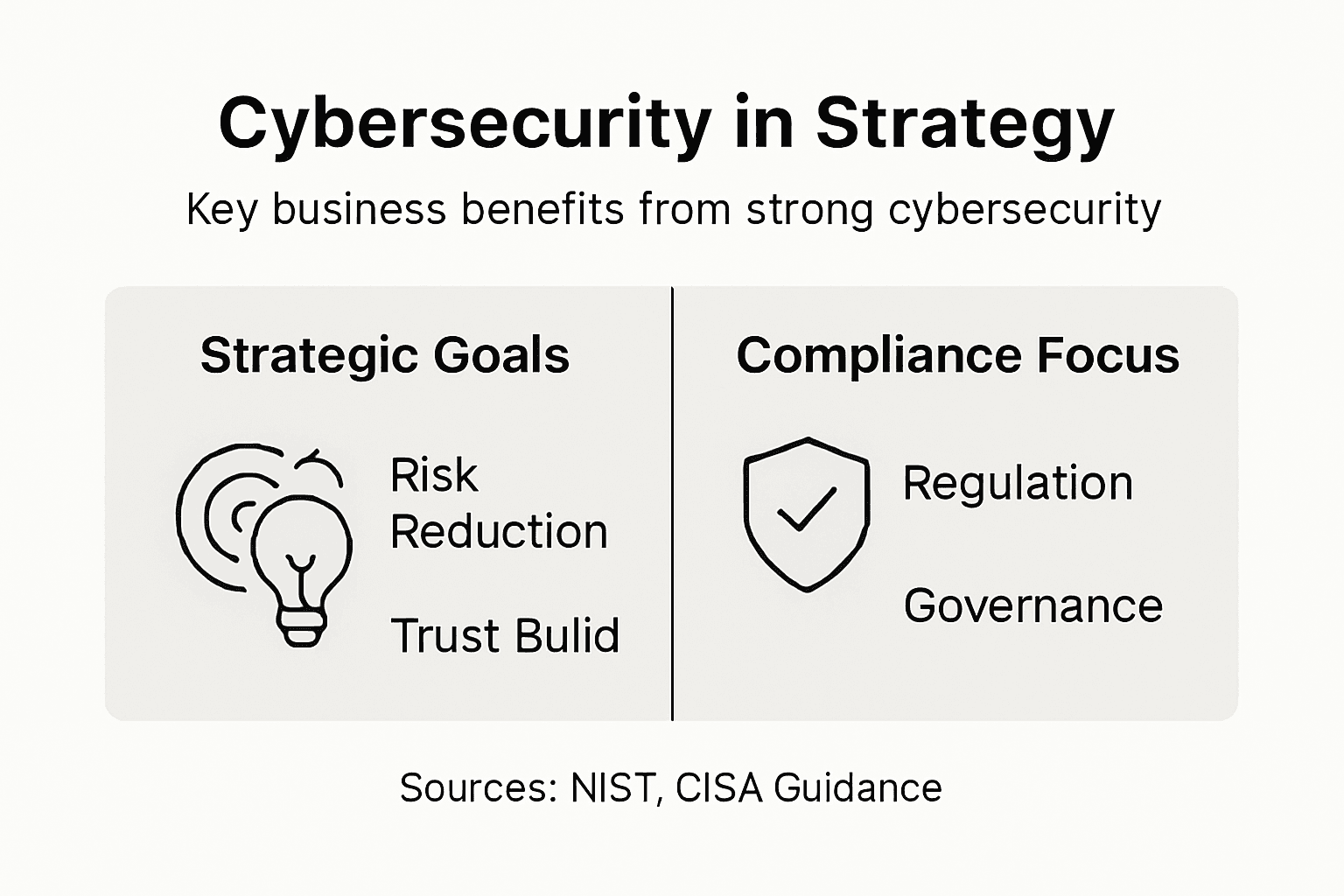
Navigating the complex landscape of cybersecurity regulatory compliance has become a critical strategic imperative for modern organizations. The evolving regulatory environment demands sophisticated governance frameworks that integrate technical safeguards, risk management protocols, and comprehensive reporting mechanisms to demonstrate organizational resilience and accountability.
The Securities and Exchange Commission (SEC) has established mandatory cybersecurity disclosure rules that fundamentally transform how public companies approach cyber governance. These regulations require organizations to:
- Promptly report material cybersecurity incidents
- Describe detailed risk management processes
- Outline specific board and executive leadership cyber oversight responsibilities
- Provide transparent disclosures about cybersecurity strategies
- Demonstrate proactive threat management capabilities
- Establish clear incident response protocols
- Maintain comprehensive documentation of governance practices
NIST provides critical guidance by developing cybersecurity and privacy standards that serve as foundational frameworks for regulatory compliance across industries. These frameworks offer organizations structured approaches to managing cybersecurity risks, ensuring that governance models remain adaptive and responsive to emerging technological and threat landscapes.
Pro tip: Create a cross-functional governance committee with representation from legal, IT, risk management, and executive leadership to develop an integrated approach to regulatory compliance and cybersecurity strategy.
Managing Third-Party and Emerging Technology Risks
Modern organizations face increasingly complex cybersecurity challenges that extend far beyond traditional internal network defenses. The rapid adoption of third-party technologies and emerging digital solutions has dramatically expanded the potential attack surface, requiring sophisticated risk management strategies that comprehensively address vendor ecosystems and technological innovations.
Education and research institutions highlight the critical importance of third-party risk management programs that systematically evaluate external technological dependencies. These comprehensive approaches involve:
- Conducting thorough vendor risk assessments
- Inventorying all third-party technology relationships
- Prioritizing risks based on potential exposure
- Implementing continuous monitoring protocols
- Establishing clear vendor security requirements
- Creating incident response mechanisms for third-party breaches
- Developing contractual security compliance standards
Emerging cyber risks from technological advancements demand proactive and adaptive defense strategies. MIT Sloan research emphasizes the growing complexity of cybersecurity risks in vendor supply chains, including cloud misconfigurations, sophisticated ransomware techniques, and increasingly intricate attack methodologies that target interconnected technological ecosystems.

Pro tip: Develop a dynamic third-party risk assessment framework that incorporates continuous evaluation, real-time threat intelligence, and adaptive security controls to manage emerging technological risks effectively.
Turning Cyber Risk Into Competitive Advantage
Transforming cybersecurity risks from potential vulnerabilities into strategic business opportunities requires a fundamental shift in organizational perspective. Modern enterprises are increasingly recognizing that robust cyber defense mechanisms can become powerful differentiators in competitive markets, driving innovation, building stakeholder trust, and creating sustainable business value.
The National Cybersecurity Strategy encourages private sector companies to take greater responsibility for cybersecurity, positioning cyber risk management as a mechanism for enhancing market competitiveness. Key strategies for turning cyber risk into a competitive advantage include:
- Developing transparent and proactive security practices
- Investing in advanced threat detection capabilities
- Creating comprehensive incident response frameworks
- Demonstrating regulatory compliance excellence
- Building customer confidence through robust security postures
- Leveraging cybersecurity as a brand differentiation strategy
- Implementing continuous security improvement processes
The Biden Administration's cybersecurity approach emphasizes that strategic cyber investments are not merely defensive measures, but critical drivers of economic strength. Organizations that view cybersecurity as a strategic asset rather than a compliance burden can unlock significant competitive advantages, including enhanced customer trust, reduced operational risks, and improved market positioning.
Pro tip: Develop a metrics-driven cybersecurity strategy that quantifies security investments' direct impact on business performance, enabling leadership to view cyber risk management as a strategic business enabler.
Transform Cybersecurity Into Your Strongest Business Asset Today
The article highlights how vital it is for organizations to move beyond viewing cybersecurity as just a technical necessity. Modern businesses face challenges like aligning cybersecurity with strategic objectives, managing regulatory compliance, and addressing evolving cyber risks. Pain points such as protecting critical assets, maintaining customer trust, and turning cyber risk into competitive advantage are at the forefront of executive concerns.
At Heights Consulting Group, we specialize in helping C-level executives and security leaders bridge these exact gaps. We focus on integrating cybersecurity strategies with broader business goals to create real value, minimize risks, and ensure compliance with frameworks such as NIST and SOC 2. Our comprehensive services include managed cybersecurity, incident response, and advanced threat hunting tailored to highly regulated industries and complex IT environments.
Don't wait until cyber threats impact your business performance or reputation. Partner with Heights Consulting Group to transform your cybersecurity from a cost center into a strategic growth driver. Explore how our strategic cybersecurity services align with your business priorities and safeguard your future. Visit us now at https://heightscg.com and take the first step toward securing your organization's success.
Frequently Asked Questions
What is the role of cybersecurity in business strategy?
Cybersecurity is a critical strategic imperative that protects organizational assets, enables secure digital transformation, maintains customer trust, ensures regulatory compliance, and supports innovation and growth strategies.
How can businesses view cybersecurity as a strategic investment?
Businesses can view cybersecurity as a strategic investment by understanding its measurable business outcomes, such as reducing financial losses, maintaining brand reputation, and ensuring compliance with regulations, thereby enhancing overall business performance.
What types of cyber risks do healthcare organizations face?
Healthcare organizations face numerous cyber risks, including ransomware attacks, social engineering schemes, unauthorized access to electronic health records, and vulnerabilities in medical devices and IoT systems, which can significantly impact patient safety and operational continuity.
How can organizations turn cyber risks into competitive advantages?
Organizations can turn cyber risks into competitive advantages by developing transparent security practices, investing in advanced threat detection, demonstrating regulatory compliance, and using cybersecurity as a brand differentiation strategy to build customer trust.