

Nearly every American financial institution faces a cybersecurity attack attempt each week, underscoring the relentless pressure on CISOs and IT security managers to defend critical assets. The complexity of modern cyber threats, combined with strict United States regulations, means even a minor lapse can lead to major damage or steep penalties. This overview explains how to identify, measure, and effectively reduce digital risks while meeting demanding regulatory standards.
Table of Contents
- Defining Cyber Risk In Financial Services
- Major Categories Of Financial Sector Cyber Threats
- Current Attack Methods And Risk Exposure
- U.S. Regulatory And Compliance Landscape
- Institutional Responsibilities And Incident Response
- Strategic Mitigation, Emerging Technologies, And Common Pitfalls
Key Takeaways
| Point | Details |
|---|---|
| Understanding Cyber Risk | Financial institutions must adopt comprehensive frameworks to identify and mitigate potential digital threats affecting their operations and reputations. |
| Emerging Cyber Threats | Institutions face various cyber threats, including ransomware and phishing, necessitating robust employee training and continuous threat monitoring. |
| Regulatory Compliance | Adhering to evolving U.S. cybersecurity regulations requires proactive risk management and incident reporting strategies. |
| Incident Response Preparedness | Developing a detailed incident response plan and conducting regular training can enhance an organization's readiness to address cyber incidents. |
Defining Cyber Risk in Financial Services
Cyber risk in financial services represents the potential for financial, operational, and reputational damage stemming from digital vulnerabilities and malicious cyber activities. Unlike traditional risk management approaches, cyber risk specifically focuses on the complex threats targeting an organization's digital infrastructure, data assets, and technological ecosystem.
Financial institutions face unique cyber risk challenges due to their critical role in managing sensitive financial data and maintaining complex technological networks. Comprehensive cyber risk management frameworks have emerged as essential strategies to identify, assess, and mitigate potential digital threats. These frameworks help organizations understand their specific vulnerabilities, quantify potential impacts, and develop proactive defense mechanisms.
The core components of cyber risk in financial services typically include:
- Potential financial losses from cybersecurity breaches
- Reputational damage from data compromises
- Regulatory compliance violations
- Operational disruptions caused by cyber incidents
- Intellectual property theft
- Customer trust erosion
Understanding cyber risk requires a multifaceted approach that combines technological assessment, threat intelligence, and strategic risk management. Cybersecurity risk assessment practices enable financial institutions to systematically evaluate their digital ecosystem, identifying potential weaknesses and developing targeted mitigation strategies.
Pro tip: Implement continuous monitoring and regular cybersecurity assessments to stay ahead of evolving digital threats and maintain robust organizational resilience.
Major Categories of Financial Sector Cyber Threats
Financial institutions face a complex and rapidly evolving landscape of cyber threats that target their critical digital infrastructure, financial systems, and sensitive data repositories. Major cyber threat categories encompass sophisticated attack vectors designed to exploit technological vulnerabilities and organizational weaknesses.
The primary cyber threat categories impacting financial services include:
- Ransomware Attacks: Malicious software that encrypts institutional data and demands financial payment for restoration
- Social Engineering: Sophisticated psychological manipulation techniques targeting human vulnerabilities
- Phishing Campaigns: Deceptive digital communications attempting to steal credentials and sensitive information
- Denial-of-Service (DoS) Attacks: Systematic efforts to overwhelm digital infrastructure and disrupt operational capabilities
- Corporate Account Takeover: Unauthorized access and control of financial institutional accounts
- Third-Party Vendor Risks: Exploitation of vulnerabilities within interconnected technological ecosystems
These cyber threats represent complex and dynamic challenges that require comprehensive cybersecurity hygiene practices to mitigate effectively. Financial institutions must develop robust, proactive strategies that combine technological defenses, employee training, and continuous threat monitoring to protect against these evolving digital risks.
Geopolitical tensions and emerging technologies like artificial intelligence are further complicating the cyber threat landscape, introducing more sophisticated and unpredictable attack methodologies. Cybercriminals increasingly leverage advanced techniques such as AI-enhanced malware and machine learning algorithms to circumvent traditional security protocols, making continuous adaptation and advanced threat intelligence critical for financial sector resilience.
Pro tip: Develop a comprehensive, multilayered cybersecurity strategy that integrates technological solutions, human awareness training, and adaptive threat intelligence to effectively mitigate complex financial sector cyber risks.
Current Attack Methods and Risk Exposure
Financial institutions are confronting an increasingly sophisticated and dynamic landscape of cyber attack methodologies that threaten their operational integrity and financial stability. Current attack methods represent a complex ecosystem of technological vulnerabilities and strategic exploitation techniques designed to compromise institutional defenses.
The primary attack methods targeting financial services include:
- Sophisticated Phishing: Advanced social engineering techniques mimicking legitimate communications
- Ransomware Campaigns: Targeted encryption attacks demanding financial compensation
- Supply Chain Exploits: Systematic infiltration through interconnected vendor networks
- Denial-of-Service Attacks: Overwhelming institutional digital infrastructure
- Advanced Persistent Threats (APTs): Long-term, covert network infiltration strategies
- Credential Theft: Unauthorized access through stolen authentication credentials
Modern cybercriminals are increasingly leveraging artificial intelligence and machine learning to develop more nuanced and adaptive attack strategies. Cyber threat detection has become exponentially more complex, requiring financial institutions to implement sophisticated, multi-layered defense mechanisms that can anticipate and neutralize emerging threats in real-time.

Risk exposure extends beyond immediate financial losses, encompassing reputational damage, regulatory penalties, and potential systemic disruptions to the broader financial ecosystem. Institutions must develop comprehensive risk assessment frameworks that continuously evaluate technological vulnerabilities, employee preparedness, and potential attack vectors to maintain robust defensive capabilities.
Pro tip: Implement a proactive, intelligence-driven cybersecurity strategy that integrates continuous threat monitoring, adaptive defense mechanisms, and comprehensive employee training to mitigate evolving financial sector cyber risks.
U.S. Regulatory and Compliance Landscape
The United States has developed a comprehensive and increasingly sophisticated regulatory framework to address the complex cybersecurity challenges facing financial institutions. Regulatory landscape strategies have evolved to create a multi-layered approach that emphasizes proactive risk management, robust incident reporting, and coordinated federal oversight.
Key federal agencies play critical roles in cybersecurity regulation for financial services:
Here's a summary of U.S. financial cybersecurity agencies and the focus of their regulations:
| Agency | Key Cybersecurity Role | Regulatory Focus |
|---|---|---|
| SEC | Oversees disclosures | Risk management and reporting |
| FDIC | Monitors banking standards | Protection and recovery protocols |
| OCC | Creates bank guidelines | Operational infrastructure controls |
| CFPB | Safeguards consumer data | Privacy and data protection rules |
- Securities and Exchange Commission (SEC): Mandates cybersecurity disclosure and risk management practices
- Federal Deposit Insurance Corporation (FDIC): Oversees cybersecurity standards for banking institutions
- Office of the Comptroller of the Currency (OCC): Establishes cybersecurity guidelines for national banks
- Consumer Financial Protection Bureau (CFPB): Ensures consumer data protection and privacy
The regulatory framework has become increasingly stringent, particularly in response to high-profile cyber incidents. Cybersecurity legal developments now require financial institutions to implement comprehensive risk management protocols, including mandatory incident reporting, rigorous third-party vendor assessments, and adherence to established cybersecurity frameworks like the NIST Cybersecurity Framework.
Institutions must navigate a complex compliance landscape that demands continuous adaptation, proactive risk assessment, and robust defensive strategies. The regulatory approach emphasizes not just technical compliance, but a holistic approach to cybersecurity that integrates technological solutions, organizational governance, and ongoing risk management practices.
Pro tip: Develop a dynamic compliance strategy that anticipates regulatory changes, integrates multiple framework requirements, and demonstrates proactive risk management capabilities to regulators.
Institutional Responsibilities and Incident Response
Financial institutions face increasingly complex responsibilities in managing and responding to cybersecurity threats, requiring a comprehensive and proactive approach to risk mitigation. Institutional cyber risk management demands a strategic framework that integrates governance, technology, and organizational resilience.
Key institutional responsibilities encompass multiple critical dimensions:
- Governance and Leadership: Establishing clear cybersecurity accountability at board and executive levels
- Risk Assessment: Continuous identification and evaluation of potential technological vulnerabilities
- Incident Preparedness: Developing and maintaining robust response and recovery strategies
- Third-Party Risk Management: Comprehensive oversight of vendor and partner technological ecosystems
- Employee Training: Implementing ongoing cybersecurity awareness and skills development programs
- Regulatory Compliance: Adhering to evolving federal and industry-specific cybersecurity requirements
Incident response capabilities require financial institutions to develop systematic approaches that enable rapid detection, containment, and recovery from cyber incidents. This involves creating detailed response protocols, conducting regular simulation exercises, and establishing clear communication channels both internally and with external stakeholders.
Successful institutional cybersecurity strategies transcend technical solutions, demanding a holistic approach that integrates organizational culture, technological infrastructure, and strategic risk management. Financial institutions must view cybersecurity as a dynamic, ongoing process requiring continuous adaptation, investment, and organizational commitment.
Pro tip: Develop a comprehensive incident response plan that includes clear escalation procedures, designated response teams, and regular tabletop exercise simulations to ensure organizational readiness.
Strategic Mitigation, Emerging Technologies, and Common Pitfalls
The financial services sector is experiencing a transformative cybersecurity landscape that demands sophisticated, forward-looking strategic mitigation approaches. Global cybersecurity strategies increasingly emphasize the critical intersection of technological innovation, risk management, and proactive defense mechanisms.
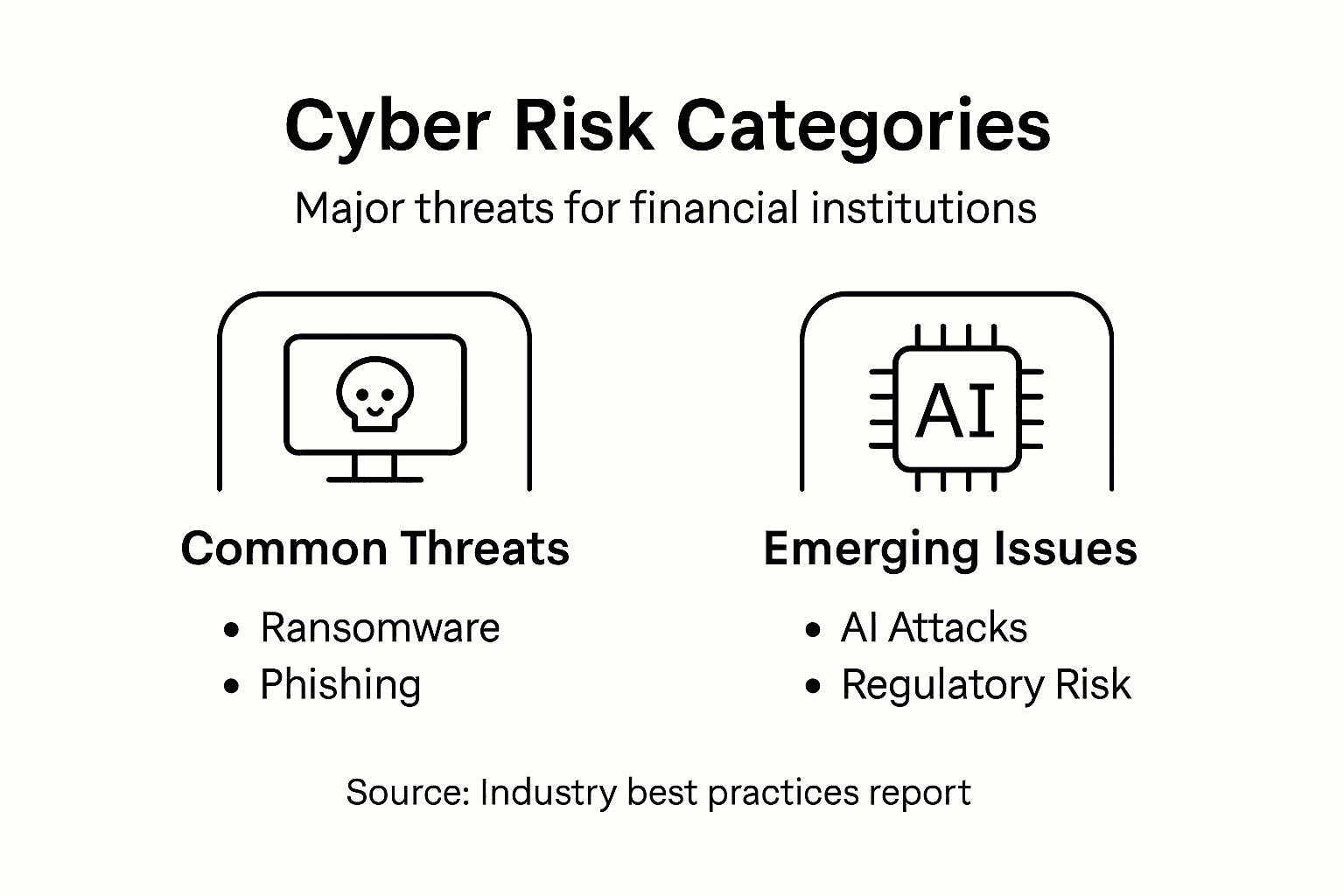
Emerging technologies and strategic mitigation strategies include:
The table below compares leading emerging cybersecurity technologies for financial institutions:
| Technology | Core Advantage | Limitation |
|---|---|---|
| AI Defense Systems | Rapid threat detection | Requires ongoing training |
| Zero-Trust Architecture | Enhanced access control | Complex implementation |
| Quantum-Resistant Cryptography | Future-proof encryption | Still experimental |
| Behavioral Biometrics | Unique user authentication | Potential privacy concerns |
- Artificial Intelligence Defense Systems: Advanced machine learning algorithms for threat detection
- Zero-Trust Architecture: Comprehensive identity verification and access control
- Behavioral Biometrics: Dynamic authentication using unique user behavior patterns
- Quantum-Resistant Cryptography: Advanced encryption techniques protecting against future computational threats
- Automated Threat Intelligence Platforms: Real-time risk assessment and predictive analysis
- Advanced Simulation and Training Technologies: Realistic cybersecurity incident response scenarios
Common strategic pitfalls that financial institutions must carefully navigate include over-reliance on legacy systems, insufficient cross-sector collaboration, and underinvestment in continuous cybersecurity workforce development. Emerging cybersecurity technologies highlight the necessity of adaptive, comprehensive strategies that transcend traditional defensive approaches and integrate innovative risk management techniques.
Successful strategic mitigation requires a holistic approach that balances technological innovation, human expertise, and organizational resilience. Financial institutions must develop flexible, forward-looking cybersecurity frameworks that can rapidly adapt to evolving threat landscapes and leverage emerging defensive technologies.
Pro tip: Implement a dynamic, continuous learning cybersecurity strategy that integrates emerging technologies, regular skills training, and adaptive risk assessment protocols.
Strengthen Your Financial Cybersecurity Posture Today
Financial institutions face relentless cyber risks ranging from ransomware to sophisticated phishing and regulatory challenges. These evolving threats demand more than basic defenses. They require a strategic partner who understands the complexity of cyber risk management, regulatory compliance, and emerging technologies like AI-driven defenses discussed in this article. If you want to transform cybersecurity into a powerful business advantage and protect your organization’s reputation and assets, you need proven expertise that aligns technology with your business goals.

Take control of your cyber risk with Heights Consulting Group’s comprehensive cybersecurity solutions. From managed cybersecurity services to specialized incident response and compliance frameworks tailored for the financial sector, we help you build resilience against modern threats. Do not wait for a breach or costly regulatory penalty to drive change. Visit Heights Consulting Group to discover how we can elevate your cybersecurity strategy. Learn more about our managed cybersecurity and incident response offerings designed specifically for organizations facing complex cyber risk landscapes.
Frequently Asked Questions
What is cyber risk in financial services?
Cyber risk in financial services refers to the potential for financial, operational, and reputational damage resulting from digital vulnerabilities and malicious cyber activities targeting an organization's digital infrastructure and sensitive data.
What are the major categories of cyber threats faced by financial institutions?
Major categories of cyber threats include ransomware attacks, social engineering, phishing campaigns, denial-of-service attacks, corporate account takeover, and third-party vendor risks that exploit technological vulnerabilities and organizational weaknesses.
How do financial institutions assess their cyber risk?
Financial institutions assess their cyber risk using comprehensive cybersecurity risk assessment practices that evaluate their digital ecosystem, identify vulnerabilities, and develop targeted strategies for mitigating potential threats.
What are the responsibilities of financial institutions in managing cyber incidents?
Financial institutions must establish clear governance, conduct continuous risk assessments, prepare incident response strategies, monitor third-party risks, and provide employee training to effectively manage their cybersecurity responsibilities.