

TL;DR:
- Cyber liability standards encompass legal, governance, and technical rules organizations must follow to manage cyber risks. Compliance involves federal laws, frameworks like NIST CSF, and documented board oversight, which regulators increasingly hold organizations accountable for. Meeting these standards helps reduce legal risks, secure insurance coverage, and demonstrate proactive cybersecurity governance.
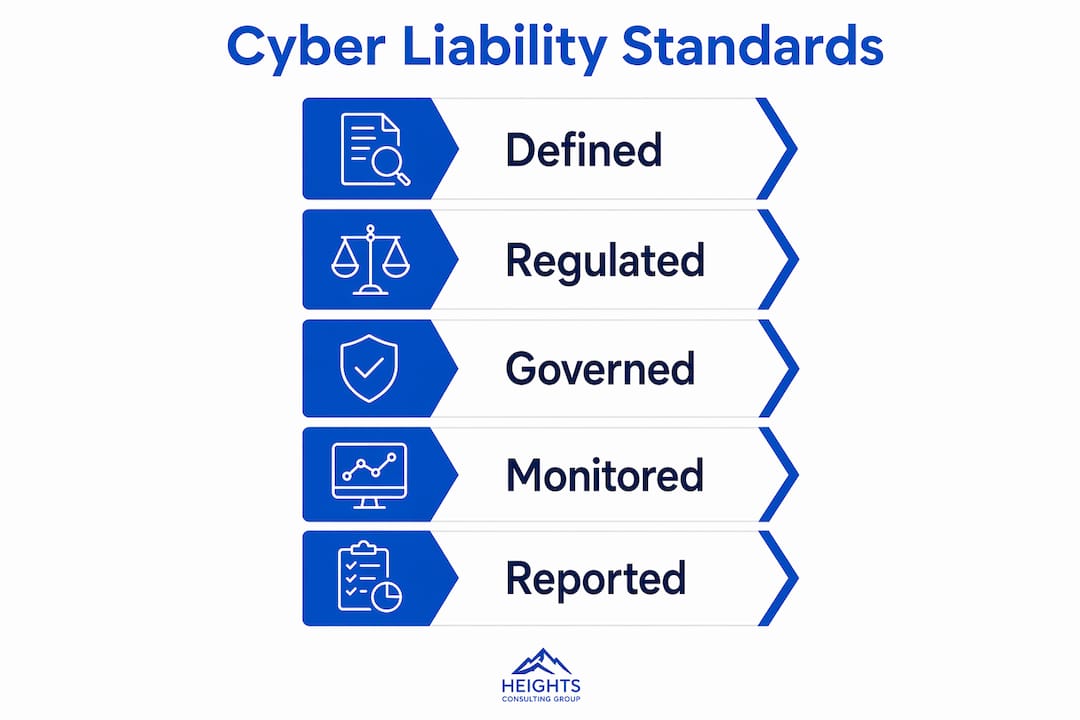
Cyber liability standards are defined as the regulatory, governance, and technical mandates that determine how organizations must protect against, detect, report, and mitigate cyber risks to manage legal and financial exposure. The recognized industry term is "cybersecurity compliance standards," though "cyber liability standards" captures the full scope of legal duty, insurance requirements, and governance obligations that executives face today. Key frameworks shaping these obligations include the SEC's 2023 cybersecurity disclosure rules, the Cyber Incident Reporting for Critical Infrastructure Act (CIRCIA), the Computer Fraud and Abuse Act (CFAA), and OFAC ransomware sanctions. Cyber insurance requirements add another layer, requiring organizations to demonstrate baseline controls before coverage applies. Understanding these standards is not optional for boards and C-suite leaders. Failure to comply carries personal liability, regulatory penalties, and reputational damage that no organization can afford to ignore.
What federal regulations define cyber liability standards?
Federal law now sets explicit, enforceable cyber liability standards for most organizations operating in the United States. Three statutes and one regulatory framework form the core of this obligation.
CIRCIA mandates that covered critical infrastructure entities report significant cyber incidents to CISA within 72 hours and ransomware payments within 24 hours. CISA estimates over 300,000 entities across 16 critical infrastructure sectors will be subject to these federal reporting mandates. That figure means most large organizations, and many mid-sized ones, cannot treat CIRCIA as someone else's problem.
The SEC's 2023 cybersecurity disclosure rules require public companies to disclose material cyber incidents within four business days via Form 8-K and to describe board oversight of cybersecurity risk annually in Form 10-K filings. Materiality assessments must be completed "without unreasonable delay." The SEC's position is that subjective delays in making materiality determinations will be scrutinized, which means organizations need pre-approved frameworks before an incident occurs, not after.
The CFAA creates both criminal and civil exposure. Under the CFAA, companies can pursue civil lawsuits for unauthorized access losses above $5,000, and attackers face criminal penalties up to 20 years. OFAC ransomware sanctions impose civil penalties up to $1.3 million per violation, and those penalties apply on a strict liability basis. An organization that pays a sanctioned threat actor faces penalties even if it did not know the actor was sanctioned.
Pro Tip: Pre-approve a materiality determination framework with legal counsel and your audit committee before any incident occurs. The SEC treats post-incident delays as evidence of inadequate governance, not reasonable caution.
Taken together, these federal mandates define a floor for cyber liability standards. Organizations that meet only the minimum still face state breach notification laws, sector-specific rules like HIPAA for healthcare and GLBA for financial services, and international obligations like GDPR for any European data subjects.
How do cyber liability standards shape board oversight requirements?
Board-level governance is now a direct component of cyber liability standards, not a best practice reserved for mature organizations. Regulators and courts treat the absence of board engagement on cybersecurity as negligence.
Directors face personal legal liability under Delaware's Caremark doctrine for failing to maintain oversight systems for cybersecurity risks. Boards are expected to document active governance, define cyber risk appetite, and assign formal committee responsibilities to mitigate that liability. The Caremark standard does not require a breach to trigger liability. A board that cannot demonstrate it monitored cyber risk proactively is already exposed.
Four governance activities define what regulators consider adequate board oversight:
- Define a quantitative cyber risk appetite. Boards must treat cybersecurity as core enterprise risk with explicit quantitative cyber risk appetite aligned with business objectives. Vague statements about "taking security seriously" do not satisfy this requirement.
- Assign audit committee responsibility. The audit committee should own the annual cybersecurity disclosure review and approve the materiality determination framework used for SEC filings.
- Document board engagement in meeting minutes. Continuous board oversight documentation is required by regulators as proof of fiduciary duty. The absence of documented engagement is treated as negligence, not an oversight.
- Engage legal counsel and a cybersecurity officer in reporting workflows. Legal counsel must review incident disclosures before filing. A CISO or virtual CISO provides the technical judgment that boards need to make informed governance decisions.
Regulatory and judicial bodies hold organizations accountable based on whether they implement a control system commensurate with data sensitivity, not on blaming the cyberattack itself. The question is never "Were you attacked?" The question is always "Did you have the right controls in place before the attack?"
This shift in accountability means that boardroom cybersecurity governance is no longer a compliance checkbox. It is a fiduciary duty with personal consequences for directors who fail to act.
What cybersecurity compliance standards and frameworks support meeting cyber liability requirements?
Technical and procedural frameworks give organizations a structured path to meeting cyber liability requirements. The major frameworks differ in scope, sector applicability, and certification requirements.

| Framework | Primary Sector | Certification Required | Key Focus |
|---|---|---|---|
| NIST CSF 2.0 | General / Federal | No | Risk identification, protection, detection, response, recovery |
| ISO 27001 | General / International | Yes | Information security management system |
| HIPAA Security Rule | Healthcare | No (audit-based) | Protected health information controls |
| SOC 2 Type II | Technology / SaaS | Yes (audit-based) | Trust service criteria: security, availability, confidentiality |
| CMMC 2.0 | Defense contractors | Yes | Controlled unclassified information protection |
No single framework satisfies every regulatory obligation. A defense contractor subject to CMMC 2.0 still needs NIST CSF alignment for general cyber risk management. A healthcare organization subject to HIPAA benefits from SOC 2 certification if it uses cloud service providers. The frameworks are complementary, not competing.
Adopting a recognized framework reduces liability exposure in two concrete ways. First, state safe harbor laws provide some protections to organizations that implement recognized cybersecurity standards, though they do not eliminate regulatory enforcement or breach notification obligations. Second, documented framework adoption demonstrates to regulators and courts that the organization exercised reasonable care, which is the standard applied under Caremark and similar doctrines.
AI is now a material factor in framework compliance. AI-enabled tools support continuous monitoring, anomaly detection, and automated compliance reporting at a scale that manual processes cannot match. At the same time, AI systems deployed without governance controls create new liability exposure. An AI model processing sensitive data without documented oversight, access controls, or audit trails fails the same "commensurate control" standard that regulators apply to human-operated systems.
Pro Tip: Map your existing controls to NIST CSF 2.0 before selecting a sector-specific framework. NIST CSF provides the common language that regulators, auditors, and insurers all recognize, making subsequent framework alignment faster and more defensible.
How do cyber insurance requirements integrate with cyber liability standards?
Cyber insurance is a financial risk transfer mechanism, not a substitute for governance or compliance. Understanding what cyber liability coverage actually covers, and what insurers require before issuing a policy, is critical for any risk management program.
Cyber insurance typically covers financial losses from data breaches, ransomware, and network attacks. Common coverage categories include:
- First-party costs: Incident response fees, forensic investigation, notification costs, and business interruption losses.
- Third-party liability: Claims from customers, partners, or regulators arising from a breach of their data.
- Regulatory defense costs: Legal fees and fines associated with regulatory investigations, subject to policy exclusions.
- Ransomware payments: Some policies cover ransom payments, but OFAC sanctions exclusions apply, and coverage is shrinking as insurers reassess ransomware risk.
Insurers require organizations to demonstrate baseline security controls before coverage applies. Common requirements include multi-factor authentication (MFA) on all privileged accounts, documented security awareness training, tested data backups, and identity access management controls. Insurers increasingly require evidence of board-level cyber governance and documented incident response plans. An organization that cannot produce these controls at underwriting faces either coverage denial or significantly higher premiums.
Insurance complements but does not replace governance obligations and compliance requirements. A policy that pays a ransomware claim does not shield the organization from SEC disclosure obligations, CIRCIA reporting duties, or Caremark liability for board members. Risk leaders who treat insurance as a primary defense rather than a financial backstop misunderstand both the coverage and the regulatory exposure.
Reviewing policy exclusions is as important as reviewing coverage limits. Common exclusions include nation-state attacks, acts of war, and incidents arising from unpatched known vulnerabilities. An organization that delays patching a critical vulnerability and then suffers a breach may find its insurer denying the claim on exclusion grounds.
What practical steps can organizations take to implement cyber liability standards?
Implementing cyber liability standards requires a structured program, not a collection of one-time projects. The following steps build a defensible, auditable compliance posture.
- Build a unified incident reporting workflow. Maintaining unified reporting workflows that integrate federal, state, and international breach notification obligations reduces compliance risk. A single workflow with defined triggers, escalation paths, and notification templates prevents the coordination failures that cause "unreasonable delay" findings under SEC rules.
- Pre-approve a materiality determination framework. Define in advance what constitutes a material cyber incident for SEC disclosure purposes. The framework should specify quantitative thresholds, qualitative factors, and the decision-makers authorized to make the final call. Legal counsel and the audit committee must approve it before any incident occurs.
- Conduct documented board education on a regular schedule. Boards that receive cybersecurity briefings only after incidents fail the Caremark standard. Quarterly briefings, documented in board minutes, demonstrate the continuous oversight that regulators require. Use cyber risk communication frameworks that translate technical risk into financial and operational terms that directors can act on.
- Integrate AI-enabled monitoring into compliance workflows. AI tools can automate log analysis, flag anomalous access patterns, and generate compliance reports faster than manual processes. The governance requirement is that every AI tool used in a compliance-relevant process must have a documented owner, defined inputs and outputs, and an audit trail. AI without oversight creates the same liability gap as any other uncontrolled system.
- Align your cyber risk management steps with your insurance requirements. Review your cyber insurance policy annually against your current control environment. Controls that satisfied underwriting two years ago may no longer meet current insurer requirements, particularly around MFA coverage and endpoint detection.
The liability gap no one talks about
The most underappreciated risk in cyber liability is not the breach itself. It is the governance gap that regulators find when they investigate the response. I have seen organizations with technically sound security programs face serious regulatory scrutiny because their board minutes showed no evidence of cyber risk discussion in the 18 months before an incident. The controls existed. The documentation did not.
AI makes this problem worse before it makes it better. Organizations are deploying AI tools in security operations, compliance monitoring, and incident triage at a pace that outstrips their governance frameworks. When an AI system makes a consequential decision, such as suppressing an alert or classifying an incident as non-material, and that decision turns out to be wrong, regulators will ask who owned that system and what oversight existed. If the answer is "no one" or "we're still figuring that out," the organization has created a new Caremark exposure on top of its existing ones.
The shift from reactive to proactive cyber liability management is not a philosophical preference. It is what the SEC, CISA, and Delaware courts now require. Organizations that build governance documentation, pre-approved frameworks, and board engagement into their normal operating rhythm will find compliance far less disruptive than those that scramble after an incident. The organizations that treat cyber liability standards as a competitive differentiator, demonstrating to customers, partners, and regulators that they take this seriously, will find that the investment pays returns beyond avoided penalties.
Personal liability for directors is real and growing. The Caremark doctrine has teeth, and courts are increasingly willing to let derivative suits proceed when boards cannot demonstrate active oversight. Every director on a board that has not discussed cybersecurity in the past quarter should treat that fact as a personal legal risk, not an organizational one.
— Dan
How Heightscg supports organizations meeting cyber liability standards
Heightscg works with organizations across highly regulated industries to build and maintain the governance, technical controls, and reporting workflows that cyber liability standards require. The firm's managed cybersecurity services provide 24/7 threat detection, incident response, and compliance monitoring, giving boards the documented oversight evidence that regulators and courts expect to see. Heightscg's compliance practice covers NIST CSF, CMMC, SOC 2, HIPAA, and SEC disclosure requirements, with advisory support that connects technical controls to board-level governance. For organizations that need to close the gap between current posture and regulatory obligation, Heightscg offers structured assessment engagements that produce a prioritized, defensible remediation roadmap.
FAQ
What are cyber liability standards in simple terms?
Cyber liability standards are the regulatory, governance, and technical requirements that organizations must meet to manage legal and financial exposure from cyber incidents. They include federal laws like CIRCIA and SEC disclosure rules, technical frameworks like NIST CSF, and governance obligations like board oversight documentation.
What is the difference between cyber liability standards and cyber insurance?
Cyber liability standards define what controls and governance an organization must implement. Cyber insurance transfers some of the financial risk if those controls fail. Insurance complements compliance but does not replace it, and insurers require evidence of baseline controls before issuing coverage.
Which organizations must comply with CIRCIA reporting requirements?
CISA estimates over 300,000 entities across 16 critical infrastructure sectors will be subject to CIRCIA's federal reporting mandates, requiring significant incident reports within 72 hours and ransomware payment reports within 24 hours.
Can board directors be personally liable for cybersecurity failures?
Directors face personal legal liability under Delaware's Caremark doctrine for failing to maintain oversight systems for cybersecurity risks. Documented board engagement, defined cyber risk appetite, and formal committee responsibilities are required to mitigate that personal exposure.
How do cybersecurity frameworks like NIST and SOC 2 reduce liability?
Adopting recognized frameworks like NIST CSF 2.0 or SOC 2 demonstrates to regulators and courts that the organization exercised reasonable care. State safe harbor laws also provide some liability protections to organizations that implement recognized cybersecurity standards, though they do not eliminate all regulatory obligations.
Key takeaways
Cyber liability standards require documented governance, pre-approved reporting frameworks, and continuous board engagement, not just technical controls, to satisfy regulators and courts in 2026.
| Point | Details |
|---|---|
| Federal mandates set the floor | CIRCIA, SEC disclosure rules, CFAA, and OFAC sanctions define minimum cyber liability obligations for most U.S. organizations. |
| Board oversight is a legal duty | Directors face personal liability under the Caremark doctrine if they cannot document active cybersecurity governance. |
| Frameworks reduce exposure | NIST CSF, SOC 2, HIPAA, and CMMC provide structured paths to compliance and support safe harbor protections where available. |
| Insurance complements, not replaces, compliance | Cyber insurance covers financial losses but does not satisfy governance obligations or shield directors from regulatory scrutiny. |
| AI governance is a new liability gap | AI tools used in compliance or security operations require documented ownership and audit trails to avoid creating new regulatory exposure. |