

Organizations with mature cyber defense capabilities report 36% lower average breach costs than those with immature defenses. For C-level executives in highly regulated industries, this statistic transforms cybersecurity from a cost center into a strategic investment. This article explains how advanced cyber defense delivers measurable financial returns, ensures compliance, and positions your organization for sustainable competitive advantage through practical frameworks, case studies, and strategic guidance.
Table of Contents
- Understanding Advanced Cyber Defense In Regulated Industries
- Financial And Operational Impact Of Cyber Defense Investments
- Regulatory Compliance As A Driver For Cyber Defense Investment
- Common Misconceptions About Cyber Defense Roi
- Comparison Of Cyber Defense Frameworks And Technologies
- Case Studies Illustrating Strategic Outcomes Of Cyber Defense
- Bridging Cyber Defense Investment To Business Value And Risk Management
- Partner With Heights Consulting Group For Strategic Cyber Defense Solutions
- Frequently Asked Questions About Investing In Cyber Defense
Key Takeaways
| Point | Details |
|---|---|
| Mature defenses reduce breach costs | Organizations achieve 36% lower breach costs with mature cyber defense capabilities. |
| Compliance frameworks cut penalties | Adopting NIST reduces regulatory fines by up to 50% through improved risk management. |
| Proactive defense prevents attacks | Proactive cyber defense investments result in 40% fewer successful cyberattacks annually. |
| ROI extends beyond technology | Cyber defense value includes governance, policy development, and workforce training. |
| Integrated frameworks maximize value | Combining compliance frameworks with emerging AI tools optimizes protection and business outcomes. |
Understanding Advanced Cyber Defense in Regulated Industries
Advanced cyber defense encompasses far more than installing security software. According to the NIST Framework for Improving Critical Infrastructure Cybersecurity, it represents a comprehensive approach combining technology, governance, and human capital to protect organizational assets. For executives in healthcare, finance, defense contracting, and other regulated sectors, understanding these components is essential for making informed investment decisions.
The core technological components include:
- Endpoint detection and response systems that identify threats across devices
- Proactive threat hunting to discover hidden adversaries before they strike
- AI-driven analytics that process massive data volumes to detect anomalies
- Security orchestration tools that automate incident response workflows
- Zero-trust architecture that verifies every access request continuously
Regulated industries face unique pressures beyond technology implementation. Your organization must demonstrate compliance with frameworks like NIST, CMMC for Department of Defense contracts, and SOC 2 for service organizations. These requirements directly influence your investment priorities. Aligning cyber defense with business objectives ensures that security supports operational resilience rather than impeding productivity.
The compliance advantage in regulated industries extends beyond avoiding penalties. It builds stakeholder confidence, enables market access, and creates competitive differentiation. Advanced cyber defense integrates governance structures, policy frameworks, and workforce training programs that transform security from a technical function into a business enabler.
Executives must recognize that the NIST cybersecurity framework provides a risk-based approach for continuous improvement. This perspective shifts investment discussions from one-time purchases to strategic capability building that evolves with your threat landscape and business environment.
Financial and Operational Impact of Cyber Defense Investments
The business case for cyber defense becomes clear when you examine measurable outcomes. The Cost of a Data Breach Report 2023 demonstrates that mature defenses reduce average breach costs by 36%, translating to millions in avoided losses for enterprise organizations. This financial impact stems from faster detection, more efficient response, and reduced operational disruption when incidents occur.
Proactive investments deliver even more compelling results. Organizations that invest strategically experience 40% fewer successful cyberattacks annually compared to those taking reactive approaches. This reduction directly impacts your bottom line through:
- Decreased incident response costs and forensic investigation expenses
- Reduced operational downtime that preserves revenue generation
- Lower regulatory penalties and legal settlement costs
- Minimized reputational damage that protects customer trust and market position
- Improved insurance premiums reflecting stronger security postures
Your operational resilience improves dramatically with advanced capabilities in place. When breaches do occur, organizations with mature defenses contain them 60 days faster than those with immature capabilities. This speed prevents attackers from establishing persistent footholds, stealing additional data, or causing deeper system compromises.

The cybersecurity business impact extends beyond incident metrics to strategic business enablement. Strong cyber defense allows you to pursue digital transformation initiatives, enter new markets, and build customer trust without compromising security. Your investment becomes a competitive advantage rather than merely a defensive necessity.
Consider the alternative scenario. A single ransomware attack costs organizations an average of $4.54 million when factoring in downtime, recovery, and lost business. The IBM data breach cost report shows that healthcare organizations face even higher costs at $10.93 million per breach. These figures make the ROI calculation straightforward for executives evaluating cyber defense budgets.
Review the Verizon DBIR 2023 for industry-specific attack patterns that inform your investment priorities. Understanding which threats target your sector most frequently helps allocate resources effectively.
Regulatory Compliance as a Driver for Cyber Defense Investment
Compliance requirements create non-negotiable investment drivers for regulated industries. The NIST Framework for Improving Critical Infrastructure Cybersecurity has become the de facto standard across sectors, with adoption reducing regulatory penalties by up to 50% through improved risk management practices. This framework provides a common language for discussing cybersecurity across your organization and with regulators.
For defense contractors, CMMC compliance is mandatory rather than optional. The Cybersecurity Maturity Model Certification requires specific advanced controls including:
- Multi-factor authentication across all systems handling controlled unclassified information
- Network segmentation to isolate sensitive data from general business systems
- Continuous monitoring with automated threat detection capabilities
- Incident response procedures with documented tabletop exercises
- Supply chain risk management programs that extend security requirements to vendors
Your investment in these controls directly determines your ability to bid on and maintain Department of Defense contracts. The financial implications extend beyond the technology costs to include potential revenue loss from contract ineligibility.
SOC 2 compliance serves a different but equally critical function for service organizations. This framework demonstrates to customers and partners that you maintain robust security and privacy controls. The cybersecurity compliance advantage includes enhanced market reputation, improved customer retention, and accelerated sales cycles with security-conscious buyers.
Meeting these compliance standards reduces legal risks substantially. Organizations facing data breaches without adequate controls experience regulatory fines, class action lawsuits, and SEC enforcement actions. Your investment in cyber defense serves as evidence of due diligence and reasonable care in protecting stakeholder data.
The cybersecurity compliance strategies you implement today position your organization for future regulatory requirements. As privacy laws evolve and enforcement intensifies, mature cyber defense programs adapt more easily than those built reactively.
Consult the NIST cybersecurity framework documentation to map your current capabilities against recommended practices. This gap analysis informs investment priorities aligned with both compliance and business risk management.
Common Misconceptions About Cyber Defense ROI
Executives often struggle with cyber defense ROI calculations due to persistent misconceptions. The most damaging myth suggests that cybersecurity investments only increase costs without delivering measurable returns. Evidence from the Verizon DBIR & IBM Cost of Breach Report 2023 Combined Analysis directly refutes this belief, showing 40% fewer successful attacks and 36% lower breach costs for organizations with mature defenses.
Another widespread misconception positions cyber defense as purely a technology problem. NIST Special Publication 800-53 clarifies that governance, policies, and workforce training are equally critical to security outcomes. Your investment must address:
- Security awareness training that transforms employees into your first line of defense
- Policy frameworks that establish clear accountability and procedures
- Governance structures that integrate security into business decision-making
- Risk management processes that prioritize investments based on threat intelligence
- Continuous improvement programs that evolve capabilities with emerging threats
The technology-only mindset leads to ineffective spending patterns. You might deploy sophisticated tools that employees bypass due to poor usability or lack of training. Your policies might fail to address modern threats like social engineering and insider risks that technology alone cannot prevent.
Some executives believe that cyber defense value cannot be quantified like other business investments. This misconception stems from focusing solely on prevented incidents rather than comprehensive benefits. Your ROI calculation should include breach cost avoidance, compliance penalty reduction, operational efficiency gains, and business enablement through secure digital initiatives.
The cyber defense ROI clarity emerges when you measure both technical and non-technical outcomes. Track metrics like mean time to detect threats, employee security awareness scores, policy compliance rates, and audit finding reductions alongside traditional security metrics.
Pro Tip: Create a balanced scorecard that communicates cyber defense value to board members and stakeholders. Include financial metrics like breach cost avoidance, operational metrics like system availability, and strategic metrics like compliance readiness and market trust indicators. This comprehensive view demonstrates how security investments support overall business objectives.
Review NIST cyber governance guidance for frameworks that connect technical controls to business outcomes in language that resonates with non-technical executives.
Comparison of Cyber Defense Frameworks and Technologies
Selecting the right frameworks and technologies requires understanding how different approaches align with your organizational needs. Each major compliance framework offers distinct advantages depending on your industry, regulatory environment, and business objectives. The table below compares key characteristics:
| Framework | Primary Focus | Regulatory Application | Key Advantages |
|---|---|---|---|
| NIST CSF | Risk management and continuous improvement | Federal agencies, critical infrastructure | Flexible, scalable, widely recognized across industries |
| CMMC | Defense contractor cybersecurity maturity | Department of Defense supply chain | Certification-based, tiered controls, contract requirement |
| SOC 2 | Security and privacy for service organizations | Technology and SaaS providers | Market trust, customer assurance, audit-based validation |
NIST offers the most comprehensive approach to risk management. Its five core functions (Identify, Protect, Detect, Respond, Recover) provide a complete lifecycle for managing cybersecurity risk. You can implement NIST incrementally, scaling your investment as your organization matures. This flexibility makes it ideal for organizations at any stage of their cybersecurity journey.
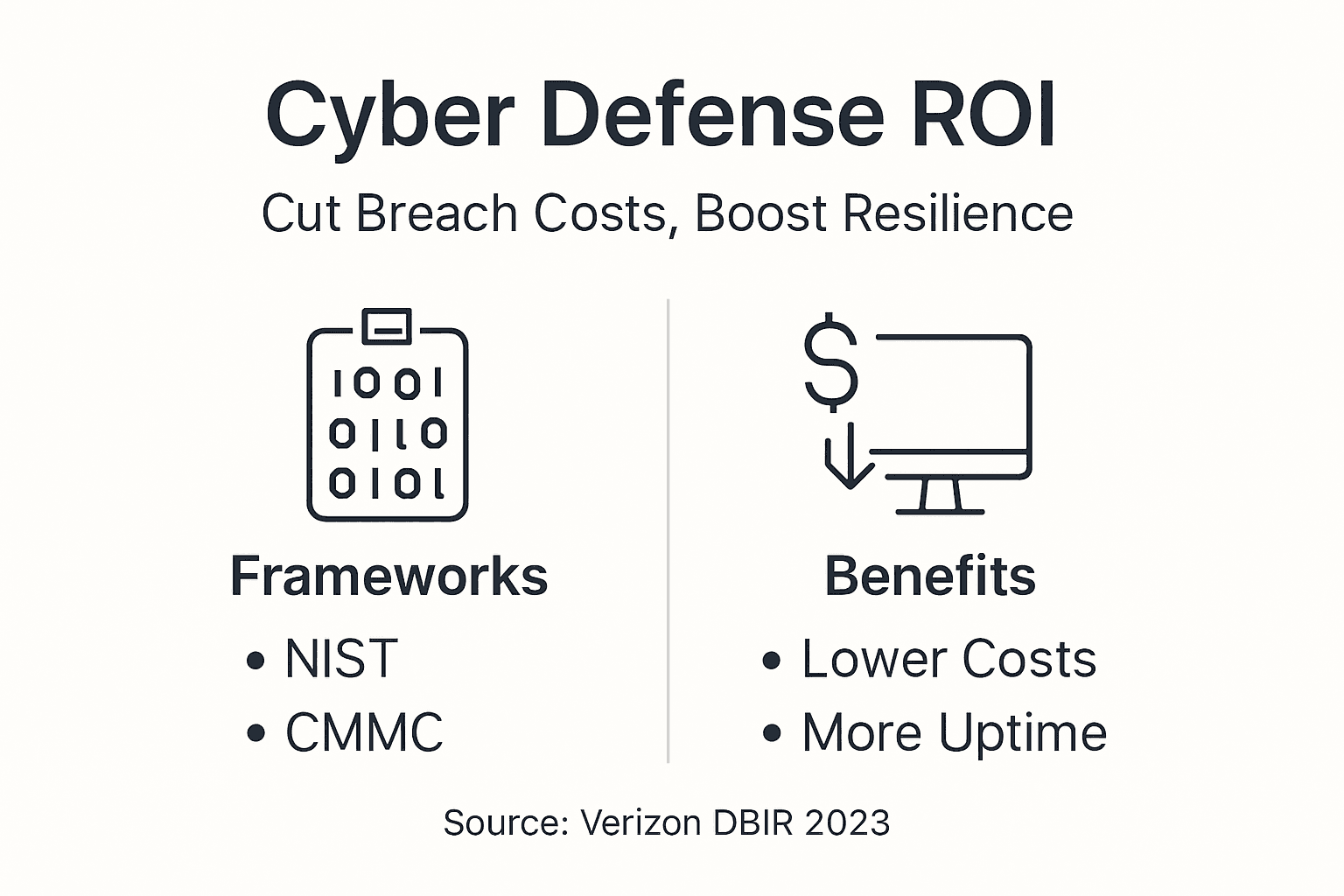
CMMC takes a more prescriptive approach with specific controls mapped to maturity levels. If you work with the Department of Defense, this framework is non-negotiable. The certification requirement means you must demonstrate compliance through third-party assessments. Your investment must address all controls at your required level, leaving little room for customization.
SOC 2 focuses specifically on service organizations handling customer data. This framework requires annual audits that verify your controls operate effectively over time. The market recognizes SOC 2 reports as credible evidence of security commitment, making them valuable for sales and partnership discussions.
Integrating multiple frameworks maximizes your compliance coverage and operational effectiveness. Many organizations adopt NIST as their foundational approach while pursuing CMMC or SOC 2 certification for specific business needs. This layered strategy ensures comprehensive protection without duplicating effort.
Emerging AI-driven technologies enhance these frameworks significantly. Machine learning algorithms detect anomalies human analysts might miss. Automated response capabilities contain threats within seconds rather than hours. Natural language processing helps security teams analyze threat intelligence at scale. Your investment in these tools amplifies the effectiveness of your chosen framework.
The cyber defense frameworks overview provides detailed guidance on implementation strategies. Review the future-ready cybersecurity checklists to ensure your technology selections align with emerging threat landscapes.
Case Studies Illustrating Strategic Outcomes of Cyber Defense
Real-world examples demonstrate how advanced cyber defense investments deliver measurable results across regulated industries. These cases provide concrete evidence of ROI that helps justify investment decisions to boards and stakeholders.
A regional healthcare provider faced escalating ransomware threats targeting patient data systems. They invested in comprehensive endpoint detection and response technology combined with security awareness training. Within 18 months, they detected and stopped three ransomware attempts before encryption occurred. Their investment of $800,000 prevented an estimated $12 million in ransom payments, recovery costs, and HIPAA penalties. The healthcare cyber defense case study details their specific implementation approach.
A mid-sized financial services firm implemented proactive threat hunting services after experiencing persistent reconnaissance activity. Their security team discovered an advanced persistent threat group had maintained access for six months, positioning themselves to steal customer financial data. Early detection through threat hunting prevented a breach that could have cost $25 million based on similar incidents in their sector. Their annual investment of $500,000 in threat hunting services delivered immediate ROI through this single prevented incident.
A defense contractor pursuing CMMC Level 3 certification invested $2.3 million in technology upgrades, policy development, and workforce training. This investment enabled them to bid on contracts worth $50 million annually that previously required security capabilities they lacked. Their cyber defense investment directly generated new revenue opportunities while improving their overall security posture.
AI-driven security tools have produced dramatic improvements in incident response times across multiple organizations. One manufacturing company reduced their mean time to detect threats from 197 days to 12 hours after implementing AI-powered analytics. This speed prevented attackers from establishing persistent footholds or causing operational disruptions.
These cases underscore the importance of combining technology with governance and training. Technology alone did not deliver results. Organizations succeeded when they invested in comprehensive programs addressing people, processes, and tools simultaneously.
Pro Tip: Build a business case for cyber defense investment using case studies from your specific industry. Executives respond more favorably to peer examples than generic statistics. Document prevented incidents, avoided costs, and business enablement outcomes to create compelling narratives for future investment discussions.
Bridging Cyber Defense Investment to Business Value and Risk Management
Integrating cyber defense into enterprise risk management frameworks transforms security from an IT concern into a strategic business function. Your investment decisions become part of broader discussions about operational resilience, competitive positioning, and stakeholder value creation.
Enhanced executive visibility starts with integrated dashboards that translate security metrics into business language. Instead of reporting on firewall rules or patch compliance percentages, present breach probability reductions, operational availability improvements, and compliance readiness scores. This translation helps C-level executives understand security posture in the context of overall business risk.
Follow these five steps to align cyber defense investments with business objectives:
- Map cybersecurity risks to business impact scenarios including revenue loss, regulatory penalties, and reputational damage to establish clear connections between security and business outcomes.
- Align security investments with your organization's risk appetite by prioritizing controls that address the most significant business-impacting threats first.
- Integrate cybersecurity metrics into enterprise risk dashboards alongside financial, operational, and strategic risk indicators for comprehensive visibility.
- Establish governance structures that include security leadership in business planning discussions to ensure cyber defense considerations inform strategic decisions.
- Communicate security program value through business-focused reporting that emphasizes prevented losses, compliance achievements, and competitive advantages gained.
The cyber defense and risk management connection becomes evident when you position security as a business enabler. Strong cyber defense allows you to pursue digital transformation initiatives confidently. You can adopt cloud services, implement remote work programs, and launch customer-facing digital platforms without unacceptable risk.
Your investment in cyber defense supports growth rather than merely preventing losses. Organizations with mature security programs can enter new markets, pursue acquisitions, and respond to customer security requirements more effectively than competitors with weak capabilities. This positioning transforms cybersecurity from a cost center into a competitive differentiator.
Proactive cybersecurity strategies facilitate informed decision-making at the highest organizational levels. When executives understand cyber risk in business terms, they make better resource allocation decisions, approve necessary investments more readily, and champion security initiatives across the organization.
Partner with Heights Consulting Group for Strategic Cyber Defense Solutions
Transforming your cyber defense posture from reactive to strategic requires expert guidance tailored to your industry, regulatory environment, and business objectives. Heights Consulting Group specializes in helping C-level executives and CISOs in highly regulated industries maximize the value of their cybersecurity investments.
Our team works directly with your leadership to align cyber defense strategies with business goals, ensuring that security investments deliver measurable financial returns and competitive advantages. We transform cybersecurity from a technical compliance requirement into a strategic enabler that supports growth, innovation, and stakeholder confidence. Contact Heights CG cybersecurity solutions to discuss how our tailored approach can elevate your organization's security posture. Explore our cybersecurity compliance strategies and risk management business security services to see how we integrate security with your broader business objectives.
Frequently Asked Questions About Investing in Cyber Defense
What are the key components of advanced cyber defense?
Advanced cyber defense integrates endpoint detection and response, proactive threat hunting, AI-driven analytics, security orchestration, and zero-trust architecture as core technologies. Equally important are governance structures, policy frameworks, and comprehensive workforce training programs. This combination of technical and organizational controls creates resilient defense capabilities that adapt to evolving threats.
How does cyber defense investment impact regulatory compliance?
Investing strategically in cyber defense enables your organization to meet requirements for frameworks like NIST, CMMC, and SOC 2 efficiently. These investments reduce regulatory penalties by up to 50% through improved risk management and audit readiness. Strong compliance postures also accelerate contract approvals and strengthen market reputation with security-conscious customers and partners.
Can cyber defense investments demonstrate measurable ROI?
Yes, organizations with mature cyber defense capabilities achieve 36% lower breach costs and experience 40% fewer successful cyberattacks annually compared to those with immature defenses. ROI calculations should include breach cost avoidance, reduced downtime, lower insurance premiums, compliance penalty prevention, and business enablement benefits. These quantifiable outcomes justify investment decisions to boards and stakeholders.
What emerging technologies should executives consider in cyber defense?
AI-driven detection and response tools offer significant advantages in threat identification speed and accuracy, processing massive data volumes to identify anomalies human analysts might miss. Security orchestration platforms automate incident response workflows, reducing mean time to contain breaches. Zero-trust architecture eliminates implicit trust assumptions, verifying every access request continuously regardless of user location or device.
How do I align cyber defense investments with business risk management?
Start by mapping cybersecurity risks to specific business impact scenarios including revenue loss, regulatory penalties, and operational disruptions. Integrate security metrics into enterprise risk dashboards alongside financial and operational indicators. Establish governance structures that include security leadership in strategic planning discussions, ensuring cyber defense considerations inform business decisions from the outset rather than being added as afterthoughts.