

TL;DR:
- Cyber asset management involves continuously discovering and managing all hardware, software, and data assets critical to an organization's security. It requires real-time updates through integration with security tools and focuses on risk exposure, not just inventory counts. Effective CSAM supports risk mitigation and compliance by providing current asset visibility and enabling automation with AI and frameworks like NIST 2.0.
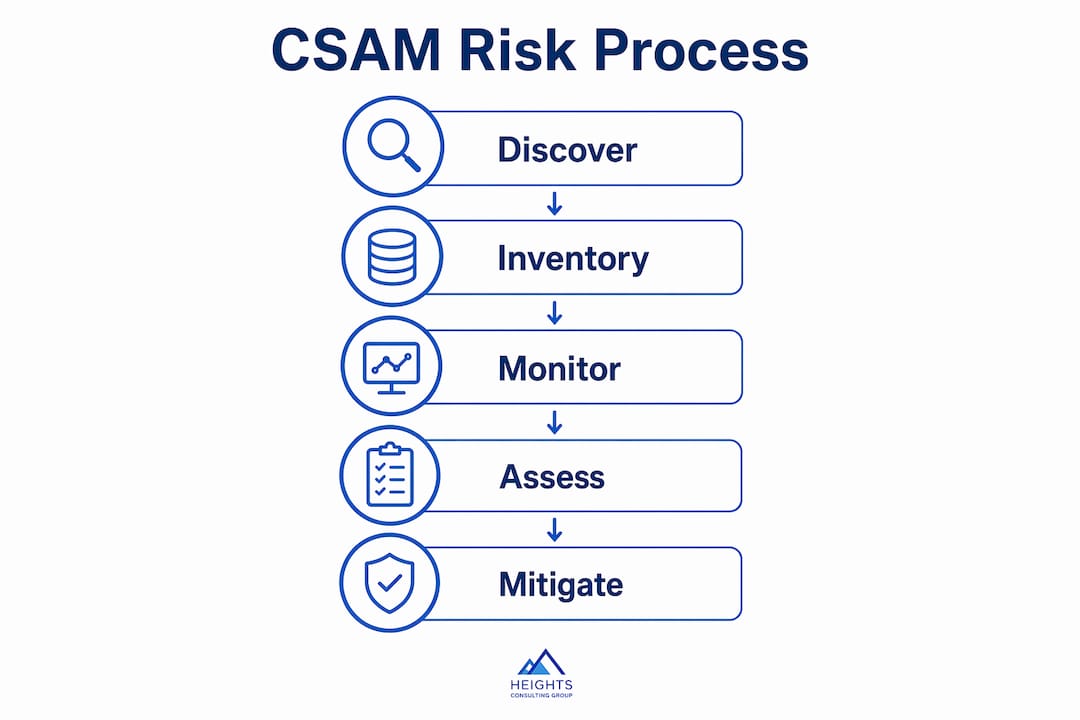
Cyber asset management (CSAM) is defined as the continuous process of discovering, inventorying, monitoring, and managing every hardware, software, and data asset that affects an organization's security posture. Unlike a one-time audit, CSAM is an ongoing discipline that eliminates blind spots across on-premises, cloud, and hybrid environments. IT leaders who treat asset visibility as a periodic exercise rather than a continuous function expose their organizations to unmanaged risk. NIST Cybersecurity Framework 2.0 and frameworks like NIST IR 8286 both treat asset data as foundational to enterprise risk management. Understanding what cyber asset management requires, and what it costs to ignore it, is the first decision every security leader must make.
What is cyber asset management and how does it differ from IT asset management?
Cyber asset management and traditional IT asset management (ITAM) address different problems. ITAM tracks assets for financial, operational, and procurement purposes. CSAM tracks assets for security risk, vulnerability exposure, and compliance readiness. The distinction matters because an asset that is fully depreciated on a balance sheet may still represent a critical attack vector on your network.
CSAM requires real-time asset state rather than periodic inventory snapshots. A laptop added to the network on a Tuesday morning should appear in your asset inventory by Tuesday afternoon, not at the next quarterly audit. That level of currency is only achievable through integration with identity and access management (IAM) systems, endpoint detection and response (EDR) platforms, and vulnerability management tools.
The most dangerous failure mode in traditional ITAM is the static inventory trap. An organization believes its asset list is accurate because it was accurate six months ago. Attackers exploit exactly that gap. CSAM closes it by treating the inventory as a living data set, not a document.
- Security context: CSAM classifies assets by risk exposure, not just by type or cost center.
- Integration requirement: Effective CSAM pulls data from IAM, EDR, SIEM, and network discovery tools simultaneously.
- Continuous monitoring: Asset states update in real time, reflecting configuration changes, new connections, and software installations.
- Compliance alignment: CSAM feeds audit-ready data directly into compliance workflows for frameworks like NIST, CMMC, and SOC 2.
Pro Tip: If your asset inventory is not updated automatically when a new device connects to your network, you are operating with a static list. That is not cyber asset management. That is a spreadsheet.
What types of assets are included in cyber asset management?
The scope of a CSAM program is broader than most IT leaders initially expect. Common cybersecurity assets include physical devices such as servers, laptops, and workstations, software applications both on-premises and SaaS-delivered, data stores, network resources, and credentials. Each category carries distinct risk profiles and requires different tracking methods.

The less obvious assets are often the most dangerous. IoT devices, operational technology (OT) sensors, service accounts, API keys, and shadow IT applications frequently escape traditional inventory processes. A forgotten service account with elevated privileges is as exploitable as an unpatched server. Cloud and hybrid environments compound this problem by creating asset sprawl at a rate that manual processes cannot track.
Asset classification is not just a cataloging exercise. It is the foundation for risk prioritization. An unclassified asset cannot be assigned a risk score, cannot be linked to a threat scenario, and cannot be included in a compliance report. Classification enables every downstream security decision.
- Hardware assets: Servers, endpoints, mobile devices, IoT sensors, OT equipment, and network infrastructure.
- Software assets: Licensed applications, SaaS subscriptions, open-source libraries, and containerized workloads.
- Data assets: Databases, file shares, cloud storage buckets, and backup repositories.
- Identity assets: User accounts, service accounts, API keys, certificates, and privileged credentials.
- Network assets: Firewalls, switches, VPN gateways, and DNS infrastructure.
Organizations operating in hybrid cloud environments face the steepest classification challenge. Assets spin up and down dynamically, often without IT's direct involvement. A CSAM program that does not account for ephemeral cloud resources will always have gaps.
How does cyber asset management support risk mitigation and compliance?
CSAM is the data layer that makes enterprise risk management (ERM) executable. Without accurate, current asset data, risk registers are theoretical. With it, they become operational tools that executives can use to allocate resources and make defensible decisions. NIST IR 8286 explicitly calls for integrating cybersecurity risk into enterprise risk registers, linking assets to threat likelihood and business impact.
The compliance benefit is equally direct. CSAM improves audit readiness by maintaining continuous records of asset states, policy enforcement actions, and vulnerability remediation timelines. Regulations such as FISMA, CMMC, and SOC 2 all require demonstrable asset visibility. An organization that can produce a current, complete asset inventory on demand is in a fundamentally stronger compliance position than one that reconstructs it before each audit.
AI is reshaping how CSAM supports risk detection. Machine learning models applied to asset telemetry can identify anomalous behavior, flag unauthorized software installations, and surface configuration drift before it becomes a breach. This is not a future capability. Organizations deploying AI-assisted monitoring today are detecting threats that rule-based systems miss entirely.
| CSAM Capability | Risk and Compliance Benefit |
|---|---|
| Continuous asset discovery | Eliminates blind spots that attackers exploit |
| Asset-to-risk linkage | Enables prioritized remediation based on business impact |
| Policy enforcement tracking | Provides audit evidence for NIST, CMMC, and SOC 2 requirements |
| Vulnerability state monitoring | Supports continuous vulnerability management programs |
| AI-assisted anomaly detection | Accelerates threat identification across large asset populations |
NIST Cybersecurity Framework 2.0 reinforces this integration model. Asset data feeds the Identify function, which underpins every other function in the framework. Organizations that skip or underinvest in asset management find that their Protect, Detect, and Respond capabilities are built on an incomplete foundation.
Pro Tip: Map every critical asset to at least one entry in your enterprise risk register. If an asset has no corresponding risk entry, it is either unclassified or unmanaged. Both conditions require immediate attention.
What are best practices for implementing effective cyber asset management?
Effective CSAM implementation follows a clear sequence. Organizations that skip steps or treat CSAM as a technology purchase rather than a program consistently underperform. The following order reflects how mature security programs build durable asset management capabilities.
- Establish continuous, automated discovery. Replace manual audits with network scanning, agent-based discovery, and API integrations that update your inventory in real time. Continuous monitoring is the operational baseline for any credible CSAM program.
- Integrate with existing security tools. Connect your asset inventory to IAM, EDR, SIEM, and SOAR platforms. Asset data that lives in isolation cannot drive security decisions. Identity and access management integration is particularly critical for tracking service accounts and privileged credentials.
- Classify assets by risk tier. Assign each asset a criticality rating based on the data it processes, the systems it connects to, and the regulatory requirements it falls under. This classification drives remediation prioritization.
- Automate policy enforcement and anomaly detection. Use automation to flag assets that fall out of compliance with configuration baselines. Apply AI-assisted monitoring to detect behavioral anomalies across large asset populations.
- Assign clear governance and ownership. Every asset needs an owner. Cybersecurity governance structures that assign accountability for asset classes prevent the siloed data problem that undermines executive decision-making. NIST guidance on consolidated risk data confirms that fragmented asset ownership produces fragmented risk visibility.
- Conduct regular program reviews. CSAM is not a set-and-forget deployment. Review discovery coverage, integration health, and classification accuracy on a defined schedule. Adjust as your environment changes.
The most common implementation failure is treating CSAM as a tool deployment rather than a program. Organizations that purchase an asset discovery platform without addressing governance, integration, and classification end up with a more expensive version of the same problem.
What emerging challenges and future trends affect cyber asset management in 2026?
The asset environment in 2026 is materially more complex than it was three years ago. AI adoption, IoT proliferation, and cloud-native architectures have expanded the attack surface faster than most asset management programs have adapted. Asset sprawl driven by cloud, SaaS, and AI technologies is now the primary challenge for security teams trying to maintain accurate inventories.
- AI-generated assets: Large language model deployments, AI agents, and automated pipelines create new asset classes that traditional discovery tools do not recognize. Organizations deploying AI without asset governance are creating accountability gaps that regulators are beginning to scrutinize.
- Regulatory pressure: Frameworks and regulations are moving toward continuous, auditable asset oversight rather than point-in-time compliance. Organizations that cannot demonstrate ongoing asset visibility will face increasing audit friction.
- Hybrid environment complexity: Assets that move between on-premises and cloud environments, or that exist only temporarily as containerized workloads, require discovery methods that match their dynamic nature.
- Supply chain asset risk: Third-party software components and vendor-managed assets introduce risk that organizations cannot manage without knowing those assets exist in their environment.
- AI-assisted CSAM: Machine learning applied to asset telemetry is becoming the standard for anomaly detection and configuration drift identification. Organizations still relying on rule-based monitoring are operating below the current capability threshold.
The organizations that manage these challenges effectively share one characteristic. They treat CSAM as a program with executive sponsorship, not as an IT operations task. Asset management decisions made at the operational level without executive visibility consistently produce the governance gaps that AI adoption and regulatory change expose.
Key takeaways
Cyber asset management is the continuous, integration-driven discipline that gives organizations the asset visibility required to execute risk management, enforce compliance, and respond to threats before they escalate.
| Point | Details |
|---|---|
| CSAM is not ITAM | Cyber asset management focuses on security risk and real-time state, not financial tracking. |
| Continuous discovery is mandatory | Static inventories create exploitable gaps; automated, real-time discovery closes them. |
| Integration drives value | CSAM connected to IAM, EDR, and SIEM produces actionable risk data; isolated CSAM does not. |
| Asset data enables compliance | Frameworks like NIST 2.0, CMMC, and FISMA require demonstrable, current asset visibility. |
| AI expands the asset scope | AI deployments create new asset classes that require governance before regulators require accountability. |
Why I think most organizations are solving CSAM in the wrong order
The most consistent mistake I see is organizations purchasing an asset management platform before they have defined what they need to manage. The tool becomes the program. Discovery runs, a list populates, and the team declares success. Six months later, the list is stale, no one owns the classification process, and the SIEM is still not connected.
CSAM maturity is a governance problem before it is a technology problem. The organizations that get it right start with ownership. They define who is accountable for each asset class, what the classification criteria are, and how asset data flows into risk registers and compliance reports. The technology selection follows from those decisions, not the other way around.
AI has made this sequencing error more consequential. When an organization deploys an AI system without first establishing asset governance, that AI model, its training data, its API connections, and its service accounts all enter the environment unmanaged. I have seen this pattern produce regulatory exposure that took months to remediate. The NIST framework implementation process is explicit about this. The Identify function, which includes asset management, is the prerequisite for everything else.
The practical implication is straightforward. Before you evaluate any CSAM platform, document your asset classes, assign owners, and define your integration requirements. That work takes weeks, not months. It also determines whether your technology investment produces security outcomes or just a more sophisticated inventory problem.
— Dan
How Heightscg supports organizations building CSAM programs
Heightscg works with IT leaders and security executives to build cyber asset management programs that connect directly to risk management and compliance outcomes. The firm's approach integrates asset discovery with existing security tools, including IAM, EDR, and SIEM platforms, and aligns asset data with frameworks like NIST, CMMC, and SOC 2. For organizations facing regulatory pressure or preparing for audits, Heightscg provides the governance structure and technical integration that turns asset visibility into a defensible compliance position. If your organization is ready to move from periodic audits to continuous asset oversight, contact Heightscg to discuss a program built around your environment and risk priorities. You can also review Heightscg's technical cybersecurity consulting services for a broader view of how asset management fits within a full security program.
FAQ
What is cyber asset management in simple terms?
Cyber asset management is the continuous process of finding, tracking, and managing every device, application, and data asset in your organization to reduce security risk. It differs from traditional IT inventory by focusing on real-time security context rather than financial or operational records.
How does CSAM support compliance with NIST and CMMC?
CSAM provides the continuous asset visibility that NIST Cybersecurity Framework 2.0 and CMMC require as a baseline for risk management and audit readiness. Organizations with current, complete asset inventories can demonstrate policy enforcement and vulnerability tracking on demand.
What assets does a CSAM program need to track?
A complete CSAM program tracks hardware devices, software applications, SaaS subscriptions, data stores, network resources, user accounts, service accounts, API keys, and certificates. IoT devices and AI-generated assets are increasingly critical inclusions in 2026.
Why do organizations struggle with cyber asset tracking?
The primary cause is asset sprawl from cloud, SaaS, and AI adoption, which creates assets faster than manual or periodic processes can capture them. Without automated, continuous discovery integrated with security tools, inventories become inaccurate within weeks.
How does AI affect cyber asset management programs?
AI deployments introduce new asset classes, including models, training datasets, and automated pipelines, that traditional discovery tools often miss. AI also enables more effective CSAM by applying machine learning to asset telemetry for anomaly detection and configuration drift identification.