

Implementing cybersecurity compliance frameworks presents a formidable challenge for organizations in regulated industries. The stakes are high: poor implementation can trigger legal penalties, data breaches, and reputational damage that cost millions. Yet many organizations struggle to navigate the overlapping requirements of multiple frameworks, unclear regulatory expectations, and resource constraints. This guide provides a comprehensive roadmap to help you implement cybersecurity compliance frameworks effectively, transforming what often feels like an overwhelming obligation into a strategic asset that strengthens your security posture and competitive position.
Table of Contents
- Key takeaways
- Understanding the foundations: preparing for compliance framework implementation
- Step-by-step execution: implementing controls and managing risks
- Verification and continuous improvement: ensuring and sustaining compliance
- Common challenges and expert tips for successful framework implementation
- How Heights Consulting Group supports your compliance journey
- Frequently asked questions
Key Takeaways
| Point | Details |
|---|---|
| Compliance as a program | Compliance should be treated as an ongoing program that evolves with risk and business needs. |
| Cross framework control mapping | Identify overlapping controls to satisfy multiple framework requirements and reduce audit fatigue. |
| Executive sponsorship essential | Secure C level backing and a clear budget to sustain compliance efforts. |
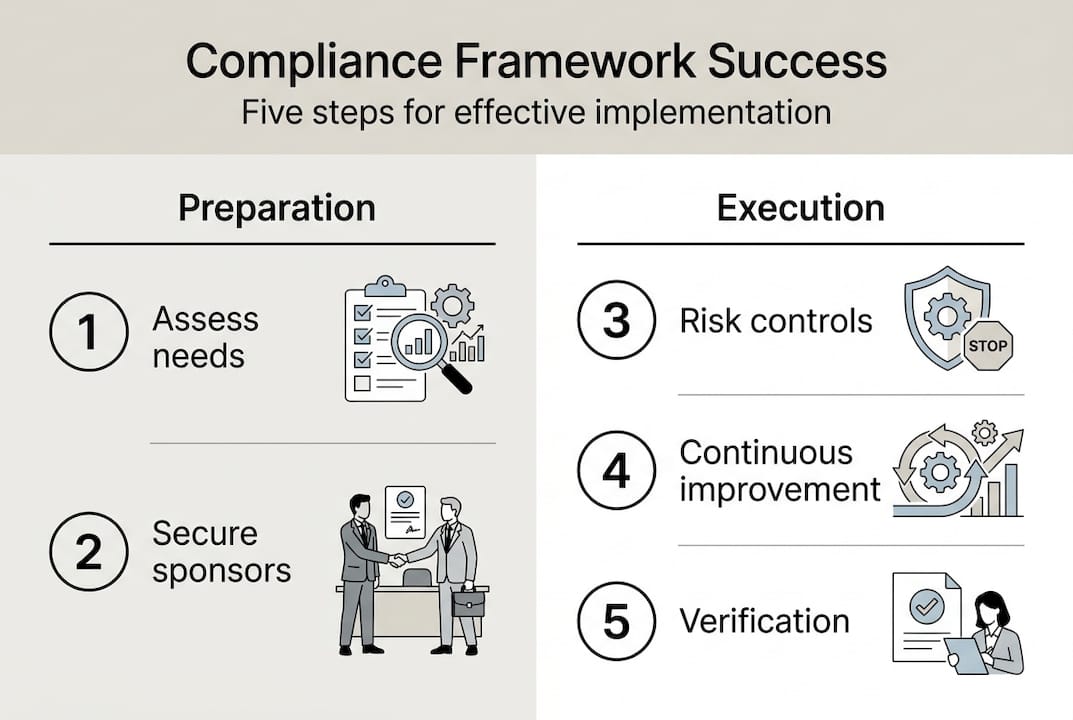
| Preparation and planning | Conduct a gap analysis, assemble a cross functional team, and create a milestone driven compliance roadmap. |
Understanding the foundations: preparing for compliance framework implementation
Before diving into implementation, you need to understand what compliance frameworks actually are and why they matter. A compliance framework is a structured set of guidelines designed to help organizations meet legal, regulatory, and security requirements specific to their industry. In regulated sectors like healthcare, finance, and defense, these frameworks provide the blueprint for protecting sensitive data and maintaining operational integrity.
The most critical mindset shift is understanding that compliance should be treated as a program, not just a project. Projects have end dates. Programs are ongoing commitments that evolve with your organization and the threat landscape. This distinction fundamentally changes how you allocate resources, measure success, and maintain momentum.
Several frameworks dominate the cybersecurity compliance landscape. NIST Cybersecurity Framework provides a flexible, risk-based approach widely adopted across sectors. ISO 27001 offers an international standard for information security management systems. CIS Controls deliver prioritized, actionable security practices. Each framework has unique strengths, and many organizations must comply with multiple frameworks simultaneously.
Successful preparation requires executive sponsorship and adequate resource planning. Without C-suite buy-in, compliance initiatives stall when competing priorities emerge. You need dedicated personnel, budget allocation, and clear timelines. Equally important is defining the legal applicability of your compliance requirements, particularly compliance by design comprehensive strategies that embed regulatory requirements into your operations from the start.
Pro Tip: Explicitly define outsourcing clauses in vendor contracts to avoid compliance gaps. Many frameworks hold you accountable for third-party security practices, so ambiguous language creates hidden risks.
Multi-framework control mapping is your secret weapon for reducing complexity. Rather than treating each framework as a separate compliance burden, identify overlapping controls that satisfy multiple requirements simultaneously. This approach cuts audit fatigue, reduces redundant documentation, and creates a unified security posture that's easier to maintain.
Key preparation activities include:
- Conducting a gap analysis to identify current security posture versus framework requirements
- Establishing a cross-functional compliance team with representatives from IT, legal, operations, and executive leadership
- Documenting your organization's risk appetite and tolerance levels
- Creating a compliance roadmap with milestones, deliverables, and accountability assignments
- Securing necessary tools and technologies to support ongoing monitoring and reporting
Step-by-step execution: implementing controls and managing risks
Once preparation is complete, execution begins with establishing comprehensive risk management policies. These policies form the backbone of your compliance program, defining how you identify, assess, and mitigate cybersecurity risks. Align your policies to recognized standards like NIST CSF 2.0 and ISO 27002, which provide proven methodologies for risk management that satisfy regulatory expectations.

ENISA NIS2 guidance provides technical implementation details for risk management including policies, monitoring, logging, event classification, root cause analysis, and standard mappings. This technical guidance offers granular direction on implementing each control effectively, from defining event severity levels to establishing incident response workflows.
Implementing monitoring and logging processes is non-negotiable for compliance. You need visibility into your environment to detect threats, investigate incidents, and demonstrate due diligence to auditors. Configure systems to capture security-relevant events, classify them by priority level, and route alerts to appropriate response teams. High-priority events like unauthorized access attempts require immediate investigation, while lower-priority events may trigger periodic reviews.
Control mapping and harmonization across frameworks saves enormous time and effort. When you map examples of security frameworks for cisos, you discover that many requirements overlap. For instance, access control requirements in NIST, ISO 27001, and CIS Controls share common elements. Implement one robust access control system that satisfies all three frameworks rather than three separate implementations.
| Framework | Access Control Focus | Monitoring Requirement | Incident Response |
|---|---|---|---|
| NIST CSF 2.0 | Identity and access management aligned to business risk | Continuous monitoring with anomaly detection | Structured response and recovery processes |
| ISO 27001 | Logical and physical access controls with regular review | Security event logging and monitoring | Incident management procedures with lessons learned |
| CIS Controls | Privileged access management and account monitoring | Audit log management and review | Incident response and management capability |
Follow these steps to roll out compliance controls systematically:
- Prioritize controls based on risk assessment results, addressing highest-risk areas first to maximize security impact quickly.
- Document each control's purpose, implementation details, and responsible parties to ensure clarity and accountability.
- Deploy technical controls like firewalls, encryption, and endpoint protection according to framework specifications.
- Implement administrative controls including policies, procedures, and training programs that govern how people interact with systems.
- Establish physical controls such as access badges, surveillance, and environmental protections for critical infrastructure.
- Test each control to verify it functions as intended and actually mitigates the targeted risks.
- Integrate compliance activities into daily operations so security becomes part of normal workflows rather than separate tasks.
Root cause analysis processes for cybersecurity incidents complete your execution framework. When incidents occur, investigate thoroughly to understand not just what happened, but why it happened and how to prevent recurrence. Document findings, implement corrective actions, and update controls based on lessons learned. This continuous improvement cycle strengthens your security posture over time.
Pro Tip: Use control mapping as a time-saving approach by creating a master spreadsheet that shows how each implemented control satisfies requirements across all applicable frameworks. This single source of truth simplifies audits and demonstrates comprehensive compliance.
Verification and continuous improvement: ensuring and sustaining compliance
Implementing controls is only half the battle. Verification ensures those controls actually work and continue working as your environment evolves. Treat compliance as an ongoing program requiring continuous verification and explicit control mappings to maintain effectiveness over time.
Ongoing compliance audits and self-assessments provide objective evidence that your controls function correctly. Schedule regular internal audits quarterly or semi-annually to identify gaps before external auditors discover them. Self-assessments allow you to course-correct proactively, addressing issues when they're small rather than waiting for them to become major findings during formal audits.
Key verification activities include:
- Control testing to validate that security measures operate as designed and documented
- Effectiveness evaluation measuring whether controls actually reduce risk to acceptable levels
- Vulnerability assessments identifying weaknesses in systems, applications, and processes
- Penetration testing simulating real-world attacks to expose exploitable vulnerabilities
- Policy compliance reviews ensuring personnel follow established procedures consistently
- Documentation audits verifying that records accurately reflect current practices and configurations
Reporting compliance status to stakeholders maintains transparency and demonstrates accountability. C-level executives need high-level summaries showing overall compliance posture, risk trends, and resource requirements. Board members want assurance that the organization meets fiduciary obligations and regulatory requirements. Operational teams need detailed metrics to guide day-to-day security activities. Tailor your reporting to each audience, providing the right level of detail for informed decision-making.
Continuous monitoring for threat detection is essential for compliance sustainability. Deploy security information and event management systems that aggregate logs, correlate events, and alert on suspicious activities. Configure monitoring to detect both external threats like intrusion attempts and internal risks like unauthorized data access. Real-time visibility enables rapid response, minimizing damage when incidents occur.
Leverage compliance results to drive security program improvements. When audits reveal gaps, treat them as opportunities to strengthen defenses. When metrics show declining performance, investigate root causes and implement corrective actions. This unified compliance by design strategic framework approach transforms compliance from a reactive burden into a proactive driver of security excellence.
Avoid common compliance pitfalls during verification by maintaining detailed documentation, preserving evidence of control effectiveness, and ensuring consistency between documented procedures and actual practices. Auditors scrutinize discrepancies between what you say you do and what you actually do. Close these gaps by regularly updating documentation to reflect operational reality and training staff to follow established procedures faithfully.
Common challenges and expert tips for successful framework implementation
Even well-planned compliance initiatives encounter obstacles. Understanding common challenges helps you anticipate and overcome them effectively. Resource limitations top the list. Organizations often underestimate the personnel, budget, and time required for comprehensive implementation. Compliance demands sustained investment, not just initial setup costs.
Conflicting controls across frameworks create confusion and inefficiency. Different frameworks may prescribe seemingly contradictory approaches to the same security objective. Resolve conflicts by understanding the underlying intent of each requirement and implementing controls that satisfy the spirit of all applicable frameworks. When genuine conflicts exist, document your rationale for chosen approaches and obtain stakeholder approval.
Unclear policies leave room for interpretation and inconsistent application. Vague language like "appropriate security measures" or "reasonable safeguards" provides little practical guidance. Replace ambiguity with specific, measurable requirements that personnel can follow consistently. Define exactly what constitutes adequate security in your context.
Pro Tip: Clarify applicable law and outsourcing clauses to avoid compliance gaps. Edge cases like ambiguous outsourcing clauses in compliance require explicit contract definitions. Specify exactly which security requirements vendors must meet and how you'll verify compliance.
Stakeholder engagement and executive support require ongoing cultivation. Initial enthusiasm fades when compliance work becomes routine. Keep leadership engaged by regularly communicating value delivered, risks mitigated, and competitive advantages gained. Frame compliance as business enablement rather than cost center. Show how strong security posture wins customer trust, opens new markets, and protects revenue.
Strategies for harmonizing multiple frameworks include:
- Creating unified control libraries that map requirements across all applicable frameworks
- Implementing controls that exceed minimum requirements, satisfying multiple frameworks simultaneously
- Scheduling coordinated audits that assess compliance with all frameworks in a single engagement
- Developing integrated documentation that demonstrates comprehensive compliance without redundant paperwork
- Training staff on the common principles underlying different frameworks rather than treating each as isolated
Compliance is a strategic program, not a one-time checkbox exercise. Organizations that embrace this mindset build resilient security postures that adapt to evolving threats and regulatory requirements, transforming compliance from obligation into competitive advantage.
Control mapping saves tremendous time by revealing synergies across frameworks. Instead of managing separate compliance efforts for NIST, ISO, and CIS, implement unified controls that satisfy all three. This approach reduces audit fatigue, streamlines documentation, and creates a more coherent security architecture. The initial investment in mapping pays dividends throughout the compliance lifecycle.
Maintaining momentum through inevitable challenges requires persistence and adaptability. When obstacles arise, resist the temptation to cut corners or defer difficult work. Shortcuts create technical debt that compounds over time, eventually requiring more effort to remediate than proper implementation would have required initially. Stay the course, address issues systematically, and why compliance is a strategic asset becomes increasingly clear as your program matures.
How Heights Consulting Group supports your compliance journey
Navigating cybersecurity compliance frameworks demands specialized expertise that many organizations lack internally. Heights Consulting Group brings deep experience helping regulated industries implement and sustain comprehensive compliance programs. We understand the unique challenges you face and provide tailored guidance that aligns multi-framework requirements with your business objectives.
Our advisory services transform compliance from overwhelming obligation into strategic advantage. We help you map controls across frameworks, prioritize implementation efforts, and build sustainable programs that evolve with your organization. Whether you're pursuing NIST, ISO 27001, CMMC, or multiple frameworks simultaneously, we provide the expertise to succeed. Connect with our team through our contact heights cg cybersecurity solutions page to discuss your specific compliance needs. Explore our insights on compliance by design strategies and security frameworks for cisos to see how we help organizations like yours achieve compliance excellence.
Frequently asked questions
What is a compliance framework and why is it important?
A compliance framework is a structured set of guidelines that helps organizations meet legal, regulatory, and security requirements specific to their industry. These frameworks provide standardized approaches to protecting sensitive data, managing cybersecurity risks, and demonstrating due diligence to regulators and stakeholders. In regulated industries like healthcare, finance, and defense, compliance frameworks are essential for avoiding penalties, maintaining operational licenses, and building customer trust.
How does multi-framework control mapping simplify compliance implementation?
Control mapping identifies overlapping requirements across different frameworks, allowing you to implement unified controls that satisfy multiple standards simultaneously. Instead of treating NIST, ISO 27001, and CIS Controls as separate compliance burdens, mapping reveals common elements like access control and incident response that appear in all three. This approach eliminates redundant work, reduces audit fatigue, and creates a more coherent security architecture that's easier to maintain over time.
What are key steps to ensure continuous compliance after implementation?
Continuous compliance requires regular audits to verify control effectiveness, ongoing monitoring to detect security events in real time, and systematic reporting to keep stakeholders informed. Schedule internal assessments quarterly to identify gaps proactively. Deploy security information and event management systems for continuous visibility. Implement feedback loops that translate audit findings and incident lessons into program improvements. Treat compliance as an evolving program rather than a static achievement.
What common challenges should executives anticipate during framework implementation?
Resource constraints frequently derail compliance initiatives when organizations underestimate the personnel, budget, and time required for comprehensive implementation. Unclear outsourcing clauses create hidden risks when vendor contracts lack explicit security requirements. Conflicting controls across frameworks generate confusion about proper implementation approaches. Strong executive sponsorship, explicit contract definitions, and expert guidance help overcome these obstacles and maintain momentum through inevitable challenges.
Recommended
- Unified Compliance by Design: Improve Your Strategy - Heights Consulting Group
- Compliance by Design: Strategies for Regulated Industries | Heights Consulting Group
- Compliance Frameworks – How They Drive Cybersecurity Success
- Why Compliance is a Strategic Asset, Not Just a Checkbox - Heights Consulting Group