

TL;DR:
- Most executives view cybersecurity as a technical issue rather than a strategic asset.
- Aligning security with business goals boosts growth, compliance, and competitive advantage.
- Successful strategies involve structured risk assessment, clear communication, and translating risks into business impacts.
Most C-level executives still treat cybersecurity as a technical obligation rather than a strategic asset, and that framing costs organizations real money. Research shows that aligned cybersecurity contributes 11 to 20% measurable value to strategic initiatives, yet the majority of boards continue to relegate security decisions to IT alone. Business-aligned security changes that equation entirely. It frames cybersecurity strategy around business outcomes rather than technical checklists, positioning security as an active driver of growth, compliance, and competitive advantage. This article walks through the frameworks, execution approaches, and executive communication strategies that transform security from a cost center into a demonstrable business asset.
Table of Contents
- Why business alignment matters in cybersecurity
- Core methodologies for achieving business-aligned security
- Speaking the language of the business: turning security into a value driver
- challenges and pitfalls: what undermines business alignment?
- Our take: what most executive playbooks get wrong about business-aligned security
- unlock strategic security alignment for your business
- frequently asked questions
Key Takeaways
| Point | Details |
|---|---|
| Alignment delivers value | Business-aligned cybersecurity adds up to 20% more value to strategic initiatives. |
| Frameworks are essential | Adopt proven methodologies like NIST CSF and ISO 27001 to operationalize business alignment. |
| Metrics speak business | Translating technical risks into financial and operational terms secures C-suite buy-in. |
| Misalignment is costly | Organizations with poor alignment face wasted investments and missed opportunities. |
| Stakeholder management matters | Effective alignment hinges on cross-functional relationships, not just technology or policy. |
Why business alignment matters in cybersecurity
Business-aligned security is not a new product or a single framework. It is a strategic posture: the intentional integration of cybersecurity goals with an organization's business objectives, risk appetite, and growth priorities. When security is designed around what the business is trying to achieve rather than what IT needs to defend, the result is a program that protects value while enabling it.
For decades, the dominant model treated security as a technical silo. The security team identified threats, deployed controls, and reported compliance metrics, largely disconnected from revenue conversations or product roadmaps. That traditional IT silo approach has given way to a modern model where security is measured by business metrics: uptime preserved, regulatory fines avoided, and deals closed because of demonstrated trustworthiness.
The shift is happening at the board level because it has to. Consider the key drivers pushing executives toward a business-aligned approach:
- Digital expansion: New channels, cloud adoption, and third-party integrations increase attack surface directly tied to revenue-generating assets.
- Rising regulatory requirements: Industries like healthcare, finance, and defense face increasingly stringent compliance mandates that carry real financial penalties for non-compliance.
- Third-party risk: Supply chain breaches now represent a significant share of enterprise incidents, putting vendor governance squarely in the boardroom.
- Executive accountability: Board members and investors are increasingly scrutinizing cyber posture as a material business risk, not just an IT metric.
The data reinforces this shift. 85% of CEOs now view cybersecurity as crucial for growth, a remarkable evolution from the historically reactive, technical framing that dominated boardrooms a decade ago.
"The modern security function is not a firewall between IT and the business. It is a strategic advisor that enables the business to move faster, expand safely, and demonstrate trustworthiness to customers and regulators alike."
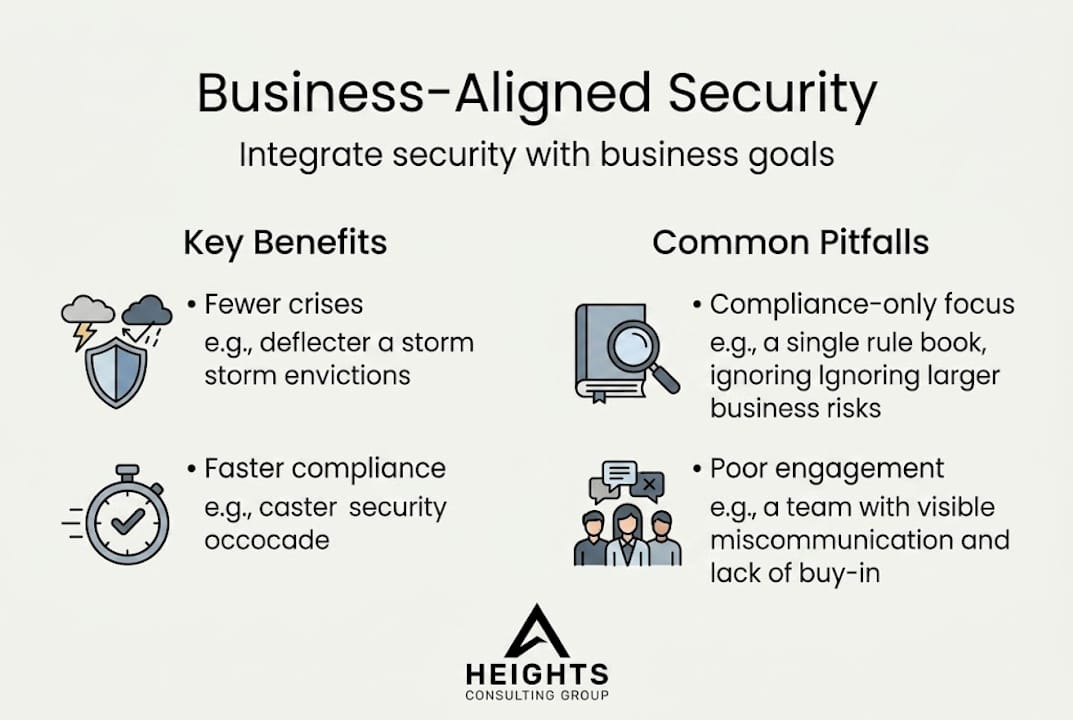
Organizations that align security with business goals routinely report fewer reactive security crises, faster regulatory approvals, and a measurably stronger negotiating position in enterprise contracts. The case for alignment is not philosophical. It is quantifiable.

Core methodologies for achieving business-aligned security
With the case for alignment established, the next question is operational: how do executive leaders actually embed security within business objectives? The approach requires discipline, structure, and the right frameworks.
A proven stepwise methodology includes the following stages:
- Risk assessment: Begin with a structured evaluation of the organization's threat landscape relative to its business priorities, not just its technical vulnerabilities.
- Map controls to goals: Connect every security control to a specific business objective, regulatory requirement, or operational resilience target.
- Gap analysis: Compare the current security posture against the desired state, identifying where investment is genuinely needed versus where resources are misallocated.
- Priority-based use cases: Not all risks are equal. Business alignment frameworks require prioritization based on business impact, not solely on technical severity scores.
- Process integration: Security controls should be embedded into product development lifecycles, vendor selection criteria, M&A due diligence, and workforce onboarding, not added as an afterthought.
These key methodologies form the foundation of a mature alignment program, and they are directly mapped to leading industry standards.
| Framework | Core focus | Best suited for | Primary benefit |
|---|---|---|---|
| Enterprise resilience blueprint | Business risk | Organizations of all sizes | Board-ready reporting |
| Risk management methodology | ESG and operational risk | Multi-regulatory environments | Cross-functional integration |
| Strategic alignment model | Security-business bridging | Complex enterprise environments | Executive buy-in and clarity |
Pro tip: When presenting security investment proposals to the board, anchor each line item to a recognized framework like the cybersecurity alignment success model or the enterprise resilience blueprint. Industry-standard framing accelerates board approval because it signals rigor and reduces perceived risk around unfamiliar expenditures.
Speaking the language of the business: turning security into a value driver
Technical accuracy is not enough. Security leaders who want to move the organization must translate risks into financial impacts that resonate with CFOs, general counsel, and business unit leaders. That translation is where most security programs either gain or lose executive support.
The following metrics table illustrates how technical measures map to business-relevant KPIs:
| Technical metric | Business translation | Why boards care |
|---|---|---|
| Mean Time to Detection (or median breach value) | Days of operational exposure | Revenue and liability at risk |
| Mean Time to Response | Cost of incident containment | Insurance and regulatory implications |
| Controls coverage | % of revenue-generating systems protected | Investment justification |
| Security program value add | 11 to 20% uplift on strategic initiatives | ROI conversation |
| $36M median avoided loss | Financial risk mitigation | Board-level risk appetite framing |
To build executive support, security leaders should focus on the metrics that matter most to the C-suite:
- Revenue protection: Frame detection and response speed in terms of hours or days of revenue at risk during an incident.
- Cost avoidance: Calculate regulatory fines, breach remediation costs, and litigation exposure that effective controls prevent.
- Strategic enablement: Show how security as competitive edge supports new market entry, enterprise contract wins, and M&A readiness.
- Build resilient frameworks: Position security architecture decisions as enabling business continuity and market confidence, not just preventing incidents.
Pro tip: Lead with the business outcome, then support it with the technical evidence. A board conversation that opens with "we reduced our median breach exposure by $4.2M this quarter" gets more budget attention than one that leads with "we deployed EDR across 94% of endpoints."
challenges and pitfalls: what undermines business alignment?
Even organizations that commit to business-aligned security often fall short. The reasons are consistent and predictable: they reflect organizational dynamics more than technical failures.
The most common root causes of misalignment include:
- Leadership silos: When security reports exclusively to IT with no direct C-suite access, strategic priorities and business language rarely cross-pollinate.
- Budget disconnects: Security budgets determined without business-context input routinely fund the wrong priorities.
- Communication gaps: 67% of security leaders struggle to demonstrate the value of their programs to senior leadership, which is the leading indicator of misalignment in 2026.
- Buy-in failure: Security initiatives launched without business-side stakeholders at the table consistently encounter resistance during implementation.
Misalignment carries consequences that are directly measurable. Budget is spent on controls that protect assets of secondary business importance. Innovation is blocked because security teams apply a one-size-fits-all risk posture regardless of business context. And worst of all, over-securing creates friction that drives shadow IT and workarounds, which increase actual risk.
"The most dangerous security posture is not under-investment. It is investment in the wrong direction, driven by technical instinct rather than business strategy."
CSO Online notes that over-securing creates friction and that reactive security programs that chase business change rather than anticipate it are structurally prone to misalignment.
Executive leaders who want to correct alignment gaps should invest in stakeholder strategy insights and build cross-functional security governance structures that include voices from legal, operations, and finance alongside the security team. Start with quick wins that demonstrate ROI in business terms, then expand from there.
Our take: what most executive playbooks get wrong about business-aligned security
The most common mistake we see from organizations pursuing alignment is treating it as a compliance exercise. Leadership teams read the frameworks, assemble the documentation, check the boxes, and then wonder why the board still does not view cybersecurity as a strategic priority. The problem is that strategic alignment is not a document. It is a relationship and an ongoing conversation.
The second missed opportunity is underestimating the relational work. Getting business unit leaders to think of security as a partner rather than a gatekeeper requires consistent, plain-language communication about risk in terms they recognize: revenue, customers, and reputation. Organizations that invest in that translation consistently outperform those that rely on technical reporting alone.
Finally, true alignment is not about reducing risk to zero. It is about balancing risk management with the organization's need to grow, innovate, and compete. The security programs that earn sustained executive confidence are the ones that enable the business to move with controlled speed, not the ones that simply prevent movement.
unlock strategic security alignment for your business
Heights consulting group works directly with C-level executives and security leaders in regulated industries to build security programs that are designed around business outcomes from day one.
Our team brings deep cybersecurity consulting expertise to organizations that need more than a technical audit. We help you turn security into opportunity by translating your risk landscape into a strategic roadmap that boards understand and invest in. Whether you are building an alignment program from scratch or repositioning an existing one, we tailor our approach to your industry, your regulatory environment, and your growth objectives. Contact Heights CG today to schedule an executive consultation and take the first step toward security that works for your business.
frequently asked questions
What is business-aligned security in simple terms?
Business-aligned security means designing cybersecurity measures that directly support your organization's strategic objectives, not just meeting technical requirements. The security program's success is measured by business outcomes, not only by the absence of incidents.
Why do most organizations struggle to achieve business-aligned security?
Most fail due to poor communication across business and security teams, lack of leadership buy-in, and focusing on technical fixes over business outcomes. 67% of security leaders struggle to demonstrate program value, which means misalignment, not tools, is the primary barrier.
What are the most effective frameworks for business-aligned security?
NIST CSF and ISO 27001 are leading standards for embedding security into business processes. Common alignment frameworks provide structured approaches to connecting controls directly to business objectives and regulatory requirements.
How can security leaders translate technical risk into business terms?
By expressing risk in terms of financial impact, operational disruption, or compliance exposure using KPIs that matter to the board. Technical risks translated into dollar values and business continuity implications consistently earn stronger executive buy-in than technical severity scores alone.
What's the number one risk of misalignment between security and business?
The biggest risk is wasted investment and missed opportunity: over-securing, disconnects with executive priorities, and business disruption. The leading 2026 risk for most enterprises is not a technical capability gap, but a strategic alignment failure between security programs and business direction.
Recommended
- Align cybersecurity with business objectives: 2026 guide
- Strategic Cybersecurity Alignment for Business Success - Heights Consulting Group
- Boardroom-Ready Cybersecurity: Aligning Security with Business Strategy to Accelerate Growth - Heights Consulting Group
- Align Cybersecurity: Executive Best Practices for 2026
- What is business security? Bristol's essential guide