

TL;DR:
- Reframing cybersecurity as a core business function enhances resilience and competitive advantage.
- Effective alignment involves integrating risk assessments, strategic translation, and operational embedding.
- Continuous measurement and executive ownership are key to sustaining security that supports business goals.
Most executives treat cybersecurity as a cost center or compliance checkbox. Those who reframe it as a core business function gain something far more valuable: measurable resilience, competitive differentiation, and the ability to move faster with confidence. The gap between organizations that merely tolerate security spending and those that leverage it strategically is widening. This guide walks through a practical, executive-level framework for aligning cybersecurity with your business objectives, covering risk assessment, strategy translation, operational integration, and outcome measurement. Each step is grounded in real-world examples and designed for leaders in regulated industries where the stakes are highest.
Table of Contents
- Understand business priorities and risk landscape
- Translate objectives into cybersecurity strategy
- Integrate cybersecurity into business processes
- Measure, optimize, and report outcomes
- Why most organizations get alignment wrong and the executive's role
- Drive strategic security alignment with expert support
- Frequently asked questions
Key Takeaways
| Point | Details |
|---|---|
| Start with business risks | Identify, assess, and prioritize risks by engaging business leaders and understanding true business impact. |
| Use proven frameworks | Adopt standards like NIST or ISO to map security controls directly to strategic goals and add measurable benchmarks. |
| Integrate, monitor, optimize | Embed security into business processes, maintain continuous oversight, and report outcomes in business language. |
| Executive leadership is critical | True alignment requires active executive involvement, beyond IT and compliance teams. |
Understand business priorities and risk landscape
With the need for alignment clear, the first step is identifying where cybersecurity efforts intersect with your core business goals. Effective alignment begins not with technology but with a clear-eyed view of what your organization is trying to achieve and what threatens that progress.
A business-aligned security strategy starts with framing security in terms executives already understand: revenue protection, regulatory compliance, and operational continuity. That framing shifts the conversation from "how much does this cost" to "what does this protect."
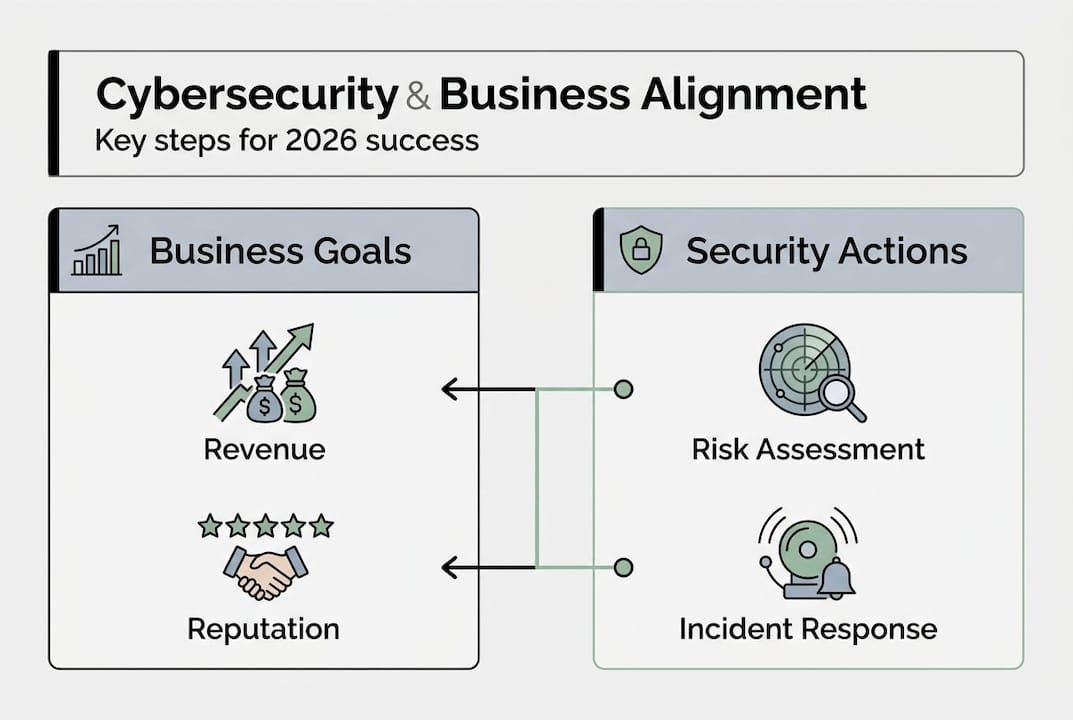
Begin with a structured cyber risk assessment that maps your most critical assets to the threats most likely to affect them. For regulated industries, this means accounting for sector-specific pressures that generic frameworks often miss.
Common risk domains to prioritize:
- Financial risk: Direct losses from fraud, ransomware, or breach-related litigation
- Reputational impact: Customer trust erosion following a publicized incident
- Compliance failures: Penalties and audit findings tied to HIPAA, CMMC, or SOC 2 gaps
- Operational downtime: Disruption to revenue-generating processes or critical infrastructure
| Risk domain | Business impact | Mitigation priority |
|---|---|---|
| Financial | Revenue loss, legal costs | High |
| Reputational | Customer churn, brand damage | High |
| Compliance | Fines, license risk | Critical |
| Operational | Downtime, SLA breaches | High |
For manufacturing and utility organizations, operational technology (OT) environments often sit outside traditional IT governance, creating blind spots that regulators and adversaries both exploit. Strategic cybersecurity alignment requires pulling OT, IT, and compliance stakeholders into the same risk conversation.
Pro Tip: Bring business unit leaders, not just IT staff, into your initial risk assessment. Operations, legal, and finance leaders often surface risk exposures that security teams never see from a purely technical vantage point.
Translate objectives into cybersecurity strategy
Once your business priorities and risk profile are clear, the next move is translating those into a concrete, measurable security strategy. This is where many organizations stall. Risk assessments get filed, frameworks get selected, and then nothing changes operationally.
The solution is a structured, step-by-step process that connects each business priority to a specific security outcome.
- Align on a framework. Choose NIST CSF, ISO 27001, or a sector-specific standard as your operational baseline. Implementing the NIST framework provides a consistent language for communicating security posture across business and technical teams.
- Conduct a gap analysis. Measure your current controls against the framework's requirements. Prioritize gaps that directly affect your top business risks.
- Implement targeted controls. Deploy controls in order of business impact, not technical convenience. Uptime-critical systems get hardened first.
- Measure and report progress. Define success metrics before implementation, not after. Tie each control to a business outcome.
The business case for this approach is concrete. One organization improved its SecurityScorecard rating from 76 (C) to 94 (A) through disciplined NIST and ISO alignment, resulting in $7,000 in annual cyber insurance savings alongside stronger resilience.
"Cybersecurity investment framed as a business enabler, rather than a compliance obligation, consistently produces better outcomes. Organizations that tie security milestones to business results sustain executive support and see faster improvement cycles."
Pro Tip: When presenting security investments to the board, quantify the avoided cost, not just the spend. Insurance savings, reduced incident response costs, and avoided regulatory penalties are all measurable returns that resonate with financial leadership.
Explore strategies for cyber-business alignment to see how leading organizations structure this translation process.
Integrate cybersecurity into business processes
Now that strategy is mapped out, it's time to embed security directly into the organization's operations. Strategy documents have limited value unless security controls become part of how work actually gets done.

Practical integration means building security into workflows rather than layering it on top. Access management should be part of employee onboarding, not an afterthought. Vendor contracts should include security requirements before signatures, not after incidents. Product development should follow secure-by-design principles from the first sprint.
Key integration practices:
- Embed access controls and identity verification into critical workflows
- Include security requirements in vendor onboarding and third-party contracts
- Apply secure-by-design principles across product and software development
- Deploy continuous monitoring with cross-functional KPIs visible at the board level
- Build executive reporting dashboards that translate technical metrics into business language
Three areas consistently receive insufficient attention in regulated industries. OT environments in manufacturing and utilities are frequently excluded from enterprise security programs despite being high-value targets. Third-party risk has grown substantially, with organizations now managing an average of 286 vendors, each representing a potential entry point. AI programs require a "Secure by Design" approach from the outset, not a security review after deployment.
| Approach | Legacy cybersecurity | Integrated cybersecurity |
|---|---|---|
| Ownership | IT department only | Cross-functional leadership |
| Timing | Reactive, post-incident | Proactive, embedded in workflows |
| Reporting | Technical metrics | Business outcome KPIs |
| Vendor management | Ad hoc reviews | Structured onboarding controls |
| OT/AI coverage | Often excluded | Explicitly included |
A comprehensive regulatory compliance guide can help leaders identify which operational workflows carry the highest compliance exposure. For a deeper look at embedding security into growth strategy, explore integrating cybersecurity and business operations.
Measure, optimize, and report outcomes
With security woven into business processes, consistent measurement and transparent reporting ensure long-term value. Without measurement, alignment becomes aspirational rather than operational.
Effective measurement starts with KPIs that connect directly to business objectives, not just technical benchmarks. Mean time to detect and respond matters. So does the percentage of vendors with verified security controls, the number of compliance findings resolved before audit, and the trend line on your security ratings over time.
Recommended KPIs for executive reporting:
- Reduction in critical and high-severity incidents quarter over quarter
- Compliance score improvement across active regulatory frameworks
- Percentage of third-party vendors meeting minimum security requirements
- Security rating trajectory (e.g., SecurityScorecard, BitSight)
- Time to remediate identified vulnerabilities against defined SLAs
Continuous improvement requires structure. Quarterly reviews should benchmark current performance against prior periods and industry peers. Remediation cycles should be tracked to completion, not just initiated. Annual assessments should revisit the original risk profile to confirm that priorities and controls remain aligned as the business evolves.
- Quarterly reviews: Compare KPI trends, identify regression areas, and adjust resource allocation.
- Benchmarking: Use external ratings and peer comparisons to contextualize internal progress.
- Board reporting: Present security outcomes in business terms, connecting metrics to revenue protection and compliance standing.
- Regulatory reporting: Maintain audit-ready documentation that demonstrates control effectiveness over time.
The business outcome case study referenced earlier illustrates this clearly. A sustained improvement in security ratings produced both insurance savings and a stronger negotiating position with enterprise clients. The executive playbook on compliance and cybersecurity executive best practices offer additional frameworks for structuring board-level reporting.
Why most organizations get alignment wrong and the executive's role
Most alignment failures share a common root cause: the process is delegated entirely to IT. Security teams are skilled at managing technical risk, but they lack the authority and context to align security investments with business strategy. That alignment requires executive ownership.
When security is positioned as a cost or compliance obligation, organizations tend to underinvest in the areas that matter most and overspend on tools that address yesterday's threats. The result is wasted budget, persistent gaps, and a security posture that doesn't actually reflect business risk.
Executives who treat cybersecurity as a strategic function, not a back-office function, consistently outperform their peers. They see faster audit cycles, lower incident costs, and stronger client relationships. They also find that turning cyber challenges into business opportunities becomes possible when security is embedded in growth planning from the start.
Real alignment demands cross-functional involvement. Legal, operations, finance, and product leadership all have a stake in how security decisions are made. The CISO or security leader should be a strategic advisor to the executive team, not a technical gatekeeper. When that relationship works, security becomes a growth driver rather than a constraint.
Drive strategic security alignment with expert support
Aligning cybersecurity with business objectives is a continuous process, and the organizations that do it well rarely do it alone. Expert guidance accelerates the path from risk assessment to measurable resilience.
Heights Consulting Group works directly with C-level executives and security leaders in regulated industries to build security programs that reflect real business priorities. From initial risk assessment to framework implementation and board-level reporting, our cybersecurity consulting services are designed to move your organization from reactive to strategic. Use our executive compliance checklist to identify your highest-priority gaps, or contact Heights CG to schedule a tailored alignment assessment.
Frequently asked questions
What is business-aligned cybersecurity?
Business-aligned cybersecurity is the practice of building security programs that directly support core business objectives, risk tolerance, and operational priorities, rather than treating security as a standalone technical function. A structured risk assessment anchored in revenue protection and compliance is the starting point.
Why do regulated industries need specialized cybersecurity alignment?
Regulated industries face unique pressures including OT vulnerabilities, high vendor counts, and sector-specific compliance mandates. OT and third-party risks are frequently underaddressed, making tailored alignment essential for avoiding penalties and sustaining operations.
How does aligning cybersecurity with business goals improve ROI?
Effective alignment eliminates redundant controls, reduces incident frequency, and can lower insurance premiums. The SecurityScorecard improvement from 76 to 94 at Select Data produced $7,000 in annual insurance savings alongside broader resilience gains.
What frameworks support aligning cybersecurity with business objectives?
NIST CSF and ISO 27001 are the most widely adopted frameworks for mapping security controls to business priorities. Both support gap analysis, continuous improvement, and simplified regulatory reporting across multiple compliance regimes.
Recommended
- Aligning Cybersecurity with Business Objectives for Growth - Heights Consulting Group
- Aligning Cybersecurity with Business Goals for Growth - Heights Consulting Group
- Align Cybersecurity: Executive Best Practices for 2026
- Why Cybersecurity Is a Business Priority in 2026: Strategies & Compliance | Heights Consulting Group